
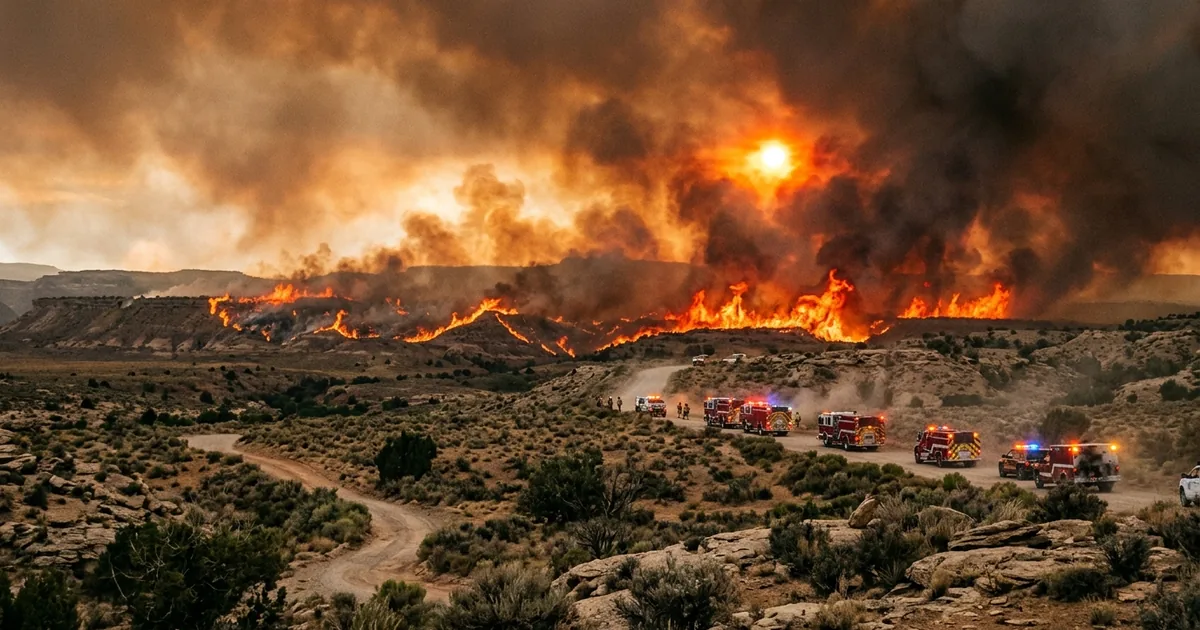
Three federal firefighters are dead and two more are hospitalized after a burnover incident on the Snyder Mesa Fire along the Colorado-Utah border, marking the deadliest wildfire event for U.S. first responders in years.
The fire has consumed more than 28,000 acres at zero percent containment, and the conditions that killed those firefighters are not easing.
What Happened on the Snyder Mesa Fire
The five firefighters were responding to the Knowles and Gore fires in Mesa County, Colorado, on Saturday when rapid wind shifts trapped them. ABC News reported that the crew deployed their emergency fire shelters as flames overtook their position, a last-resort measure known as a burnover. Three did not survive. Two were medically evacuated by helicopter to area hospitals, where they remain in treatment.
The U.S. Wildland Fire Service confirmed the fatalities Sunday morning but has not yet released the names of the fallen firefighters, pending family notification. The agency said it would share further details “as it is able to.”
A Fire That Outran Its Responders
The Snyder Mesa Fire ignited Saturday morning in Grand County, Utah, before explosive winds pushed it east across the state line into Colorado’s Mesa County. It merged with the smaller Jones and Knowles fires to form the sprawling Snyder Fire complex, which as of Sunday sits at 28,000 acres with no containment lines established.
The fire behavior was driven by what forecasters describe as a dangerous convergence: consecutive days exceeding 100 degrees, single-digit humidity, and sustained wind gusts above 40 mph. Those conditions did not just spread the fire. They accelerated it past the pace at which ground crews could establish escape routes, the fundamental safety mechanism that keeps wildland firefighters alive.
That is the core problem. When fire weather escalates past the envelope that ground crews are trained and equipped to survive, no amount of individual heroism closes the gap. The National Weather Service had issued red flag warnings across the region before the burnover occurred. The firefighters went in anyway, because someone has to.
Colorado Declares a Disaster Emergency
Colorado Governor Jared Polis declared a disaster emergency in response to the Snyder Fire on Saturday, authorizing deployment of the Colorado National Guard to assist firefighting operations. The Mesa County Sheriff’s Office issued pre-evacuation orders for properties near Glade Park, directing residents along BS Road west of 11 5/10 Road to the Utah border to prepare to leave. That evacuation zone has since expanded to 16 1/2 Road.
The declaration follows a pattern that has become grimly familiar across western states. Just weeks ago, Texas issued its own disaster declaration across 101 counties for catastrophic flooding, underscoring how states are cycling through overlapping emergencies with increasing frequency.
The Broader Western Fire Crisis
The Snyder Fire is not an isolated event. Wildfire activity has intensified across the entire western United States this week, with new fires erupting in Utah, Arizona, and across Colorado’s Western Slope. Utah Governor Spencer Cox addressed residents near the Eureka Fire, which has forced evacuations in Juab County, and the state has imposed emergency fireworks restrictions ahead of the July 4th holiday.
The federal wildland firefighting workforce has been stretched increasingly thin in recent years. Pay reform legislation passed in 2022 temporarily boosted base wages, but those increases have been difficult to sustain through annual appropriations fights. Retention has suffered. Experienced crews are aging out faster than replacements are trained. When a burnover kills three in a single incident, the loss reverberates through an already depleted force.
Colorado’s air quality has also deteriorated sharply. Newsweek reported that multiple air quality alerts have been issued across the state as smoke from the Snyder and other fires blankets population centers along the Front Range.
What Comes Next
The immediate outlook offers little relief. Red flag warnings remain in effect across the Four Corners region through Monday, with temperatures forecast to stay above 100 degrees and humidity in the low single digits. Containment on the Snyder Fire will require either a significant weather shift or a massive influx of aerial and ground resources, neither of which is imminent.
The names of the three fallen firefighters will be released after their families have been notified. When they are, they will join a list that grows longer every fire season, a cost measured in lives that the country has so far been unwilling to address with the structural investment the crisis demands.