
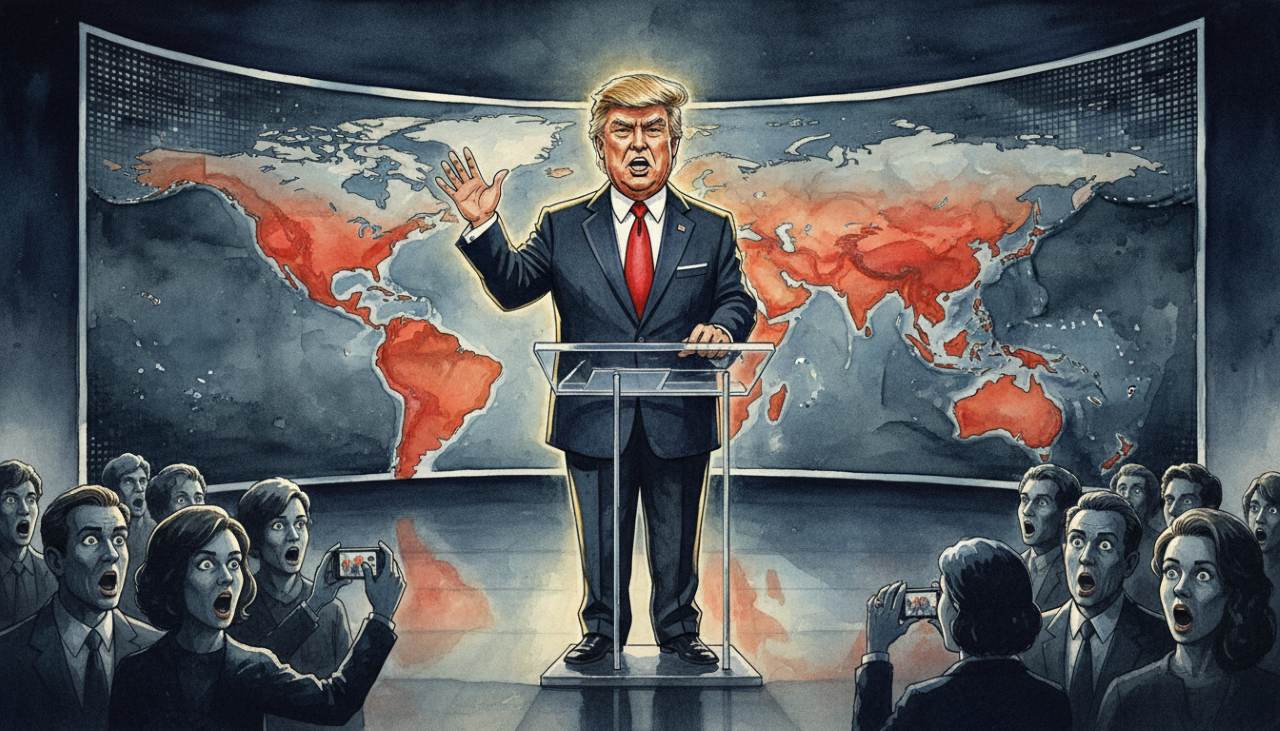
Trump delivered one of the most combative speeches in World Economic Forum history on Wednesday, insulting allied leaders by name, demanding control of Greenland, and warning that America would be “unstoppable” in any armed conflict with Europe.
The performance left the assembled global elite in stunned silence and accelerated what Canadian Prime Minister Mark Carney called a “rupture” in the Western alliance.
Here is a clip from the Jesse Dollemore show where he covers the insane speech.
Speaking for more than an hour in Davos, Switzerland, Trump tore into Carney personally, mocked French President Emmanuel Macron’s sunglasses, called Denmark “ungrateful,” and repeatedly described Greenland as American territory that must be acquired through “immediate negotiations.” The president ruled out military force to seize the Arctic island, but coupled that assurance with language designed to intimidate: “We probably won’t get anything unless I decide to use excessive strength and force, where we would be, frankly, unstoppable.”
Canada Gets Direct Warning
Trump’s sharpest barbs were reserved for Canada. After Carney delivered a widely praised speech Tuesday declaring the “rules-based international order” dead and warning that middle powers must unite or end up “on the menu,” Trump responded with unveiled contempt.
“Canada gets a lot of freebies from us, by the way. They should be grateful, also, but they’re not,” Trump told the Davos audience. “I watched your Prime Minister yesterday. He wasn’t so grateful.”
Then came the line that may define this moment in U.S.-Canada relations: “Canada lives because of the United States. Remember that, Mark, the next time you make your statements.”
Carney left Davos without meeting Trump, departing around the same time the president’s helicopter touched down. His office confirmed there was no interaction between the two leaders. The prime minister headed to a cabinet retreat in Quebec City while his Trade Minister Maninder Sidhu told reporters the Canadian delegation had accomplished what it came to do.
Europe Faces Coordinated Pressure Campaign
The Greenland situation has become the most serious rift in the transatlantic alliance since NATO’s founding. Trump announced new tariffs on eight European countries, starting at 10% in February and escalating to 25% by June unless they support U.S. acquisition of the Danish territory. Those nations have responded with a unified statement backing Denmark’s sovereignty.
Trump also took aim at Macron, questioning why the French president wore sunglasses during his Davos address Tuesday. Earlier this week, Trump leaked a private text message in which Macron wrote: “I do not understand what you are doing on Greenland.” The French president added an olive branch about dinner after Davos, but the disclosure itself violated diplomatic norms.
When asked about Macron potentially skipping his proposed “Board of Peace” meeting, Trump escalated further, threatening 200% tariffs on French wine. “Nobody wants him because he’s going to be out of office very soon,” Trump added.
European Commission President Ursula von der Leyen, who also left Davos without meeting Trump, called the tariff threats “a mistake” and warned Europe was “fully prepared” to retaliate. Macron invoked the EU’s economic “bazooka,” signaling a willingness to deploy major countermeasures.
Markets Already Feeling the Pain
The “Sell America” trade has returned with force. On Tuesday, before Trump even arrived in Davos, U.S. markets experienced their worst day since October. The S&P 500 plunged 2.1%, wiping out more than $1.2 trillion in value. The Nasdaq dropped over 2.4%, while the Dow shed roughly 870 points. Both the S&P 500 and Nasdaq fell into negative territory for 2026.
The damage extended beyond stocks. Investors dumped U.S. government bonds, driving up interest rates in a pattern suggesting global capital is reassessing American assets. Danish pension fund AkademikerPension announced it was exiting roughly $100 million in U.S. investments. Gold and silver, traditional safe havens, hit new highs.
“The weaponization of tariffs in the short term to achieve a non-economic goal is new,” Brad Long, Chief Investment Officer at Wealthspire, told CNBC. UBS CEO Sergio Ermotti offered a grimmer assessment from Davos: “I don’t see any path to normalization in the near future.”
The Greenland Ultimatum
Trump has made clear that nothing short of full ownership will satisfy his demands. “You can’t defend it on a lease,” he argued, dismissing the fact that the U.S. already operates a military base on Greenland. “This enormous unsecured Island is actually part of North America, on the northern frontier of the Western Hemisphere. That’s our territory.”
He framed the acquisition as essential for his proposed “Golden Dome” missile defense system, which he claims will protect North America, including Canada. “Now what I’m asking for is a piece of ice,” Trump said. “Cold and poorly located that can play a vital role in world peace and world protection.”
Greenlanders are not interested. Naaja Nathanielsen, Greenland’s minister for business and mineral resources, told the BBC: “This is an entirely new situation where an ally is threatening to annex or even occupy us. We do not want to be Americans, and we have been quite clear about that.”
Several European countries have deployed troops to Greenland for what they describe as Arctic security training. Denmark, Germany, Sweden, and Norway have all increased their military presence on the island, though Trump dismissed this as meaningless: “They sent a few people.”
What Rupture Looks Like
Carney’s speech Tuesday may have been the clearest articulation yet of how America’s closest allies view this moment. “We are in the midst of a rupture, not a transition,” the Canadian prime minister declared. “The old order is not coming back. We should not mourn it. Nostalgia is not a strategy.”
He described a world where great powers use “economic integration as weapons, tariffs as leverage, financial infrastructure as coercion, supply chains as vulnerabilities to be exploited.” Without naming Trump, Carney urged middle powers to call out bullies and hegemons, adding: “If we’re not at the table, we’re on the menu.”
Belgian Prime Minister Bart De Wever was more direct. “Until now we tried to appease the new president,” he said at a Davos panel. “But now so many red lines have been crossed that you have to choose your self-respect. Being a happy vassal is one thing. Being an unhappy slave is something else entirely.”
Trump’s response to all of this? “You can say yes and we will be very appreciative, or you can say no, and we will remember.”
That combination of carrot and threat may define the next four years. The question now is whether Europe and Canada are prepared to pay the economic price for defiance, or whether Trump’s bet that they’ll eventually fold proves correct. Either way, the postwar alliance system that held together for eight decades is undergoing its most serious stress test in history.