
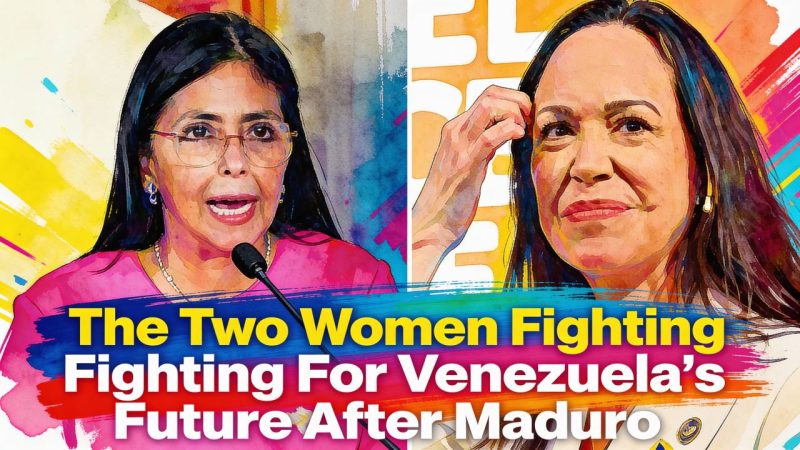
Venezuela’s future hangs in the balance, and two women with radically different visions are at the center of the fight for control. One is a Nobel Peace Prize winner who has spent decades battling authoritarianism, spent the past year in hiding, and now finds herself sidelined by the very American administration she praised. The other is a chavista loyalist, the daughter of a Marxist revolutionary, who ascended to power through a Supreme Court order after U.S. forces captured her boss in a predawn raid.
María Corina Machado and Delcy Rodríguez represent opposite poles of Venezuelan politics. Their collision course will determine whether the country gets the democratic transition millions voted for, or a continuation of the same authoritarian system with a new figurehead.
The Opposition’s Iron Lady
María Corina Machado, 58, has been the face of Venezuelan democracy for more than two decades. An industrial engineer by training, she co-founded Súmate in 2002, an organization dedicated to ensuring free and fair elections, a concept so threatening to the Chávez regime that it earned her constant surveillance, legal prosecution, and eventual expulsion from the National Assembly in 2014.
When Machado won the opposition primary in 2023 to become the unity candidate for the July 2024 presidential election, the Maduro government responded exactly as expected: it barred her from running. The Venezuelan courts, controlled entirely by chavista loyalists, upheld allegations that she had supported U.S. sanctions and engaged in corruption, claims she and international observers dismissed as politically motivated.
Undeterred, Machado threw her support behind Edmundo González Urrutia, a former diplomat who became the opposition’s substitute candidate. What followed was one of the most documented electoral frauds in Latin American history. The opposition mobilized thousands of volunteers who collected vote tallies from polling stations across the country, evidence showing González won by approximately 67% to Maduro’s 30%. International observers, including the United States and the European Union, recognized González as the legitimate winner.
Maduro claimed victory anyway.
For the next year, Machado lived in hiding, moving from safe house to safe house while continuing to organize resistance. In October 2025, the Norwegian Nobel Committee awarded her the Peace Prize for “her tireless work promoting democratic rights for the people of Venezuela.” In her acceptance speech, she dedicated the honor to President Donald Trump, a gesture that seemed strategically designed to curry favor with the incoming American administration.
Then came January 3, 2026.
The Night Everything Changed
The U.S. military’s Operation Absolute Resolve struck Venezuela around 2 a.m. local time, bombing air defenses and infrastructure across northern Venezuela before special forces captured Maduro and his wife, Cilia Flores, at their compound in Caracas. Within hours, the dictator who had ruled Venezuela for over a decade was photographed blindfolded aboard the USS Iwo Jima, being transported to face drug trafficking charges in New York.
Machado immediately released a statement: “The hour of freedom has arrived.” She called on Venezuelans to recognize González as the legitimate president and urged the military to fall in line behind the opposition.
Then Trump held a press conference.
Asked whether Machado would have any role in the post-Maduro government, the president dismissed the woman who had dedicated her Nobel Prize to him just months earlier. “She’s a very nice woman,” Trump said, but “she doesn’t have the support within or the respect within the country” to lead Venezuela.
Instead, the Trump administration chose to work with Delcy Rodríguez.
The Chavista Who Inherited Power
Delcy Rodríguez, 56, is everything Machado is not. Where Machado advocates for free markets and privatization, Rodríguez has spent her career defending the socialist system that transformed Venezuela from one of Latin America’s wealthiest nations into an economic catastrophe that forced nearly 8 million people to flee.
Her political identity was forged in tragedy. Her father, Jorge Antonio Rodríguez, was a founder of the Socialist League, a Marxist revolutionary group. He was arrested in 1976 for his alleged involvement in the kidnapping of an American businessman and died in police custody. Rodríguez has described the Chávez revolution as her family’s revenge.
She climbed the ranks of chavismo methodically: communications minister, foreign minister, president of the Constituent National Assembly, and finally vice president in 2018. Along the way, she earned a reputation for aggressive defense of the regime. At a 2017 Organization of American States meeting, she called the secretary-general “a liar, dishonest, a criminal, and a mercenary.” Maduro called her a “tiger” for her loyalty.
When the U.S. struck Caracas, Venezuela’s Supreme Court ordered Rodríguez to assume the presidency. On January 5, her brother Jorge, president of the National Assembly, swore her in as acting president, making her the first woman to hold that office in Venezuelan history.
Her initial statements condemned the American operation as “barbaric” and an “illegal kidnapping.” She called the attack “Zionist” and demanded Maduro’s immediate release. Within days, however, her tone shifted. She offered an “agenda of cooperation” with the United States and began releasing political prisoners, a gesture Trump credited with preventing a second wave of strikes.
Why Washington Chose The Chavista
The Trump administration’s decision to sideline Machado in favor of Rodríguez has baffled many observers, including former National Security Adviser John Bolton, who called it “a major mistake.”
“The Venezuelan people, who voted overwhelmingly for the surrogate candidate that was put in for Machado, are wondering: ‘Does the United States not trust the opposition?'” Bolton told CNN.
The answer appears to be about stability, not democracy. U.S. officials have zeroed in on Rodríguez because she can provide something Machado cannot: control over the Venezuelan military and security apparatus. Senior White House aide Stephen Miller dismissed calls to install Machado as “absurd and preposterous,” arguing that Venezuela’s military would not view her as legitimate.
There’s also the matter of oil. Venezuela sits atop the world’s largest proven petroleum reserves, and Trump has been explicit about his intentions. “We’ll have the greatest oil companies in the world go in and invest billions and billions of dollars,” he said at his post-raid press conference. Rodríguez, who served as oil minister, offers a pathway to those resources that doesn’t require the uncertainty of political transition.
A January 9 poll by The Economist found that 43% of Venezuelan respondents support Machado as their leader, compared to just 13% for Rodríguez. But popular support means little when power flows from military barracks, not ballot boxes.
What Comes Next
Machado remains in exile, though she has vowed to return to Venezuela “as soon as possible.” In an interview with Fox News, she thanked Trump for “the historical actions he has taken against the narco-terrorist regime” while carefully avoiding criticism of his decision to work with Rodríguez.
The International Crisis Group has warned that the current arrangement is unsustainable. Rodríguez lacks any electoral mandate or popular support, and the preservation of chavismo in power backed by the U.S. “poses a continuing threat of factional ruptures, public unrest and the emergence of new violent challenges to the status quo.”
For now, Venezuela exists in a strange limbo: a woman who won a Nobel Prize for fighting dictatorship watches from abroad while a woman who helped build that dictatorship negotiates its future with Washington.
The millions of Venezuelans who voted for change last July are still waiting to see if it will ever come.