
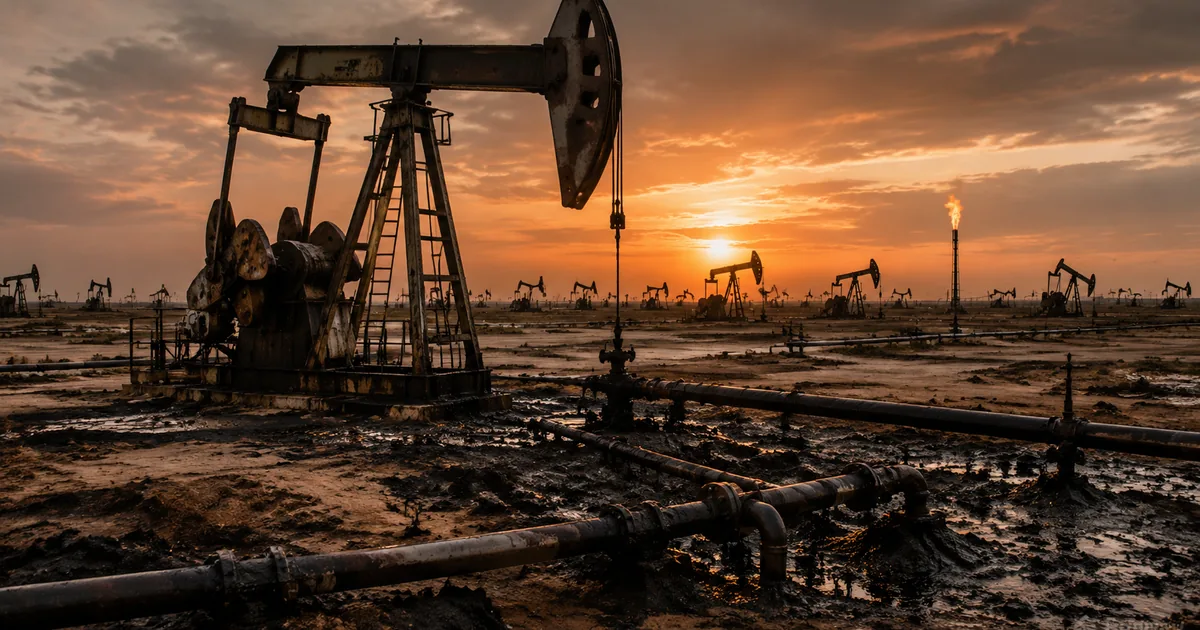
President Trump announced on Friday that the United States had entered a deal giving it control of 65 billion barrels of Venezuelan crude, and he wrote that the arrangement “MORE THAN DOUBLES American Oil Reserves.” That last claim is the one nobody checked, and it is the one that falls apart first.
Every major outlet ran the reserves line as a political statement to be argued with. It is not a matter of opinion. The Energy Information Administration, the federal agency that keeps the official count, measures American proved reserves as crude physically inside the United States, and its most recent tally puts that figure at 46.0 billion barrels at the end of 2024. Oil in the Orinoco Belt stays in Venezuela’s column no matter who owns equity in the company pumping it. What the United States acquired is a stake in a business. That is a real thing, and it may turn out to be a lucrative thing. It is not a reserve.
What the Deal Actually Is
The structure, as NBC News reported it, works like this. Venezuela’s interim president, Delcy Rodríguez, granted a private joint venture a 100-year concession over 17 fields holding 65 billion barrels. The US government holds 55% of that venture, split between equity and the right to buy oil out of it at cost. Secretary of State Marco Rubio and Defense Secretary Pete Hegseth negotiated it. Trump says it will draw more than $100 billion of investment and return over $209 billion in taxes to Caracas.
Strip the numbers back and what is left is a sovereign wealth position. The United States government is now the majority owner of an oil company operating abroad. Whether that is a good idea is a legitimate argument. Whether it is what the president described is not.
The gap between the two matters because of what the reserves framing is doing politically. Reserves imply supply, supply implies price, and price implies the thing Trump actually promised, which is cheaper gasoline. NPR walked through why that will not happen on any timeline a driver would notice: most of the fields in question are barely developed, the crude in them is extra-heavy and expensive to move, and analysts put meaningful production years out. Venezuela sits on roughly 303 billion proved barrels, the largest holding on earth, and it has sat on them through decades of not being able to get them out of the ground at scale.
Two Governments Described Two Different Deals
Here is the part that should have set off alarms on Friday afternoon. A US official told CBS News the concession runs 100 years. Rodríguez, standing in Caracas, described a 25-year bilateral project with a production target of 1.5 million barrels a day. Those can be reconciled if the 100 years attaches to the concession and the 25 to the intergovernmental framework, which is the reading most reporters settled on. They can also not be reconciled, and there is no way to know, because the two governments announced different lengths for the same arrangement and neither has released a document.
PBS put it plainly in its explainer: no text of any agreement has been made public. Not a memorandum, not a term sheet, not the concession instrument itself. What exists is a social media post from one head of state and a press appearance by another, and a hundred headlines built on top of both.
The United States government has taken majority ownership of a commercial enterprise and has not told the public what the enterprise is called.
The Partner Nobody Has Named
The 55% figure has been repeated everywhere. The 45% has been repeated nowhere, because nobody has said who holds it. Every account describes the counterparty as “a private joint venture” or “an experienced private operator in Venezuela,” which is the language of a press release, not of reporting.
This is the reserves problem again in a different suit. A government equity stake is not an abstraction. It comes with a partner, a cap table, a governance structure, and a set of people who will be extremely rich if 1.5 million barrels a day ever materializes. The United States government has taken majority ownership of a commercial enterprise and has not told the public what the enterprise is called. That is not a detail that emerges later. That is the deal.
The Signature on the Concession
Rodríguez became interim president because the United States removed her predecessor. In January, American special forces raided Nicolás Maduro’s compound in Caracas and flew him to New York, where he pleaded not guilty to narcoterrorism and cocaine trafficking charges in a proceeding legal experts immediately began picking apart. Eight months later, the official that operation left in charge has signed a century of her country’s oil over to a venture the United States controls.
We think that sequence is indefensible, and we do not think it becomes defensible because the crude is heavy or the timeline is long. A concession granted by a government installed through the forcible removal of the previous one carries exactly as much legitimacy as the installation did. Venezuelans who spent 2026 arguing over who should actually lead the country were not consulted about a hundred-year lease on the thing that funds the state. If a future Venezuelan government voids this, it will have a strong case, and the American taxpayer whose interests Trump invoked will be the one holding the loss.
There is also a market verdict already on the record. In January, when the White House convened oil executives to pitch investment in a post-Maduro Venezuela, ExxonMobil made clear it wanted no part of it. The largest American producer looked at the same barrels and called the country uninvestable. Seven months later the federal government has taken the position Exxon declined, with public money, on terms it will not publish, alongside a partner it will not name.
What Should Happen Now
Congress should demand two documents: the concession instrument and the joint venture’s ownership schedule. Neither is classified in any obvious way, and both are the minimum required to evaluate a transaction the executive branch is describing as the largest oil deal in history. The Senate Foreign Relations Committee has jurisdiction and a hearing calendar.
Until those arrive, the honest description of Friday’s announcement is narrower than the one the president gave. The United States bought a majority position in an oil venture in a country it recently invaded, from a government it recently installed, at a price and on terms that remain unpublished. That may still prove to be a shrewd trade. It is not 65 billion American barrels, and the people telling you it is have not shown you the paperwork.