
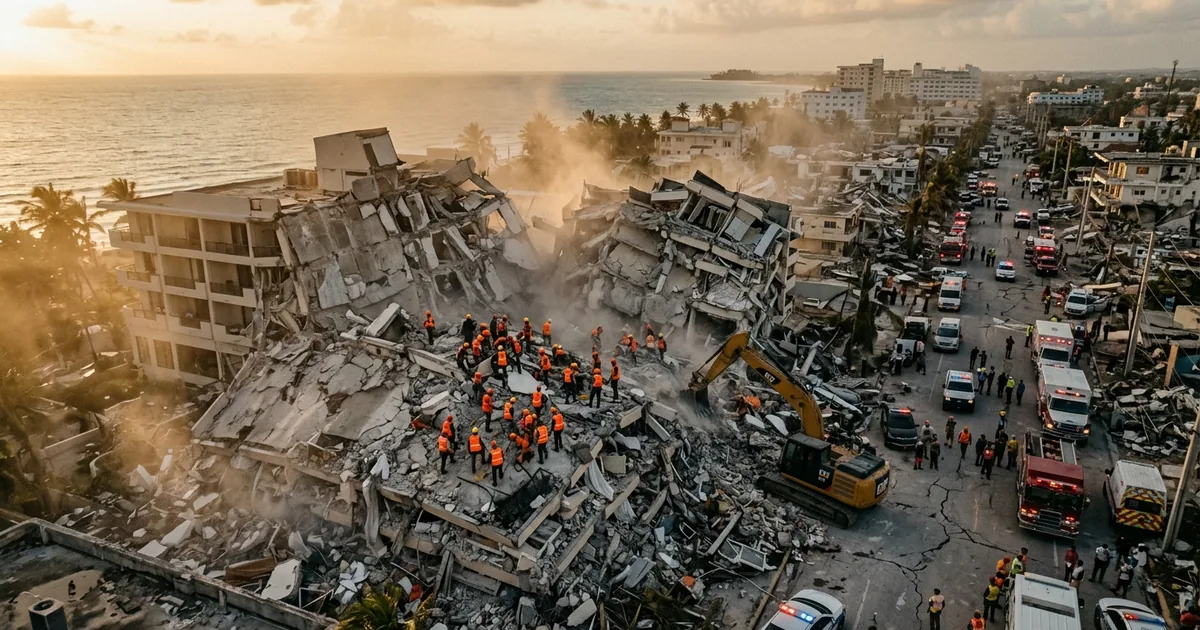
A deportation flight carrying 146 Venezuelans landed in Caracas on June 24, and within hours the passengers were trapped inside a collapsing hotel as twin earthquakes tore through the country’s coast.
More than 100 of those deportees are now missing or confirmed dead, and the U.S. government has said nothing.
The flight, which NPR confirmed departed from Miami, carried 19 women and seven children among its 146 passengers. Upon arrival, Venezuelan intelligence agents with the Servicio Bolivariano de Inteligencia Nacional transported the group to Hotel Santuario La Llanada in La Guaira, a coastal city that would become one of the hardest-hit zones when 7.2 and 7.5 magnitude earthquakes struck 39 seconds apart at 6:04 p.m. local time.
The hotel collapsed. The deportees had been inside for hours.
A Flight Into Catastrophe
What makes this story more than a tragic coincidence is the machinery behind it. ICE Flight Monitor, the nonprofit tracking program, documented 288 deportation flights to 38 countries in May 2026 alone, with 12 flights specifically to Venezuela. The Trump administration’s deportation operation has been running at industrial scale, and on June 24 it fed people directly into the path of the worst natural disaster Venezuela has experienced in modern memory.
The deportees were not given a choice about where they were housed. They were not free to leave. They were undergoing mandatory medical exams and receiving identification documents when the ground began to shake, according to Al Jazeera’s reporting. They were, in the most literal sense, wards of a state that placed them in a building that could not survive what came next.
Survivors Walked Out of the Rubble Alone
Lisbeth Portillo, 58, is one of the survivors. She escaped the collapsed hotel with roughly 20 other deportees and walked five kilometers through a devastated city looking for help. “I was born again,” she told reporters. “God gave me a second chance.”
Jenny Rodriguez, 24, was pinned under the rubble. She managed to free one hand from the debris, grabbed a fellow deportee by the trousers, and begged him to pull her out. He did.
Not everyone had someone nearby. Liliana Rojas, whose 33-year-old partner was deported from an El Paso detention center and placed on the flight, has heard nothing. “No one is giving an answer about anything,” she told the AP.
ICE Has Said Nothing
U.S. Immigration and Customs Enforcement did not respond to press inquiries from NPR, the AP, or Al Jazeera about the fate of the deportees. The agency has not confirmed how many of the 146 passengers are accounted for, whether it is coordinating with Venezuelan authorities on rescue or recovery, or whether it has contacted the families of the missing in the United States.
That silence is the policy choice that turns a natural disaster into something worse. The U.S. government put these people on a plane, delivered them to a foreign government, and has offered no accounting of what happened next. The families searching for answers are doing so without any institutional support from the country that removed their relatives.
Venezuela’s Broader Catastrophe
The deportees’ fate is one thread in a disaster that has killed more than 1,700 people across Venezuela, with the death toll still climbing as rescue crews work through rubble. The Venezuelan government reported 1,719 dead and 5,034 injured as of Sunday, with more than 46,600 people still missing. CNN reported that NASA researchers estimate 58,870 buildings were damaged or destroyed by the twin quakes, based on satellite radar analysis.
La Guaira, where the deportees were housed, sits on the coast north of Caracas and absorbed some of the worst damage. The mountainous terrain complicated rescue operations from the start, and infrastructure failures left survivors without communication for days.
No Precedent, No Protocol
This is the first confirmed mass-casualty event involving people deported from the United States into a natural disaster zone. It will not be treated as a policy failure by the administration that ordered the flights. It will be framed, if it is addressed at all, as an act of God that no one could have predicted.
But the earthquake struck hours after the plane landed. The deportees were in government custody from takeoff to collapse. There was no gap in the chain of responsibility, no moment where they became free agents who chose their own shelter. They were moved from a U.S. detention facility to a Venezuelan processing hotel, and the hotel fell on them.
The question is not whether anyone predicted the quake. The question is whether a government that runs 288 deportation flights a month to 38 countries bears any responsibility for what happens to the people it delivers, and whether “we put them on a plane and they’re not our problem anymore” is a position that can hold when more than 100 of those people are dead or missing inside a building they were never allowed to leave.