
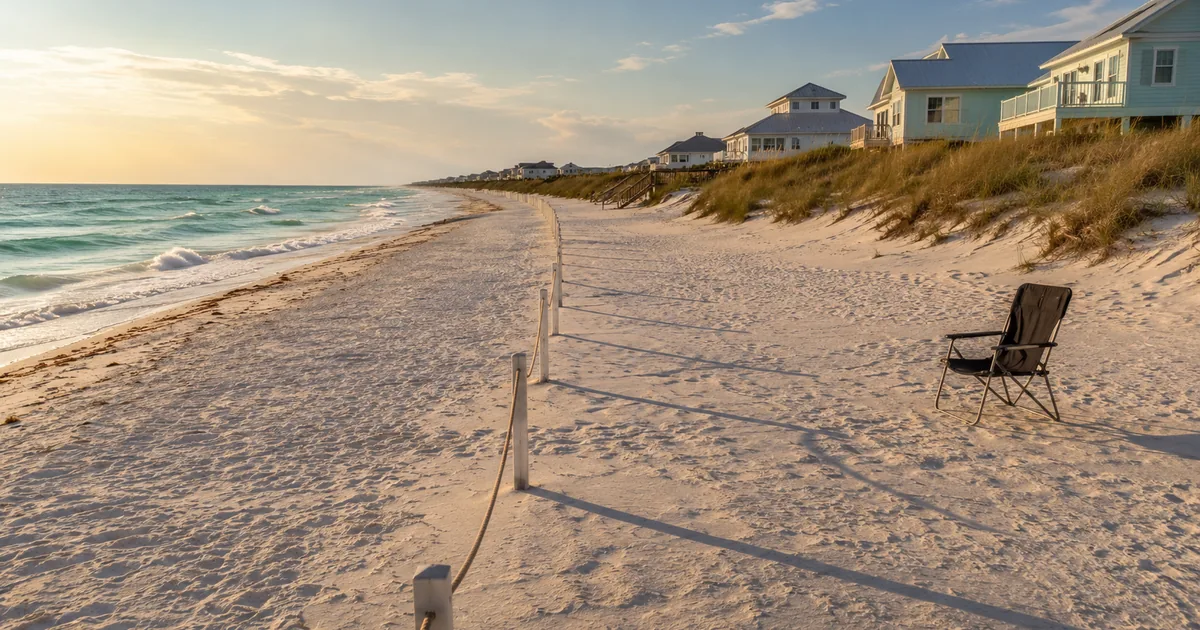
Florida threw out the statute that shut the public off 26 miles of Panhandle sand on June 24, 2025. Fourteen months later the no-trespassing signs are still planted, private security still patrols the dry sand along Highway 30A, and beach advocates are now campaigning for a statewide constitutional amendment to settle a question the legislature already settled.
Every version of this story being told right now, including NPR’s dispatch from 30A this week, frames it the same way: an unresolved values fight between property owners and the public, with a constitutional amendment as the only remaining path. That framing skips the part that actually explains why nothing has changed. When Governor Ron DeSantis signed Senate Bill 1622, the law handed Walton County back the power to reopen its beaches by ordinance. In the fourteen months since, the county commission has not passed one. What it passed instead, on May 26 of this year, was a resolution affirming its support for public use of the beaches, which specifically thanked a private landowner for graciously sharing the sand with non-owners.
A resolution is a press release with a vote attached. An ordinance is law. The bill restored the second one.
The 2018 Law Was a Procedure, Not a Principle
The thing people get wrong about HB 631 is that it never announced that Florida beaches were private. It did something quieter and far more effective. It said that if a local government wanted to recognize the public’s customary use of dry sand, it had to go to court and prove it, and it exempted ordinances adopted before January 2016. Walton County had adopted its customary-use ordinance in October 2016, which put it on the wrong side of the line by nine months and made it the only county in Florida forced to litigate.
So the county sued, and the scope of what it was asked to prove is the whole story: 1,194 individual Gulf-front parcels, each with its own history of public use to establish. That case is still open. Along the way the county settled with a large share of the owners rather than try 1,194 mini-trials, which is exactly the outcome a parcel-by-parcel burden is designed to produce. Nobody had to win the argument that the beach was private. They only had to make proving otherwise expensive enough.
That is worth naming clearly, because it is a template. Rick Scott signed it, the 2018 legislature passed it, and the mechanism was procedural cost rather than an open transfer of public rights. Sand changed hands without anyone having to cast a vote saying so.
What the Repeal Did and Did Not Reach
Senator Jay Trumbull, a Republican from Panama City, sponsored the repeal, and his pitch was not ideological. As WCTV reported when DeSantis signed it, Trumbull put it in local economic terms: “When 80 percent of your economy relies on these beautiful beaches and tourism, this isn’t just a legal issue, it’s a community issue.” The governor’s office called the bill a measure that restores local authority to recognize recreational customary use and framed it as a win for recreation and tourism.
It took effect immediately. And the county’s own lawyer told residents almost at once what that meant in practice. Acting County Attorney Clay Adkinson, quoted by Mid Bay News in the weeks around the signing, said: “On Day 1, nothing changes.” He was right, and he was describing a starting gun, not a dead end. The repeal returned Florida to the pre-2018 sequence, where a local government declares customary use, adopts an ordinance, and property owners who disagree carry the burden of suing to overturn it.
Three things the repeal genuinely could not fix, and they matter:
- Parcels already covered by a settlement stay covered by that settlement. A new ordinance does not reopen a signed agreement.
- Quiet-title judgments already entered are judgments. A statute passed later does not vacate them.
- The seven years of on-the-ground habit, the guards, the signs, the roped lines, the deputies telling people to stay on wet sand, do not un-happen because Tallahassee changed the law.
What the repeal did reach is everything else, which is most of the coastline, and the leverage it restored is real. Under the pre-2018 sequence the county does not have to prove anything first. The owners have to sue.
The Amendment Is Aimed at the Wrong Government
Dave Rauschkolb, the restaurateur behind Florida Beaches for All, wants a constitutional amendment guaranteeing public access from the dune line to the water. It is a defensible goal and it would outlast any legislature. It is also a heavier lift than almost anyone campaigning for it says out loud, because Florida requires 60 percent of voters statewide to approve any constitutional amendment, a threshold that has killed thirteen measures since it was adopted.
Here is our position. Asking 60 percent of Florida to fix Walton County’s beaches is a way of not asking the five people who can already fix them. The commission has held the authority since June 2025. It has used that authority to pass a resolution of support and to praise a landowner for being generous. Meanwhile the reporting keeps quoting Kent Safriet, the attorney for roughly 80 landowners, on the Fifth Amendment and just compensation, and treating that as the obstacle. It is not the obstacle. It is an argument, and under the sequence the repeal restored, it is an argument his clients would have to bring to a judge rather than one the county has to defeat in advance.
The reason nobody says this plainly is not mysterious. Walton County’s population has more than doubled since 2000 and it drew 4.5 million visitors last year, and a meaningful share of the tax base and the political weight in that county belongs to the people who own the houses behind the dune line. A commission that passes a customary-use ordinance is a commission that gets sued by its own biggest taxpayers. A commission that passes a resolution gets a headline and no litigation.
Pass the ordinance. Draw the line at the dune, publish it, mark it, and let the owners who object take it to court parcel by parcel the way the public just spent seven years and 1,194 parcels doing. If the Fifth Amendment claim is as strong as Safriet says, he will win and Florida will know where it stands. If it is not, the sand goes back to being what NPR’s reporting from 30A this week describes people remembering it as, which is a place you could walk without checking a phone app to see whose chair you were passing.
Either way the answer arrives faster than a statewide ballot campaign, and it arrives from the government that was handed the job.