
On Thursday, October 1, SNAP benefits go up and the federal government stops paying half the cost of running the program, and almost every story about the date has led with the first fact.
- Maximum monthly benefits rise for fiscal 2027. A family of four in the lower 48 can now receive up to $1,023, up from $994.
- The federal share of SNAP’s administrative costs falls from 50% to 25% the same day, under the One Big Beautiful Bill Act Trump signed in July 2025.
- States with payment error rates of 6% or more start paying 5% to 15% of the benefits themselves beginning October 1, 2027.
- In fiscal 2025, 41 states and Washington, D.C. were above that 6% line.
Those four facts are all public. What nobody has put next to each other is how they interact. The administrative cut takes money out of the offices that process applications. The error-rate penalty then charges states for the mistakes those offices make. And the law gives its most generous grace period to the states that make the most mistakes. Read together, the October 1 changes are a loop, and the people inside it are the caseworkers and the families on the other side of their desks.
The Raise Is Real, and It Is Small
Start with the good news, because it is the part being sold. Newsweek laid out the new maximums in early September: $306 for one person, $562 for two, $808 for three, $1,023 for four. Those figures follow USDA’s Thrifty Food Plan, which is recalculated every June from grocery prices. For the reference family of four, that is $29 a month more, a 2.9% increase by our own arithmetic. NBC Washington’s explainer made the important caveat plainly: a higher maximum does not mean every household gets more, because actual benefits depend on income, household size and deductions. For most families the raise is an adjustment to food inflation that has already happened. It keeps the benefit level roughly where it was in real terms. It does not expand anything.
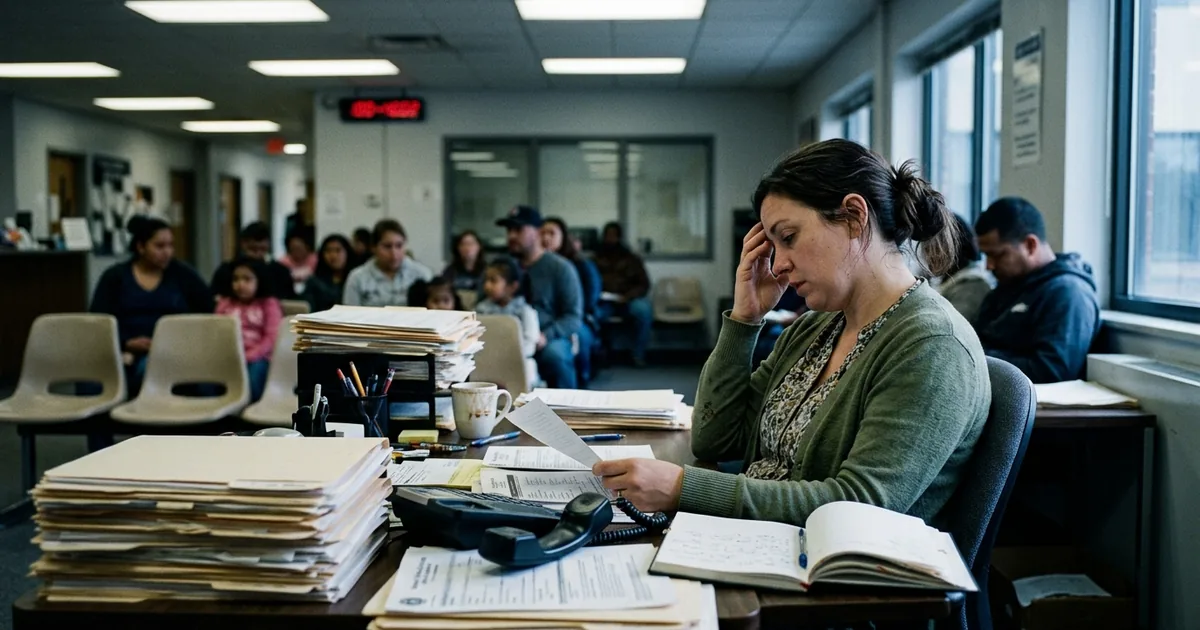
The other change arriving Thursday gets a line near the bottom of most of those explainers. For decades, Washington and the states have split the cost of administering SNAP evenly: eligibility workers, call centers, computer systems, fraud units, the interview a family sits through before a card is issued. Starting Thursday, Washington pays a quarter. In states where counties run SNAP offices, that bill lands on counties. Stephen Acquario, executive director of the New York State Association of Counties, described the new arithmetic to Spectrum News this month: “It’s 75% funded by county governments in New York and only 25% funded by the federal government.” His association puts the cost to New York counties at $168 million a year, with $60 million landing in the last quarter of 2026 alone. Schenectady County expects to absorb about $1.2 million in that first quarter. Counties do not print money. They raise property taxes, freeze hiring or cut something else, and in a benefits office the thing that gets cut is people.
The Penalty Arrives Next, and It Punishes the Wrong Thing
Now the second half of the loop. In June, USDA released the fiscal 2025 payment error rates that will set the first round of state penalties. The national rate was 10.62%, and Grocery Dive’s summary counted only ten states at or under the 6% threshold. Agriculture Secretary Brooke Rollins treated the numbers as a verdict on the states.
“These payment error rates are further proof that state accountability is severely lacking in SNAP.”
The error rate counts underpayments as well as overpayments, so it is a measure of how accurately a state processes cases, not a measure of fraud. Accuracy is a function of staffing, training and caseloads. That is the part Thursday’s cut goes after. Ballotpedia’s breakdown of the schedule shows how the pieces fit: states with error rates between 6% and 8% pay 5% of their benefits, between 8% and 10% pay 10%, and above 10% pay 15%. For fiscal 2028, states may use either their 2025 or their 2026 rate. After that, the penalty is based on the rate from three years earlier. The fiscal year that begins Thursday, with its thinner county staffing, is the year that will price the penalties of fiscal 2030. Congress built a system that cuts the funding for accuracy and then fines states for inaccuracy, and it scheduled both to start from the same week.
Then there is the escape hatch. The Food Research and Action Center has documented how Senate Republicans, to secure Sen. Lisa Murkowski’s vote, wrote in a delay for Alaska and then widened it to any state whose error rate, multiplied by 1.5, reaches 20%. In practice that means a rate of roughly 13.34% or higher. The Anchorage Daily News reported that Alaska’s fiscal 2025 rate topped 23%, and that Delaware, Georgia, Illinois, New Mexico, Oregon and Washington, D.C. also cleared the bar. A state sitting at 9% starts paying in October 2027. A state sitting at 14% gets a pass. We think that is indefensible on its own terms. A law sold as a push for accountability pays its biggest reward to the states that are furthest from it, and it came into being as a vote-buying clause for one senator.
This administration has fought over SNAP before. It also backed restrictions on what families could buy with the benefit, and a federal judge blocked the SNAP junk food restrictions in June. The pattern across both fights is the same. The program is framed as a problem of recipient behavior and state sloppiness, and the fixes consistently shift cost and risk downward, to counties and families, while the federal spending line gets shorter.
Who is served by the framing that Thursday is the day SNAP benefits go up? The people who wrote the cost shift, for one. It lets a real reduction in the federal commitment arrive disguised as a raise. The National Association of Counties has warned its members that states may pass penalties down to counties even when local offices are doing their jobs, and advocates warn that states unable to absorb the expense may tighten eligibility, cut outreach or, at the extreme, walk away from parts of the program. None of that shows up in a table of new maximum benefits. The consequences will instead show up as longer phone queues, more missed recertifications and more families dropped for paperwork, which happens to be exactly the kind of case that inflates an error rate.
What should happen is not complicated. Congress can delay the administrative cut until the error-rate system has run for a year, so states are not asked to fix accuracy while losing the staff who produce it. The Center on Budget and Policy Priorities has already called for that delay, and county officials of both parties have every reason to push for it before next year’s budgets harden. Failing that, states can refuse to pass the cost down to counties, which is a choice every state legislature with county-run SNAP offices is now making, whether it says so or not.
Families on SNAP will see a slightly larger deposit this month. The offices that decide whether they keep getting it will see a smaller budget the same day. Watch the county budget votes this fall. They will tell you more about the future of food assistance than Thursday’s benefit tables.