
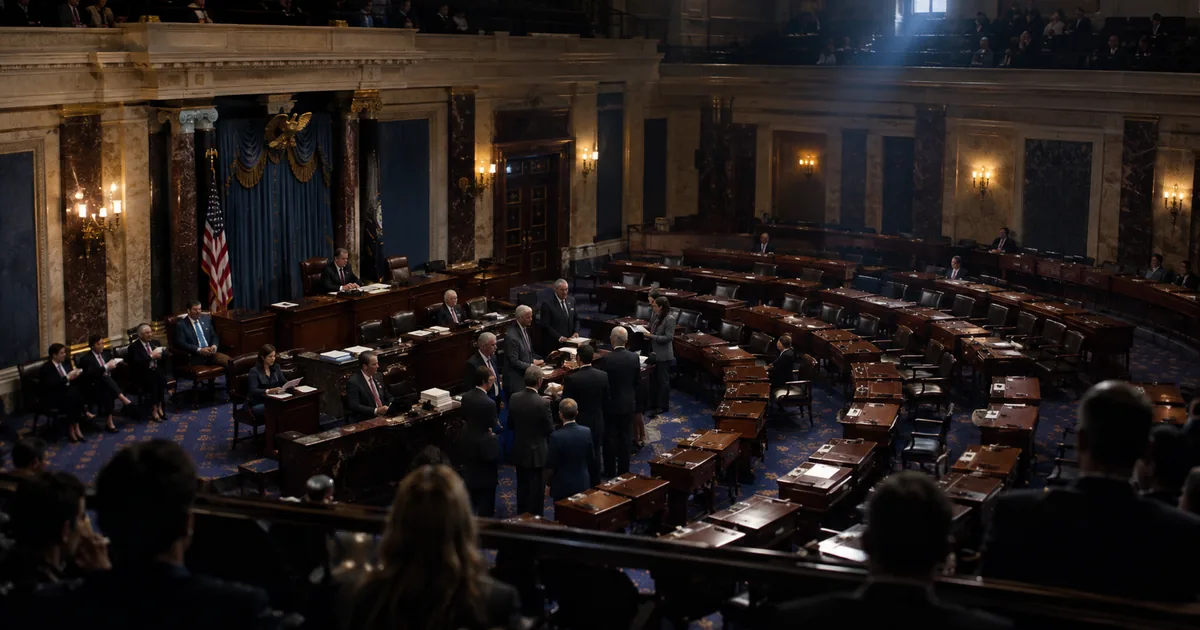
The Senate voted 49 to 50 on Thursday afternoon against a resolution directing President Trump to pull American forces out of the war with Iran, with four Republicans crossing the aisle and one Democrat, John Fetterman of Pennsylvania, voting no. Every account running tonight is counting the four Republicans. The number that decides whether the afternoon mattered is a different one, and it is not on the tally sheet.
The measure that died was House Concurrent Resolution 89. A concurrent resolution does not go to the president’s desk. It is not signed, it cannot be vetoed, and it carries no force of law. Roll Call put it plainly when the House passed the thing in July, noting that the resolution did not go to the president for his signature and therefore had little power to actually force him to withdraw troops from the war. So the Senate spent Thursday rejecting a measure that would not have ended the war if it had passed. That is the part the coverage is leaving out, and it changes what the four Republican votes are worth.
Start with what happened, because the arithmetic is tight enough to matter.
- The vote was a motion to discharge the resolution from the Senate Foreign Relations Committee. With 99 senators voting, it needed 50.
- Four Republicans voted yes: Susan Collins of Maine, Lisa Murkowski of Alaska, Rand Paul of Kentucky and Thom Tillis of North Carolina.
- Fetterman was the only Democrat to vote no.
- Four Republicans crossing was enough to win. One Democrat erased it. Had Fetterman voted with his caucus, the motion carries 50 to 49.
NBC News reported that 19 American service members have died since the fighting started in late February, and that its own polling found 62 percent of registered voters saying the war was not worth it, with 57 percent more likely to back a candidate who opposes it. Those are not soft numbers in a midterm year. They are also, seven months in, not moving the floor.
There is a binding version of this fight, and it is a separate track that has already lost. Senator Chris Van Hollen of Maryland wrote Senate Joint Resolution 180, a joint resolution, which does go to the president and does carry legal force if it survives him. It failed to clear committee in July on a 47 to 49 vote, when the Senate blocked the only version of this measure that could have stopped the war. That is the vehicle with teeth. It got fewer votes than the one that died Thursday.
Four Republicans were willing to cross on the version that cannot compel anything. Two fewer were willing to cross on the version that can.
We are putting those two tallies side by side because nobody else has, and the comparison is the clearest thing available about where the Senate actually is. It is not a perfect match. The votes are two months apart, the attendance differs, 96 senators voted in July against 99 on Thursday, and the two resolutions moved through different procedural doors. But the direction holds, and the direction is the point. Republican support goes up as the legal consequence goes down. A senator who tells a reporter the war should end, and then supplies that sentiment only to the measure that files it as a suggestion, has not changed anything except the record they will run on.
Tim Kaine has been the person living inside this machinery longer than anyone else in the building. The Virginia Democrat has spent years trying to make the War Powers Resolution do the thing its authors said it would do, and he has now forced the question over and over across a single war. Democrats have put more than a dozen war powers votes on the floor since February. Kaine’s argument has not changed across any of them: Congress has the constitutional power to declare war, not the president. He is correct on the civics and he keeps losing on the mechanics, which is a specific kind of defeat. The statute he keeps invoking was built around the idea that both chambers could pass a concurrent resolution and the troops would come home. That mechanism stopped working decades ago, because a resolution that never reaches the president cannot direct him to do anything. What is left is a joint resolution he can veto, which means the real threshold is not 50 votes. It is 67.
Nobody is close to 67. Everybody in the chamber knows that.
Which is why Thom Tillis is the most interesting vote of the four. The retiring North Carolina Republican told CBS News he would back the resolution because 60 days had passed since the administration notified Congress in July that military action against Iran had restarted. That is not a foreign policy position. That is a man reading the clock written into the statute and voting what it says. The War Powers Resolution gives a president 60 days of hostilities before he needs authorization. Tillis counted to 60, voted accordingly, and the clock did not produce a consequence, because the only instrument attached to it was one that does not bind. A deadline with nothing on the other side of it is a calendar entry.
Meanwhile the majority leader spent the day talking about something else. Senator John Thune pointed at voter fatigue over gas prices and pressed the administration to focus on reopening shipping lanes. Read that back slowly. Seven months into a war that has killed 19 Americans, with his own chamber voting on whether to end it, the leader’s framing was the cost at the pump and the freight routes. That is how a war gets metabolized into a logistics problem.
Here is where this site stands.
The vote count is a press release. Congress has one lever that binds a president who does not want to be bound, and it is not a resolution of any kind. It is the money. The Constitution gives the appropriations power to the legislature without qualification, no veto to override and no committee to discharge from, and it has been sitting there for seven months while both parties ran a dozen votes that could not reach the war. On September 13, Congress pushed the Iran war funding decision into the lame duck session, the one sitting that voters cannot reach with a ballot. That is a choice, and it is the choice that actually determined whether the fighting continues past January. Thursday’s vote did not.
Responsibility here is not evenly distributed, but it is not one-sided either. Republican leadership controls the floor and has kept the binding vehicle off it. Republicans who say the war should end and vote only for the version that cannot end it are running a scoreboard, not an opposition. Fetterman broke a one-vote margin on a measure his caucus had built its entire seven-month record around and owes his constituents a fuller explanation than he has given. And Democratic leadership brought a symbolic vehicle to the floor on the day it had the votes for a symbolic vehicle, which is defensible as a record-building exercise and useless as a brake.
What should happen next is narrow and specific.
- Force S.J. Res. 180 back to the floor. It is the binding text. It lost by two. Make Republicans vote on the one with legal effect, repeatedly, on the record, before November.
- Attach the war to the appropriation. The lame duck is where the Iran funding decision now lives, and an appropriations rider is the one instrument in this fight that does not require the president’s signature to work.
- Stop calling the concurrent resolution a rebuke. Representative Gregory Meeks has already introduced a measure to pursue a lawsuit to enforce the one the House passed in July, which tells you the House understood at the time that it had passed something unenforceable.
The unpopularity is now structural. Sixty-two percent against, a war past its six-month mark, 19 families with folded flags, and four Republicans willing to say so in the safest available form. None of that has produced a vote that could stop anything, and the reason is not that the Senate is evenly split. The reason is that the instrument Congress keeps reaching for was hollowed out long before this war started, and reaching for it again is easier than using the one that still works.
The next real test is the funding bill, in a session that begins after the voters have gone home.