
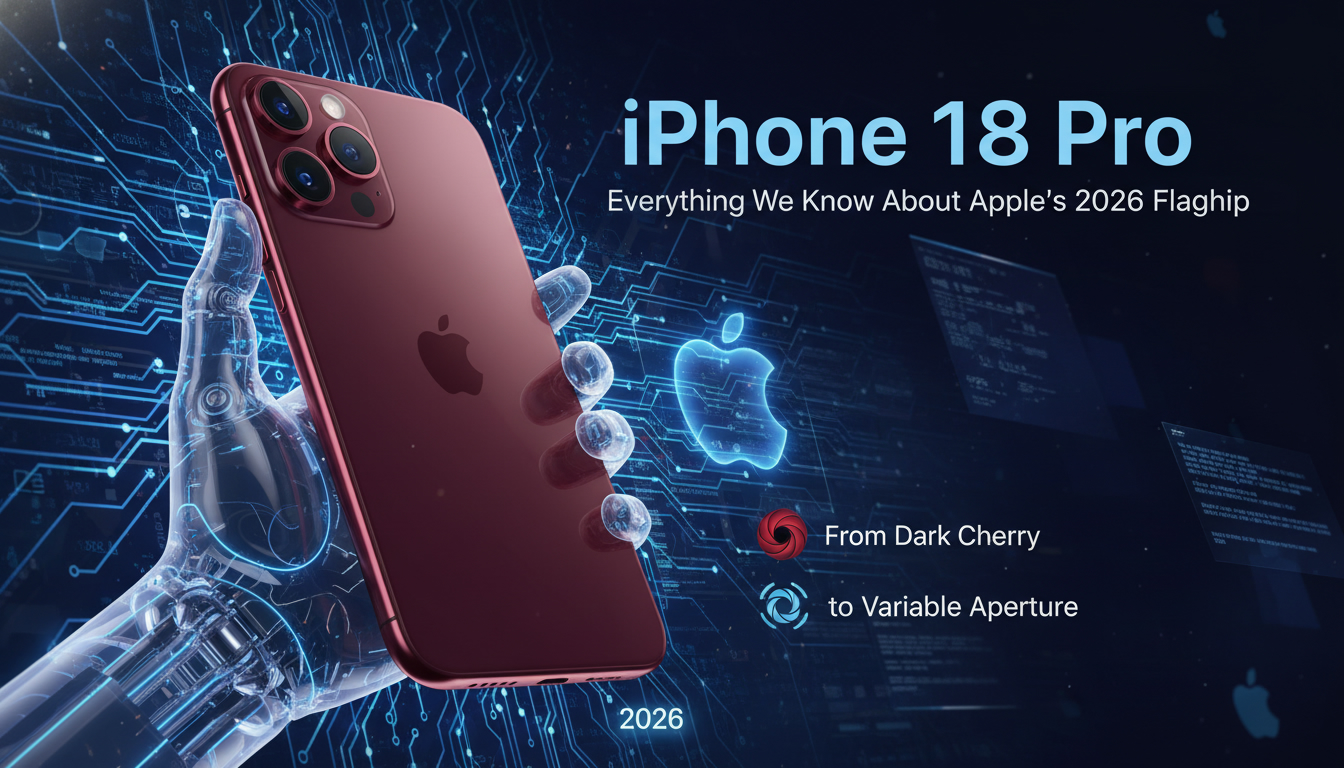
Apple’s annual iPhone cycle is the closest thing the tech industry has to a liturgical calendar, and the faithful are already parsing the prophecies. The iPhone 18 Pro, expected to arrive in September 2026, is shaping up to be one of the more meaningful upgrades in recent memory.
Not because Apple is reinventing the smartphone (that ship sailed a decade ago) but because the specific changes rumored for this generation address complaints that power users have been voicing for years.
Here is everything the leaks, analysts, and supply chain sources are telling us, and what it actually means for the roughly one billion people in Apple’s ecosystem.
The Design: Familiar Shape, Smarter Details
If you were hoping for a radical exterior redesign, temper your expectations. The iPhone 18 Pro will retain the general form factor of the iPhone 17 Pro: the same flat-edged titanium frame, the same large camera plateau on the back, and screen sizes locked at 6.3 inches for the Pro and 6.9 inches for the Pro Max.
The meaningful design change is at the top of the screen. The Dynamic Island, Apple’s pill-shaped cutout that has housed the front camera and Face ID sensors since 2022, is reportedly shrinking by up to 35 percent. This is not just cosmetic. Apple is achieving the reduction by moving Face ID components beneath the display itself, a technical challenge the company has been working toward for years. The result is more usable screen real estate in the area where notifications, live activities, and media controls appear.
For anyone who has found the Dynamic Island more annoying than delightful (and there are plenty of you), this is welcome news. A smaller island means less visual intrusion and more room for the software features Apple keeps piling into that space.
The Camera: Variable Aperture Changes The Game
This is the upgrade that photographers and videographers should pay attention to. At least one iPhone 18 Pro model is expected to feature a variable aperture lens on the main camera. If you are not a camera person, here is why that matters: aperture controls how much light reaches the sensor, and a variable aperture means you can adjust it manually rather than being stuck with whatever Apple’s software decides for you.
In practical terms, this means better control over depth of field (how blurry the background is), better performance in challenging lighting conditions, and the ability to shoot in a wider range of scenarios without the computational photography system overprocessing your image. It is the kind of feature that professional cameras have had forever but that smartphones have struggled to implement due to the physics of tiny lenses.
Samsung introduced a version of variable aperture on the Galaxy S9 back in 2018, but the implementation was limited to two fixed positions. What Apple is reportedly developing is more granular, offering a range of aperture settings that give the user genuine creative control. If the execution matches the ambition, this could be the most significant iPhone camera upgrade since the introduction of the 48-megapixel sensor.
The front-facing camera is also getting a bump, moving from 18 megapixels to 24 megapixels across all iPhone 18 models. For the selfie-and-video-call generation, that translates to noticeably sharper FaceTime calls and social media content.
The Chip: 2nm Arrives
The A20 Pro chip will be built on TSMC’s 2-nanometer process, a significant leap from the 3nm process used in the A17 and A19 generations. For non-technical readers, the nanometer number refers to how small the transistors on the chip are, and smaller transistors mean more processing power in less space with less energy consumption.
The practical impact: faster app launches, better gaming performance, longer battery life, and more headroom for Apple Intelligence features that are increasingly doing heavy computation on the device rather than in the cloud. Apple has been leaning hard into on-device AI processing as a privacy differentiator, and the A20 Pro gives the company more silicon budget to work with.
The new C2 modem, Apple’s second-generation in-house cellular chip, is also expected to debut in the iPhone 18 Pro. The headline feature is expanded satellite connectivity, building on the emergency SOS functionality introduced in 2022 to offer broader coverage in areas with no cellular signal. If you hike, travel to rural areas, or simply live somewhere with spotty coverage, this could be genuinely useful.
The Colors: Dark Cherry Headlines A New Palette
Apple’s color strategy for its Pro line has been conservative in recent years, cycling through shades of titanium, blue, and black. The iPhone 18 Pro is reportedly breaking from that pattern with a deep wine-red called “Dark Cherry” as the flagship color, replacing the iPhone 17 Pro’s “Cosmic Orange.”
Supply chain sources confirmed to Macworld that four color options are in production. Notably, according to Weibo leaker Instant Digital, Apple still will not offer the Pro in black in 2026. A coffee-toned option is also rumored, joining the Dark Cherry along with the expected Natural Titanium and a lighter shade yet to be confirmed.
Color may seem trivial, but it matters to Apple’s marketing machine. The company has learned that a distinctive, photographable color option drives social media conversation and early adoption. Dark Cherry is clearly designed to be this year’s “it” shade.
What Apple Is Not Releasing In September
Here is an important wrinkle that could affect buying decisions. Reports indicate that Apple will only release the high-end models in September 2026: the iPhone 18 Pro, iPhone 18 Pro Max, the new foldable iPhone, and possibly an updated iPhone Air. The base model iPhone 18, typically the entry point for most buyers, may not arrive until spring 2027.
This staggered release strategy, if accurate, represents a shift in how Apple rolls out new hardware. It could be a supply chain decision driven by the complexity of the 2nm chip, or it could be a deliberate move to push more buyers toward the higher-margin Pro models at launch. Either way, if you are waiting for the most affordable new iPhone, you may be waiting longer than usual.
Pricing: Holding The Line (Probably)
Apple analyst Ming-Chi Kuo has indicated that Apple does not plan to raise the price of the iPhone 18 Pro models despite the added costs of the 2nm chip and new camera hardware. The company will reportedly absorb those costs to protect market share, keeping the starting price at $999 for the Pro and $1,199 for the Pro Max.
In an era when flagship smartphones from Samsung and Google have been creeping steadily upward in price, holding the line is itself a competitive statement. Apple’s bet is that volume at $999 generates more long-term ecosystem revenue than a $50 price hike that pushes marginal buyers toward cheaper alternatives.
The Bottom Line
The iPhone 18 Pro is not going to convert anyone who has sworn off Apple products. It is not a paradigm shift. But for the enormous installed base of iPhone users who upgrade every two to three years, this generation offers a genuinely compelling list of reasons to make the jump: a camera system with real manual control for the first time, a smaller Dynamic Island, a meaningfully faster chip, better satellite connectivity, and a color that will make your current phone look dated.
September is five months away. The leaks will keep coming. But the broad contours of what Apple is building are now visible, and for once, the spec sheet reads less like incremental iteration and more like a phone that was designed with a clear point of view about what needed to get better. Whether Apple delivers on that promise is, as always, a question that will only be answered when the thing is actually in your hand.