
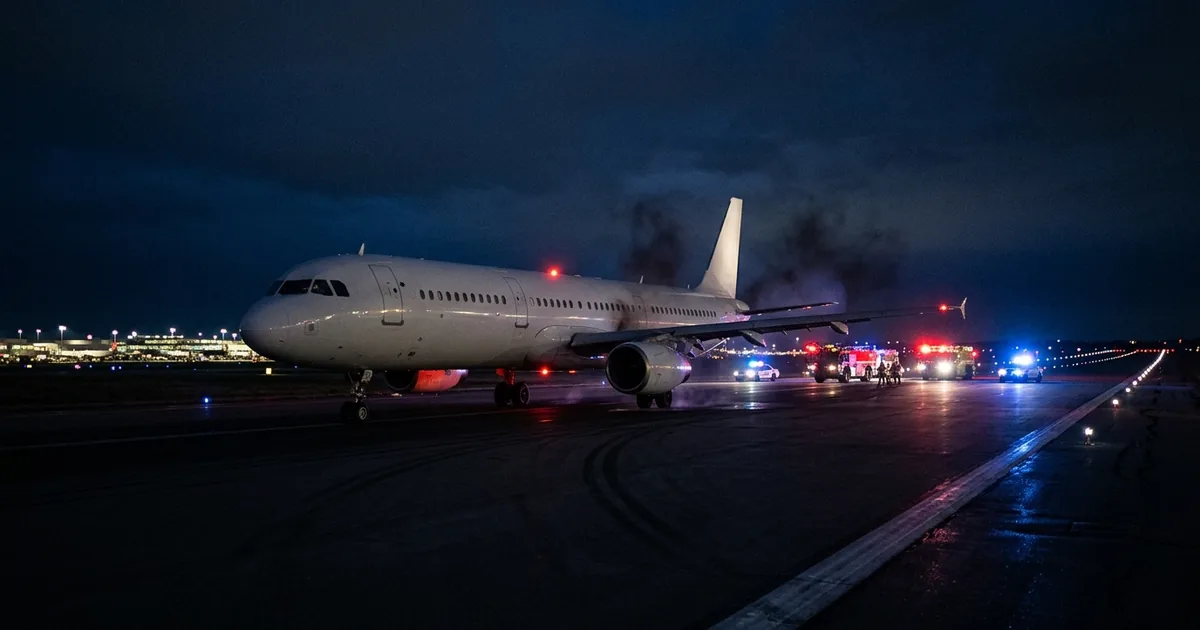
A Frontier Airlines Airbus A321 bound for Los Angeles struck and killed a person who had scaled the airport perimeter fence at Denver International, ran onto runway 17L, and met the jet during its takeoff roll at 11:19 p.m. Friday, May 8, 2026.
A Frontier Airlines Airbus A321 bound for Los Angeles struck and killed a person who had scaled the airport perimeter fence at Denver International, ran onto runway 17L, and met the jet during its takeoff roll at 11:19 p.m. Friday, May 8, 2026. The collision shredded an engine, forced the pilots to slam the brakes mid-takeoff, and turned a routine red-eye into the worst-case scenario for an industry already nervous about how easy it is to walk onto an active runway.
What Happened on Runway 17L
Flight 4345, an A321 carrying 224 passengers and 7 crew, was rolling for takeoff to LAX when the aircraft hit the trespasser approximately two minutes after the person jumped the perimeter fence, as the Colorado Sun reported in its Saturday morning recap. The pilots aborted the takeoff. Smoke filled the cabin. Passengers evacuated down emergency slides and were bused back to the terminal. Twelve people suffered minor injuries. Five went to local hospitals.
Passenger John Anthens told CBS Colorado he saw “a spark, followed by what he said was a big explosion in the wing and engine area.” Firefighters extinguished the engine fire. Local reporting confirmed the person was at least partially consumed by one of the engines, a detail every passenger account has so far echoed.
The pedestrian has not been identified. Denver airport authorities confirmed the individual was not an airport employee.
A Perimeter Breach the Industry Is Tired of Pretending Cannot Happen
Transportation Secretary Sean Duffy posted on social media that the trespasser “deliberately scaled a perimeter fence, and ran out onto a runway,” adding that “No one should EVER trespass on an airport.” The framing is convenient: a single bad actor, a single bad decision, no system to fix.
That is not what the public record shows. Perimeter breaches at major US airports surface in news reports with disturbing regularity, ranging from drunk drivers crashing through gates to pedestrians walking onto active taxiways without being detected. Every breach is treated as an anomaly. None are ever the system’s fault. And then another one happens.
Denver International occupies one of the largest airport land footprints in North America, with a perimeter that runs for miles across open prairie east of the city. The runway involved, 17L, sits in the airport’s eastern complex. A jet rotating for takeoff cannot stop on a dime. The pilots had perhaps two seconds of decision time between seeing the figure on the runway and impact. They did everything right and a person still died.
The questions worth asking are uncomfortable for the airport. How did the person get past the fence? Why did the perimeter intrusion detection system, if one was active on that segment, not alert tower controllers in time to clear the runway before the takeoff roll began? And how does an airport that size monitor every foot of fenceline in real time?
What the NTSB Investigation Will Look At
The National Transportation Safety Board has dispatched investigators and is coordinating with the FAA, Denver airport operations, and local law enforcement. Runway 17L will remain closed while the field investigation continues, an outage that is already cascading into Frontier’s Saturday schedule and pulling regional traffic onto the airport’s other six runways.
NTSB runway-incursion files typically take twelve to eighteen months to produce a final report. The interim recommendations are usually faster, especially when the gap between human and aircraft is measured in seconds rather than minutes. Expect the board to request an audit of perimeter intrusion detection coverage at DEN, a review of tower-to-perimeter-security communications, and an industry-wide bulletin on response times when a runway incursion is detected during a takeoff roll.
For Frontier, the operational hit is real but contained. The carrier is one of the most aggressive ultra-low-cost operators in North America, and a single grounded A321neo is recoverable. The reputational risk is harder to model. Passengers do not pick airlines based on perimeter security at the destination airport, but they do remember the brand on the side of a plane that hit somebody. That asymmetry has shaped post-incident communications at every major US carrier for years, and it intersects directly with the FAA’s broader squeeze on capacity, including the agency’s flight-cap order at 40 major airports that has left every operator running closer to the wire.
What Comes Next
The pedestrian’s identity, motive, and route through the perimeter will determine the shape of the investigation. If this turns out to be a suicide, the conversation pivots to mental health and to whether airports owe a duty of care that includes better fencing in known risk corridors. If it turns out to be a security breach, the FAA’s perimeter-protection rules, last updated meaningfully more than a decade ago, are in for a hard look. Either way, “trespasser” is not the answer the flying public will accept twice.
Runway 17L is expected to reopen by Saturday afternoon, per Denver airport operations. The 224 passengers from Flight 4345 mostly continued to LAX on a replacement Frontier flight overnight. The crew and the responding firefighters who extinguished the engine fire deserve quiet credit. The pilots aborted a takeoff mid-roll, with a fire on the wing, without a hull loss or a passenger fatality. That is what training is for.
The harder work, fixing the fence and the system that lets people climb it, falls to the airport, the FAA, and the NTSB.