
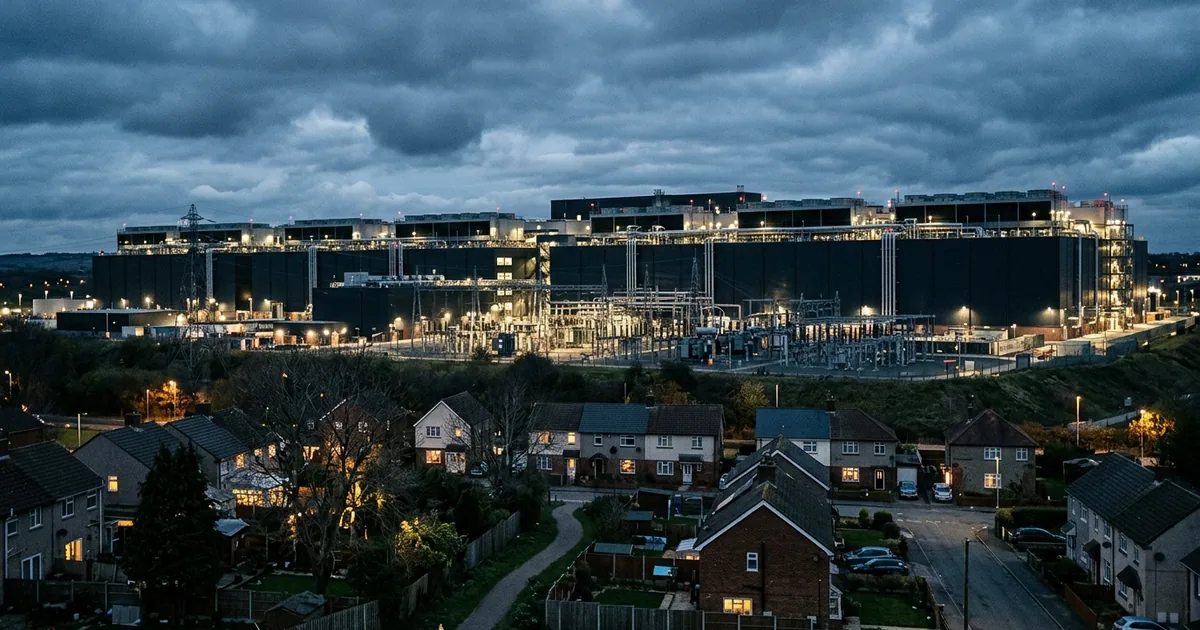
Across 24 states, 142 activist groups are organizing against data center construction, and the numbers tell you why: $64 billion worth of projects have been blocked or delayed in the last two years, with a record number of cancellations in the first quarter of 2026 alone.
The Bill Arrives
The backlash is not abstract. If you live near a cluster of data centers, your electricity bill has probably gone up, and in some areas it has doubled. Consumer Reports found that communities with high concentrations of data centers saw electricity prices jump as much as 267 percent over the past five years, a cost that lands squarely on residential ratepayers who never asked for a server farm next door.
Data centers now consume roughly 6 percent of total U.S. electricity, a figure that was closer to 2 percent as recently as 2020. The explosion in demand is driven almost entirely by the AI boom: training and running large language models requires enormous computational power, and that power has to come from somewhere. In most cases, “somewhere” is the same grid that heats your home and keeps your refrigerator running.
Ohio’s $2.3 Billion Lesson
No state illustrates the tension better than Ohio, where the government has committed at least $2.3 billion in sales tax exemptions for data centers. Signal Ohio’s investigation revealed that Google, Meta, and Amazon affiliates each received roughly $600 million in tax breaks distributed over a 40-year window, while Microsoft and QTS Data Centers each got $73 million.
The backlash hit a tipping point when a state report revealed the exemption cost Ohio $1.5 billion in the 2025 fiscal year alone. Governor Mike DeWine, a Republican not typically associated with reining in corporate incentives, declared a pause on new data center tax exemptions and directed the Tax Credit Authority to stop processing applications while officials review the program’s actual costs and benefits.
A survey of 19 economists convened by the state found that only one believed the benefits would outweigh the infrastructure costs. Most cited deferred road maintenance, strained water systems, and grid capacity concerns as hidden costs that the tax break calculus ignored entirely. Residents at the committee’s only public hearing demanded a moratorium, citing water contamination risks, corporate secrecy through non-disclosure agreements, and what they called inadequate state oversight of an industry that operates largely behind closed doors.
The Moratorium Movement
Ohio is not alone. More than 30 states have introduced over 300 bills in 2026 addressing data center impacts, ranging from moratoriums to revised tax incentive structures to new energy policy requirements. Stateline documented how the moratorium movement has spread rapidly: Denver’s city council unanimously approved a one-year moratorium, Bloomington and Normal in Illinois each passed six-month pauses, and Michigan’s Huron County enacted a three-year ban.
The pattern is consistent. A tech company announces a data center project, often with nondisclosure agreements that prevent local officials from sharing details with their own constituents. Tax breaks are approved. Construction begins. Electricity demand spikes. Utility bills rise. Water usage becomes a concern. And by the time residents organize, the facility is already operational.
A Gallup poll published in May found that a majority of Americans now oppose having data centers built in their local area, a significant shift from even two years ago when most people had no opinion on the topic. The opposition is bipartisan: concerns about utility costs and water use cut across political lines in a way that few tech-policy issues manage.
The AI Connection Nobody Wants to Talk About
Underneath the local fights over zoning and utility bills sits a larger question that neither the tech industry nor the communities opposing it have fully reckoned with. The AI energy race is accelerating at a pace that existing grid infrastructure cannot sustain. Every major AI company has announced plans to dramatically expand data center capacity over the next five years, and their projections assume energy will be available at scale.
The disconnect is striking. Tech executives talk about AI as the most transformative technology since the internet. Community activists talk about their water bills and property values. They are both right, and they are talking about the same buildings.
What nobody has proposed is a framework that acknowledges both realities: that AI infrastructure is coming regardless, and that the communities hosting it deserve genuine transparency, fair compensation, and a real voice in decisions that reshape their neighborhoods. Until that framework exists, expect the moratoriums to keep spreading and the $64 billion in blocked projects to keep growing.