
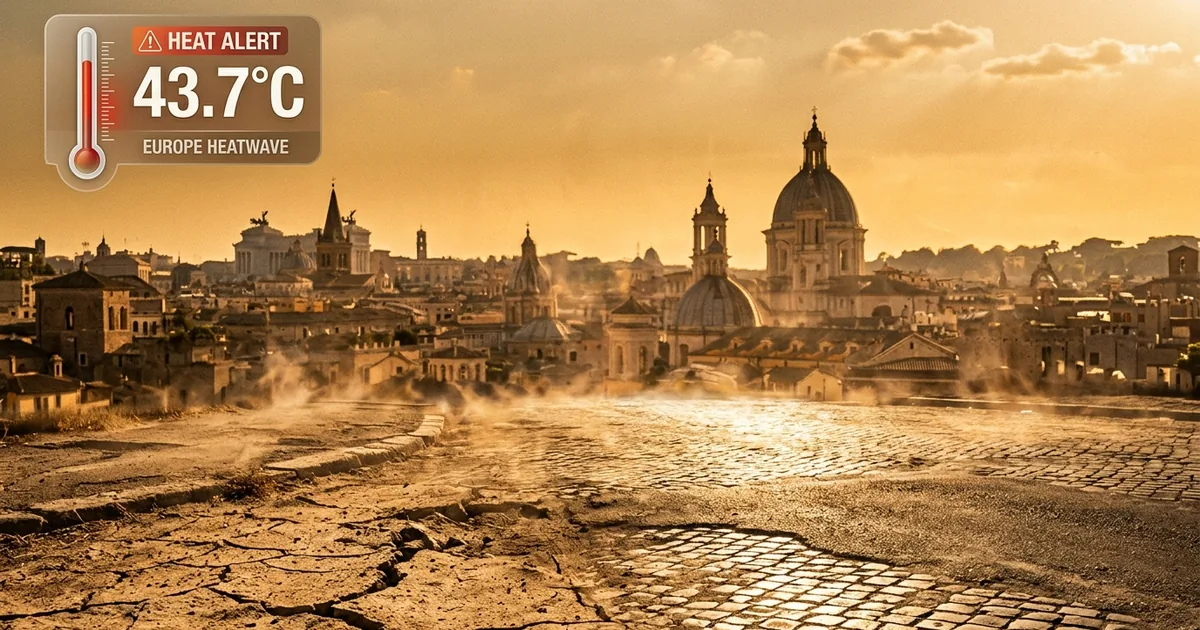
France recorded its hottest day in recorded history on Tuesday as a punishing heat dome settled over western Europe, killing at least 18 people and triggering drowning deaths that have climbed past 40 since mid-June.
The temperatures are not a forecast gone wrong or a freak event. They are the new baseline, and Europe’s infrastructure is buckling under it.
A Country on Red Alert
French authorities placed 54 departments under their highest-level heat warning as nationally averaged temperatures hit 29.8 degrees Celsius (85.6 degrees Fahrenheit), smashing the previous record set during the deadly 2019 wave. The southwestern commune of Pissos in Landes department recorded 44.3 degrees Celsius (111.7 degrees Fahrenheit), a number that would be alarming in the Sahara, let alone a country where many homes still lack air conditioning.
CNN reported on Tuesday that the extreme conditions were hitting millions from Brittany to the Pays de la Loire region, with temperatures of 42 to 45 degrees Celsius expected across broad swaths of the country. Overnight temperatures were the hottest since France began keeping records in 1947, which means the body never gets a chance to recover.
The Drowning Crisis Nobody Saw Coming
The most disturbing dimension of this heat wave is not the thermometer readings. It is the body count in the water. At least 40 people have drowned in France since June 18 as millions rushed to rivers, lakes, and the coast seeking relief, according to NPR. Many of the victims were in unsupervised swimming areas. The pattern is grimly predictable: extreme heat drives people to water, and undertrained or exhausted swimmers pay the price.
Power cuts compounded the misery. Reuters confirmed that thousands of French households lost electricity during the worst of the heat, stripping away the fans and cooling systems that keep vulnerable populations alive.
Not Just France
This is a continent-wide emergency. Spain extended its own heat alerts as temperatures climbed past 40 degrees across the Iberian Peninsula. Britain, a country whose housing stock was designed to retain warmth, faced projections pushing toward 40 degrees Celsius. The heat dome responsible for these conditions represents a phenomenon that has become a recurring feature of Europe’s climate system, one that atmospheric scientists link to the accelerating disruption of jet stream patterns.
Schools across southern France closed. Outdoor workers were ordered to halt shifts during peak hours. Hospitals activated emergency heat protocols, particularly for elderly patients, the demographic most likely to die quietly at home when the mercury stays elevated through the night.
What a Heat Dome Actually Is
The term “heat dome” has been trending in Google searches across the United States, and the mechanism is straightforward but ruthless. A dome of high-pressure air traps heat near the surface and prevents cooler air from cycling in. It is essentially a lid on a pot. What makes this June event exceptional is its intensity and duration. The heat arrived weeks earlier than historical norms, hitting in late spring rather than peak summer, and Scientific American noted that it is obliterating seasonal temperature records that were themselves only recently set.
The Pattern Is the Point
Europe’s second major heat wave of 2026 follows a punishing May event that sent temperatures 10 to 15 degrees above normal. That earlier wave set records of its own, including France’s hottest May on record. Two record-breaking heat events inside 30 days is not an anomaly. It is a trend line.
The question that European policymakers keep deferring is whether the continent’s infrastructure can adapt fast enough. Most French homes were built to hold heat in, not shed it. Air conditioning penetration in France remains far below American or Asian levels. Emergency services are designed for acute crises, not weeks of sustained thermal stress.
What is happening across Europe right now is a preview, not a peak. Summer has not officially arrived, and the forecasts show no meaningful relief through the end of the month.