
American jets hit Iranian missile depots and coastal radar sites on Friday, the first U.S. strikes on Iran since the two presidents signed a ceasefire memorandum nine days earlier.
The war that everyone declared finished in June is not finished. It is being rationed, and both governments have now built a vocabulary for pretending otherwise.
What Actually Happened in the Strait
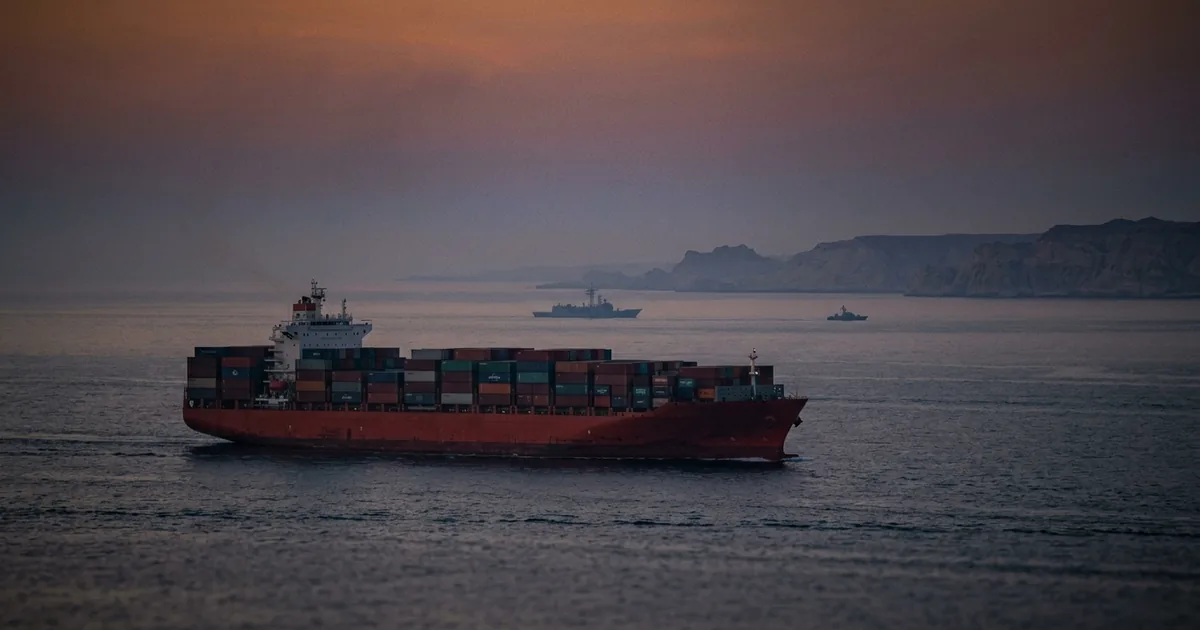
The trigger was a drone. On Thursday, a one-way attack drone that U.S. officials attribute to Iran struck the upper deck of the Ever Lovely, a Singapore-flagged cargo ship moving through the Strait of Hormuz off the coast of Oman. The vessel took damage and kept sailing. President Donald Trump said Iran had fired at least four such drones at ships in the strait and that American forces knocked down three of them, calling the episode a “foolish violation of our Ceasefire Agreement” on Truth Social.
The response came Friday. Six U.S. aircraft hit four targets along the Iranian coastline, striking missile and drone storage facilities and radar installations, according to CNBC’s account of the operation. Defense officials framed the strikes the way you frame a thing you do not want to escalate: large enough to signal that the United States will not let the strait be choked, narrow enough to avoid blowing up the diplomacy that ended the shooting two weeks ago. When a reporter asked whether Iran would face further consequences, Trump answered, “You’ll find out.”
This is the same choreography that played out in late May, when U.S. jets struck southern Iran while ceasefire talks ran in Doha. The pattern is becoming the policy: a provocation at sea, a calibrated strike in return, and a shared insistence from both capitals that the truce is still intact.
A War That Ended on Paper
To understand why a bombing run counts as restraint, you have to remember how recently this was a full war. From late February to mid-June, the United States and Israel fought Iran and its regional proxies across the Gulf and the Levant. It stopped, on paper, on June 17, when Trump and Iranian President Masoud Pezeshkian signed a memorandum of understanding that froze the fighting for sixty days so negotiators could try to convert a ceasefire into a settlement. Trump signed it at a dinner outside Paris after the G7; Pezeshkian signed in Tehran. Pakistan is mediating.
Sixty days is not a peace. It is a clock. Inside that window, negotiators are supposed to resolve the questions the war did not: freedom of navigation through Hormuz, the future of Iran’s nuclear and ballistic missile programs, sanctions relief, reconstruction, and the possible release of up to $25 billion in frozen Iranian assets contingent on compliance. Four days before Friday’s strikes, U.S. and Iranian negotiators told NPR they had agreed on a “road map” toward a final deal. Four days is a long time in this conflict.
The Language of Managed Escalation
The most telling document of the week was not a strike report. It was a sentence from Ebrahim Azizi, who chairs the Iranian parliament’s national security commission. Asked whether the drone attacks on shipping broke the ceasefire, Azizi said: “This is not a violation of the ceasefire; it is ceasefire management.”
Sit with that phrase. Shooting drones at civilian cargo ships has been redefined, in real time, as a form of compliance. Trump’s matching euphemism is “course correction,” the bureaucratic gloss officials reached for to describe the Friday strikes. Both sides are now performing violence as a kind of negotiating language, each blow small enough to be deniable as escalation, each one carrying a message the other is meant to read precisely.
There is a logic to it, and it is not a reassuring one. The only thing keeping Thursday’s drone and Friday’s airstrikes from becoming a third week of open war is a direct communications line that Iran and the United States stood up to deduplicate exactly this kind of incident, which Iran’s state-backed Press TV confirmed on Friday. A hotline is a thin guardrail. It works until someone misreads a radar contact, or a commander on a fast boat acts without waiting for Tehran, or a drone meant as a signal kills a crew instead of denting a deck. Managed escalation assumes everyone involved is a careful manager. Wars rarely grant that assumption for long.
The Enrichment Wall
Underneath the theater sits a problem the sixty-day clock probably cannot solve. Pezeshkian has been blunt that Iran will not surrender the core of what the United States and Israel went to war to eliminate. “What is certain is that we will never back down from the right to enrich uranium,” he said, “and the other side is also forced to accept it.” That is not a negotiating position that narrows. It is a wall.
The pressure is building from more than one direction. On June 26, the same day as the strikes, foreign ministers of the Gulf Cooperation Council issued a statement insisting that any deal with Tehran also cap Iran’s missile capability, widening the list of demands rather than trimming it. Trump, for his part, spent the prior week threatening to invade Iran outright if it moved to close the Strait of Hormuz. Every party is escalating its asks while the ceasefire is supposed to be cooling things down.
That is the contradiction the next month has to hold. A truce works when both sides want the fighting to stop more than they want what the fighting was about. Here, neither side has given up the thing it fought over. Iran will not trade away enrichment. Washington and the Gulf states will not sign a deal that leaves it. The drones and the airstrikes are not the breakdown of diplomacy. They are what diplomacy looks like when the underlying dispute is still fully alive and the only agreement anyone has reached is on the choreography.
What to Watch
The question is no longer whether the ceasefire will be tested. It is whether the people managing it can keep the tests small. A drone that hits a deck instead of a bridge, a strike on a storage shed instead of a city, a hotline call answered on the first ring: those are the fragile margins holding a region back from its third war in eighteen months. The next provocation is already being planned by someone who calls it management. The only open question is how much damage the word can keep absorbing.