
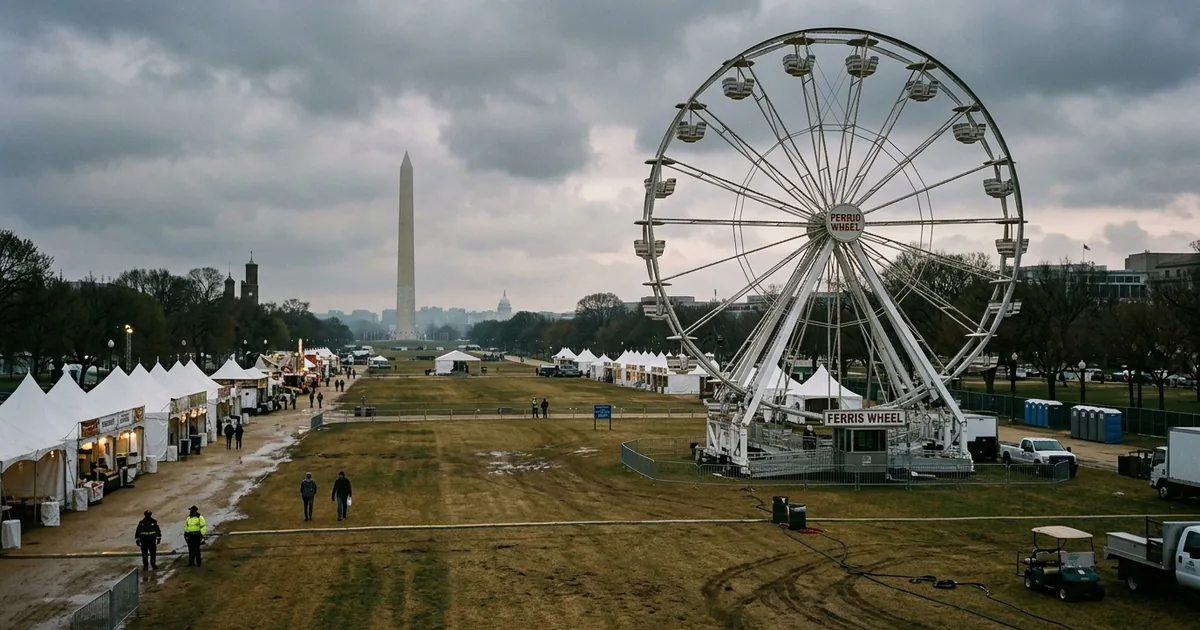
The Great American State Fair opened on the National Mall on June 25 with a food hall that lost power, a 110-foot Ferris wheel that stopped mid-spin, and ice cream melting in 80-degree heat.
Sold as the centerpiece of the nation’s 250th birthday, the 16-day event is a daily audit of what happens when a president routes a national celebration around the bipartisan commission built to run it and stages it himself instead.
The Commission Trump Decided to Replace
Here is the part that explains the rest. Congress already built an organization to run the 250th. The U.S. Semiquincentennial Commission, created by law roughly a decade ago and supported by the bipartisan nonprofit America250, exists for exactly this moment, with members from both parties and a congressional appropriation behind it. Trump chose not to use it. He stood up a parallel operation, Freedom 250, housed inside the National Park Foundation and run as the public face of a White House task force he created in 2025, then put his own people in charge of it, his top 2024 fundraiser and a former campaign manager among them.
The difference is not cosmetic. America250 answers to Congress. Freedom 250 does not, which is the point. Free of that oversight, it can keep its donors secret and sell proximity to the president by the tier: a half-million-dollar gift buys VIP seating, a million buys a private reception and a photo with Trump, and larger checks have been dangled for speaking slots, an arrangement Citizens for Responsibility and Ethics in Washington has flagged as a pay-for-access machine. Public Citizen has tracked more than $100 million in federal contracts flowing to Freedom 250 events, even as the bipartisan commission says it has seen only a fraction of the money Congress set aside. A national birthday was a public trust. Trump turned it into something he controls, and a vehicle built to flatter and to fundraise does not suddenly become competent because the flag flying over it is bigger.
A Unity Event That States Refused to Fund
The first tell was not the weather. It was the empty pavilions. At least ten states declined to take part, among them Connecticut, Illinois, Maine, Massachusetts, North Carolina, Oregon, Rhode Island, Vermont, and Washington, as NPR reported from the Mall. The common reason was money. Freedom 250, the Trump-aligned nonprofit commissioned to stage the fair, asked states for as much as $700,000 to participate, a figure a spokesperson for Pennsylvania Governor Josh Shapiro confirmed, and then left states to cover their own decorations and multi-week staffing on top of that.
Pennsylvania’s economic development office put it plainly when it announced the state would sit out, citing the high cost to taxpayers and the failure to line up Pennsylvania businesses willing to sponsor a booth. Oregon went further. A spokesperson said the state balked not only at the price but at growing concerns that the event was shaping up to be a more partisan affair than originally presented, a worry The Hill tracked as the boycott widened. A celebration of all fifty states works only if the states show up. This one asked them to pay for the privilege, and a fifth of the country said no.
The Crowd-Size Tell
If you want to understand why the fair feels off, watch how its host talks about attendance. Trump claimed on Truth Social that 45,000 people came to his opening-night speech. NBC News, standing in the same field, counted around 1,000. The gap is not a rounding error. It is the entire story in miniature.
He has done this before. The same instinct that turned a Memorial Day grievance into a Truth Social tirade now governs a federal birthday party, and the result is a celebration measured less by who attends than by how large the host can claim it was. Reporters described vast stretches of open grass and a worker-to-visitor ratio that ran the wrong way. A high school history teacher from Vermont, quoted by NPR, summed up the mood: “I feel like this is kind of more of a reflection of how divided we are.”
A Monument, Not a Midway
Tucked among the funnel-cake stands sits the giveaway: a scale model of the triumphal arch Trump wants built in Washington. A state fair is supposed to be about the states. This one routes visitors past a tribute to the man who ordered it. The arch model is not a quirk of the layout. It is the thesis. The event was never really a showcase of fifty states and six territories. It was a frame around a single figure, and the empty booths only make the frame more visible.
That confusion of country and self runs through the programming. A kickoff concert built around Vanilla Ice was scrapped barely two hours before showtime, officially over weather, leaving the marquee entertainment as one more thing that did not happen. The religious overtones and uneven state participation left some visitors cold. One attendee, who is Jewish, told NPR he came with an open mind and left uneasy, saying he did not feel included in the celebration. For an event whose organizers insist it is for everyone, that is a damning piece of testimony.
Twenty-Three-Dollar Turkey Legs
Then there is the price of a snack. The lone food stall open on opening day sold turkey legs for $23, roughly double what the same item costs at a Disney park, alongside $20 smashburgers and $9 lemonade, with stuffed pretzel rolls climbing toward $25. The New Republic catalogued the menu, and the numbers land badly for an administration that campaigned on the cost of eggs and gas. A populist fair that gouges its own attendees is not a messaging accident. It is the business model showing through the bunting.
None of this would matter much if the fair were a private venture that could quietly fold. But it carries the seal of a national anniversary, sits on public land, and leans on the machinery of the federal government to exist. The cost of the flop is not only Freedom 250’s. It is borrowed against the meaning of the milestone itself.
What the Empty Grass Says
The fair runs through July 10, which leaves nearly two weeks for the distance between the story Trump tells and the one the Mall shows to keep widening. A country turning 250 had a rare chance to throw itself a party that looked like the whole of it. What went up instead is a paywalled tribute to one man, ringed by the booths of states that refused to come. The Ferris wheel may be running again. The harder question is the one the empty grass keeps asking: a celebration of America that so much of America declined to attend, what exactly is it celebrating?