
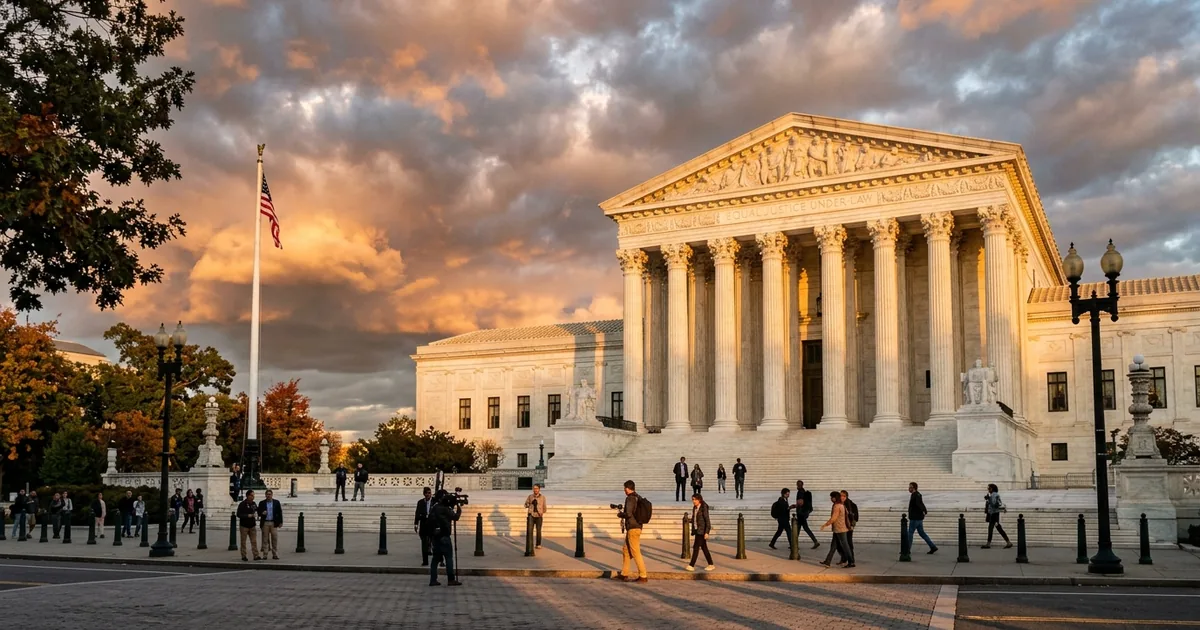
The Supreme Court on Sunday refused to hear Donald Trump’s appeal of the $5 million jury verdict finding him liable for sexually abusing and defaming writer E. Jean Carroll, closing the last door on his legal challenge to a case that has followed him from civilian life into the presidency and back out again.
The justices issued no comment and no noted dissent. That silence is the point: it means not a single member of a 6-3 conservative court found Trump’s arguments worth even discussing.
What the Jury Found
In May 2023, a federal jury in Manhattan found Trump liable for sexually abusing Carroll in the dressing room of Bergdorf Goodman, a luxury department store on Fifth Avenue, in the mid-1990s. The same jury found him liable for defaming Carroll when he publicly denied her account and attacked her credibility. The combined award: $5 million.
Trump’s legal team appealed, arguing that the trial judge made several improper evidentiary rulings. Chief among their complaints was the admission of the “Access Hollywood” tape, the 2005 recording in which Trump bragged about grabbing women by their genitals, and the testimony of two additional women who accused Trump of similar sexual misconduct decades ago. His lawyers called the evidence “highly inflammatory” and said it prejudiced the jury.
The Second Circuit Court of Appeals rejected that argument, and now the Supreme Court has declined to second-guess that rejection.
Why the Court’s Silence Matters
The legal argument Trump made was not frivolous on its face. Evidentiary challenges in sexual assault cases, particularly around “prior bad acts” testimony, raise genuine due process questions that appellate courts regularly grapple with. But the Supreme Court takes roughly 70 cases a year out of thousands of petitions. Denial of certiorari means the justices collectively decided this case presented no legal question important enough to warrant their time.
That is a devastating signal for a defendant who happens to be a former and potentially future president. Trump’s team had framed this as a case about evidence law, not about Trump himself. The court’s refusal to engage suggests the justices saw through the framing: the evidentiary rulings Trump challenged, allowing pattern-of-behavior testimony and contemporaneous statements by the defendant, are standard tools in sexual assault litigation, not novel constitutional territory.
The deeper institutional story here is about accountability mechanics. Trump has spent three years attempting to use the appellate system not to correct a legal error but to delay and relitigate a jury’s factual finding. Juries exist precisely to weigh credibility and evidence. When every appellate court in the chain, including the highest court in the country, declines to disturb that finding, the system is saying the jury got it right and the defendant’s objections do not merit further review.
The Evidentiary Fight Was Always a Distraction
The specific evidence Trump objected to tells you more about the strength of the case against him than about any procedural unfairness. The “Access Hollywood” tape was admitted because Trump’s own words, captured on a hot mic, described exactly the kind of conduct Carroll alleged. The testimony from two other women who accused Trump of groping them in similar settings was admitted under Federal Rule of Evidence 415, which explicitly allows prior sexual assault evidence in civil cases involving sexual misconduct claims. That rule exists because sexual predation is, by nature, a pattern crime, and Congress decided decades ago that juries should be allowed to hear about it.
Trump’s lawyers repackaged a policy disagreement with Congress as a constitutional violation. Every court that reviewed the record said no. The trial judge applied the rules correctly. The Second Circuit agreed. And the Supreme Court saw nothing worth reviewing. Three layers of judicial review, zero reversals.
The $83 Million Case Still Looms
This ruling concerns the first Carroll verdict. A second, larger case remains unresolved. In January 2024, a separate jury awarded Carroll $83.3 million in a defamation-only suit stemming from statements Trump made about her while he was president. That case, which LNC covered when the original $83.3 million verdict came down, is on a separate appellate track.
Trump’s lawyers have indicated they will petition the Supreme Court to review that verdict as well, though the legal terrain just got harder. If the court was unwilling to hear arguments about evidentiary rulings in the $5 million case, the odds of it taking up the larger defamation award, which rests on even more straightforward legal ground, look slim.
What Comes Next
Trump now owes Carroll $5 million, and barring further procedural maneuvering, collection can proceed. The practical question is whether this changes anything in the broader political landscape. For Trump’s supporters, the case has long been dismissed as a political attack. For his critics, it is evidence of a pattern the legal system has now affirmed at every level.
The institutional takeaway is narrower but more durable: the American court system, from a Manhattan jury to the Supreme Court, processed a sexual abuse claim against a former president and arrived at a unanimous conclusion across every tier. No court found a reason to reverse. No justice found a reason to dissent from the denial. The system, for once, worked exactly as designed.