
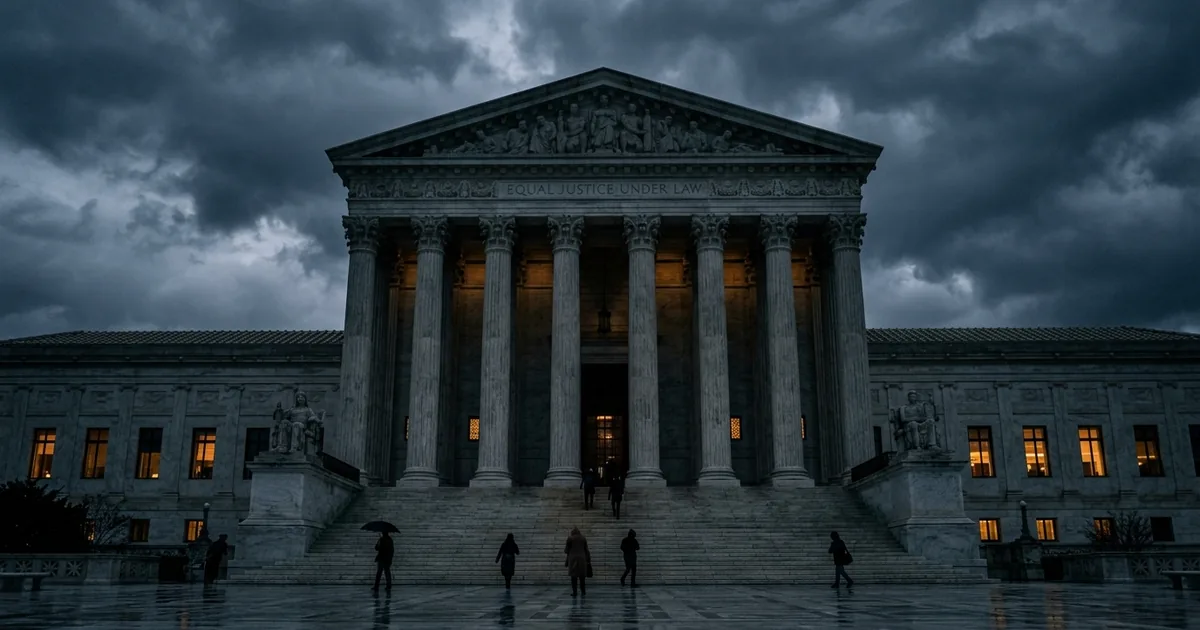
The Supreme Court ruled Monday that states can bar transgender girls and women from competing on school sports teams that match their gender identity, delivering the most consequential decision on transgender rights in years and handing the conservative legal movement a victory it has pursued for half a decade.
The 6-3 decision means that biological sex, not gender identity, is the controlling category under both Title IX and the Equal Protection Clause when it comes to school athletics.
What the Court Actually Decided
Justice Brett Kavanaugh, who has publicly spoken about coaching his daughters’ basketball teams, wrote the majority opinion in two consolidated cases: West Virginia v. B.P.J., involving 15-year-old Becky Pepper-Jackson, a transgender girl barred from her high school running team, and Little v. Hecox, centered on Lindsay Hecox, a transgender woman who wanted to compete on Boise State University’s track and cross-country teams.
Kavanaugh’s core holding is blunt: “The Constitution and Title IX do not require an overhaul of women’s and girls’ sports throughout America.” He argued that men and women have “inherent physical differences” in “height, weight, strength, speed, endurance, and jumping ability” and that “forcing female athletes to compete against males can create significant safety risks” in contact sports.
The majority found that both West Virginia’s and Idaho’s laws survive scrutiny under the Equal Protection Clause because they serve a legitimate state interest in competitive fairness and safety. On Title IX, all nine justices agreed that the federal education law permits sex-based eligibility rules in athletics.
The Dissent Reveals the Deeper Problem
Where the ruling fractures is on equal protection, and that fracture is where the real stakes live. Justice Sonia Sotomayor, joined by Justices Kagan and Jackson, concurred on the Title IX question but dissented sharply on whether the Court should have resolved the constitutional claim at all.
Sotomayor’s argument is that the majority reached the equal protection question without adequate facts. She would have sent the case back for more fact-finding on whether athletes like Pepper-Jackson, who has identified as female since the third grade and has been on puberty blockers, are “similarly situated to cisgender girls” in athletic terms. Her conclusion landed hard: states “can deny B.P.J. and others like her” the benefits of playing sports “simply because it thinks they have an inherent athletic advantage, even if the facts show that they do not.”
Put plainly, three justices told the country that the majority chose ideology over evidence. That the Court skipped the factual record to reach a culture-war conclusion.
Why This Ruling Reaches Far Beyond the Playing Field
The structural why here is not about high school track meets. It is about which definition of sex controls American law.
Idaho was the first state to pass a transgender athlete ban in 2020. Since then, 25 additional states have enacted similar restrictions, most in the last three years. Monday’s ruling does not just bless those laws. It provides the constitutional scaffolding for states to extend biological-sex-only frameworks into any domain currently governed by Title IX or equal protection analysis: bathrooms, locker rooms, housing, healthcare access, and employment protections that have evolved through administrative interpretation rather than statute.
The conservative legal strategy here was never limited to sports. Sports was the wedge, the most publicly sympathetic framing for a broader project: locking the legal meaning of “sex” to the sex assigned at birth, before the courts or Congress could codify a broader definition. Monday’s opinion accomplished that at the highest level of American law.
Kavanaugh tried to soften the landing, writing that transgender girls and women deserve “respect” and should not be “ostracized or vilified.” But respect is not a legal standard. It confers no rights, triggers no scrutiny, and provides no remedy. For Becky Pepper-Jackson, who has lived as a girl since elementary school, respect means she is free to attend the meets. She just cannot run in them.
The Immediate Fallout
President Trump called the decision a “BIG WIN” on Truth Social within minutes of the ruling. The political dynamics are predictable: red states will accelerate enforcement of existing bans, and several legislatures already have bills extending biological-sex definitions into non-athletic contexts.
For the 26 states with bans on the books, the legal challenge pathway just narrowed to almost nothing. Lower courts that had issued injunctions or expressed skepticism now have binding precedent. The appeals court that ruled the transgender military ban unconstitutional earlier this month is operating in an entirely different legal environment after Monday.
Civil rights organizations, including the ACLU and the Trevor Project, signaled they would continue challenging individual state implementations, but the constitutional floor has dropped. Any future litigation will have to work within Kavanaugh’s framework rather than around it.
What Comes Next Is Already in Motion
The question the Court answered Monday was never really whether transgender girls could run track. It was whether the Constitution protects gender identity the way it protects biological sex. Six justices said no. That answer will reverberate through every federal courthouse, every state legislature, and every school board in the country for years.
Sotomayor’s dissent will read better with time. “The facts do not matter, even though the consequences are serious” is the kind of line that ends up in law school casebooks, usually in chapters about how the Court got it wrong.