
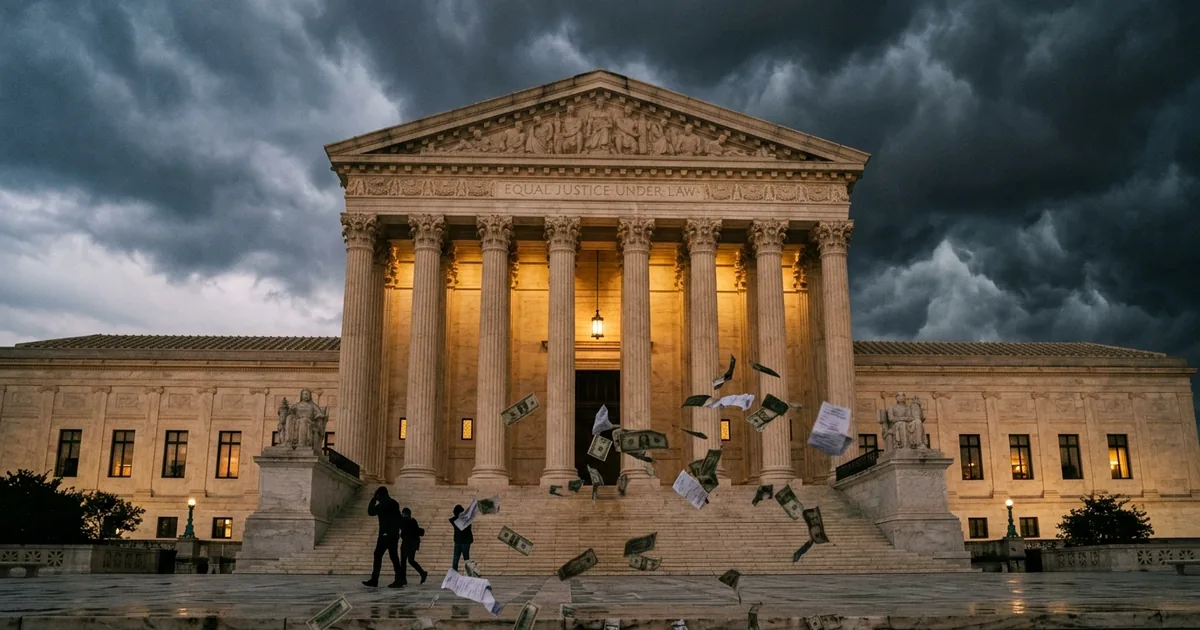
The Supreme Court handed the Republican Party a massive tactical advantage on Tuesday, striking down a 50-year-old federal law that limited how much political parties could spend in direct coordination with their candidates.
The 6-3 ruling, arriving just months before November’s midterm elections, is already being called the most consequential campaign finance decision since Citizens United.
What the Court Actually Did
Justice Brett Kavanaugh, writing for the majority in National Republican Senatorial Committee v. Federal Election Commission, ruled that the 1974 limits on coordinated party-candidate spending violate the First Amendment. The decision overturns the court’s own 2001 precedent in FEC v. Colorado Republican Federal Campaign Committee, which had upheld those same restrictions by a single vote.
The case originated with a challenge filed by then-Senate candidate JD Vance and the National Republican Senatorial Committee. The argument was straightforward: political parties exist to elect candidates, and capping how much they can spend doing exactly that amounts to unconstitutional speech suppression. Kavanaugh agreed, writing that political parties occupy a “unique and constitutionally protected role” in American democracy.
Follow the Money
Here is why this matters beyond the legal abstraction. Before this ruling, parties could spend unlimited amounts on independent advertising but faced strict caps on spending that was coordinated directly with a campaign. That distinction forced parties to maintain a fiction of separation, creating a cottage industry of technically-independent-but-obviously-aligned spending operations.
Now that wall is gone. National party committees can funnel unlimited funds directly into a candidate’s messaging operation, ad buys, and ground game. The practical effect is that the Republican and Democratic national committees become extension offices of their strongest candidates’ campaigns.
Why the GOP Wins Twice
The timing is not accidental. Republicans have consistently outraised Democrats at the national party committee level, and this ruling lands precisely when that fundraising advantage converts most efficiently into electoral power. As CNN’s analysis noted, the decision “handed Republicans a major political victory just ahead of this fall’s midterm elections.”
The structural advantage runs deeper than any single cycle. Removing coordinated spending caps makes parties the most efficient vehicle for big-dollar donors who previously had to route money through a maze of PACs and super PACs. The party apparatus becomes a one-stop shop for the donor class, concentrating financial power inside institutions that already answer primarily to their biggest contributors.
Kagan Saw It Coming
Justice Elena Kagan’s dissent cut through the majority’s First Amendment framing to name the actual mechanism at work. “With no limits on coordinated expenditures, the party can serve as the candidate’s checking account,” she wrote. The analogy is deliberately blunt: when a party can spend in lockstep with a candidate, the legal distinction between a party contribution and a direct donation evaporates.
Kagan’s concern is not theoretical. The 1974 limits were enacted in the wake of Watergate, specifically because unlimited coordinated spending had enabled the kind of transactional corruption that brought down a presidency. The majority opinion does not grapple seriously with that history.
What Changes Practically
For voters watching ads this fall, the shift will be invisible. The same 30-second spots will air during the same commercial breaks. But the machinery behind those ads changes fundamentally. A Senate candidate in a competitive race can now sit down with the party’s media team, share internal polling, coordinate message timing, and deploy the party’s entire war chest in service of a unified strategy. Before Tuesday, that meeting was illegal.
That efficiency advantage compounds in down-ballot races. House candidates in competitive districts who lack the fundraising muscle to compete with self-funding opponents can now tap the party’s coordinated spending apparatus directly. The party decides which races get resourced and which get starved, a power dynamic that strengthens leadership’s grip on its own members.
The Bigger Pattern
This ruling fits a trajectory the Roberts Court has been carving since 2010’s Citizens United: systematically dismantling the post-Watergate campaign finance architecture on First Amendment grounds. Each decision treats political spending as pure speech while declining to weigh the corrupting influence of that spending on democratic governance. The result is a campaign finance landscape where the only remaining constraints are disclosure requirements that are themselves under legal challenge.
The question heading into November is not whether more money will flood the system. It will. The question is whether voters notice the difference between a party-funded ad and a candidate-funded one, or whether the distinction ever mattered to anyone outside the FEC’s compliance offices.