
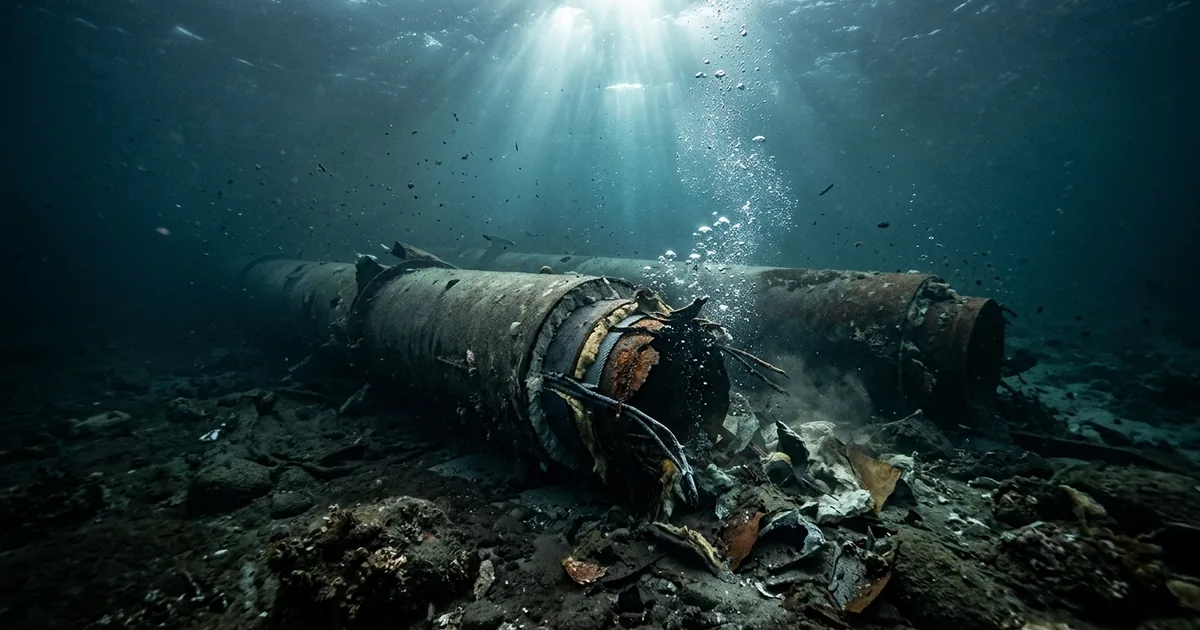
German prosecutors have charged a Ukrainian national with war crimes over the 2022 destruction of the Nord Stream gas pipelines, marking the first criminal indictment in one of the most consequential acts of infrastructure sabotage in modern European history.
The suspect, identified as Serhii K., is a 46-year-old former officer of Ukraine’s Security Service (SBU) who allegedly commanded the seven-person team that planted explosives on the undersea pipelines in the Baltic Sea.
The Case That Took Nearly Four Years to Build
The Federal Prosecutor’s Office in Karlsruhe announced the charges on Tuesday, accusing Serhii K. of attacks on civilian energy infrastructure, causing an explosives detonation, and demolition of built structures. The charges carry a war crimes designation because the sabotage occurred during the active armed conflict between Russia and Ukraine, as Euronews reported.
Serhii K. was arrested in the summer of 2025 while in Italy and extradited to Germany that November. He is currently detained in Hamburg, where the trial is expected to take place. Prosecutors described the evidence against him as “overwhelming,” bolstered by phone calls the suspect allegedly made to relatives and acquaintances while in Italian custody that proved self-incriminating, according to The National.
What the Charges Actually Tell Us
The structural significance of this indictment goes far beyond one man in a Hamburg courtroom. Germany is asserting criminal jurisdiction over an act carried out by an intelligence operative of a nation it actively supports with military aid, billions in economic assistance, and vocal diplomatic backing. That is the tension this trial will force into the open.
The Nord Stream 1 and 2 pipelines were not abstract infrastructure. They were the physical arteries of Europe’s energy relationship with Russia, carrying natural gas directly from Russian fields to German processing facilities under the Baltic Sea. When explosions ripped through three of the four pipeline strings on September 26, 2022, they didn’t just sever gas supply lines. They destroyed the last structural incentive Russia had to negotiate energy access as a lever for de-escalation, and they handed Moscow a permanent grievance about Western-allied sabotage of Russian state assets.
For Germany specifically, the pipelines represented a multi-billion-euro investment in energy security that Berlin had defended for years against fierce American and Eastern European opposition. The sabotage wiped that bet off the board overnight and accelerated Europe’s scramble to replace Russian gas with costlier alternatives from the United States, Norway, and global LNG markets.
The Uncomfortable Alliance Question
The prosecution puts Germany in an extraordinarily awkward diplomatic position. Ukraine remains the frontline state in Europe’s most significant security crisis since the Cold War, and the broader Western alliance has spent tens of billions arming and financing Kyiv’s defense. Charging a Ukrainian intelligence operative with war crimes for destroying German infrastructure isn’t just a legal proceeding. It is a public test of whether the rule of law applies uniformly within the Western alliance, even when the accused acted in what Kyiv may argue was wartime strategic interest.
Investigators allege Serhii K. led the operation aboard a yacht, coordinating the placement of explosives at the bottom of the Baltic Sea. The seven-member team he allegedly commanded carried out the attack in a way that initially left investigators uncertain whether Russia itself had destroyed its own pipelines as an escalatory tactic, whether Ukraine had acted unilaterally, or whether a rogue operation had gone forward without state authorization.
The fact that German prosecutors are pressing war crimes charges, not merely property destruction or terrorism, signals that Berlin views the sabotage as an act embedded within the broader armed conflict. That classification carries heavier sentences, but it also implicitly frames Ukraine’s intelligence services as actors in a war whose battlefield extends to allied nations’ critical infrastructure. That framing will reverberate in every European capital that hosts pipelines, undersea cables, or energy terminals, as the broader investigation context from the BBC makes clear.
What Comes Next
The trial itself will be watched far beyond Germany. It will likely surface classified intelligence assessments, operational details about how the attack was planned and executed, and potentially uncomfortable questions about what Western intelligence agencies knew before September 2022 and whether any warnings were shared or suppressed.
For Ukraine, the diplomatic calculus is delicate. President Zelensky has previously denied any Ukrainian state involvement, and Kyiv’s official position has been that it had no connection to the operation. Whether that position holds under the weight of what prosecutors describe as overwhelming evidence will shape not just the trial’s outcome but the texture of European solidarity with Ukraine as the war with Russia continues to grind forward.
The ongoing Russian drone and missile campaign against Ukrainian cities provides the backdrop against which this trial will unfold. Both the infrastructure sabotage and the aerial bombardment are expressions of the same conflict. But only one of them is being prosecuted in a Western courtroom, and that asymmetry will be the subtext of every hearing in Hamburg.
Germany’s message, whether Berlin intended it or not, is unmistakable: alliances do not immunize allies from criminal accountability when they destroy your infrastructure. Whether that principle survives contact with the geopolitical pressures of a live war is the question this trial will answer.