
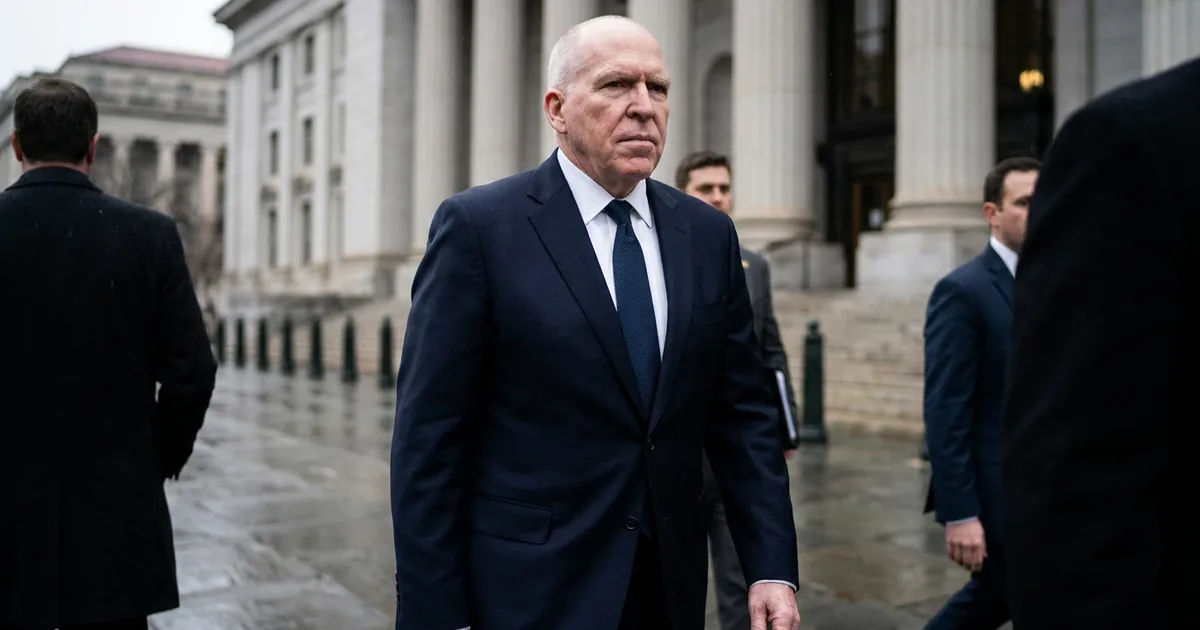
Former CIA Director John Brennan sued the Justice Department, the White House, and Acting Attorney General Todd Blanche this week, demanding a federal court order that they preserve every record tied to two criminal investigations into him.
He has not been charged with anything, and that is precisely the point: Brennan is building the defense before the indictment arrives.
A Lawsuit Filed Against Charges That Do Not Exist Yet
The 46-page complaint, filed Wednesday in federal court in Washington, does not ask a judge to stop the investigations or clear his name. It asks the government to hold on to its own paperwork. Brennan’s lawyers want the DOJ, the White House, the Office of the Director of National Intelligence, and the CIA barred from destroying “materials and communications potentially relevant to Director Brennan’s legal and constitutional challenges to any future criminal charges,” as CBS News reported.
Read that phrase again. Future criminal charges. Brennan is telling a court, on the record, that he expects to be indicted, and that when he is, he intends to prove the case against him was manufactured as political revenge. The records-preservation suit is the scaffolding. It forces the administration to freeze the internal trail of how these probes were built, before anyone in the building has an incentive to make that trail disappear.
Two investigations hang over him, both born in the opening months of Trump’s second term. One alleges Brennan lied to Congress in 2023 about the intelligence community’s assessment of Russian interference in the 2016 election. The other is a sprawling “grand conspiracy” probe examining whether Obama- and Biden-era officials ran a years-long plot to keep Trump out of office. Neither has produced a charge. Both have produced grand jury activity, which is what gives Brennan standing to worry about the paper.
The Real Allegation Is About How the Sausage Gets Made
Strip away the procedural framing and the complaint is an indictment of the Justice Department itself. Brennan’s team lays out a pattern of conduct that reads less like law enforcement and more like a search for someone willing to sign the charging document.
The filing accuses officials of “issuing pronouncements that evince a pre-conceived belief in Director Brennan’s guilt,” of “removing or sidelining career prosecutors who have balked at using the criminal process to promote the President’s retribution agenda,” and of “engaging in forum-shopping by moving the investigations from federal district to federal district” alongside “judge-shopping.” That last detail is the tell. Prosecutors with a real case do not tour the country looking for a more agreeable venue. They bring it where the conduct happened. Moving a probe from district to district is what you do when the first prosecutor said no.
This is the structural rot the lawsuit is designed to expose. A functioning Justice Department has a built-in brake: career prosecutors who decline to bring cases they cannot win, and who answer to norms older than any administration. Brennan’s complaint alleges those brakes are being cut one by one, the professionals reassigned until someone compliant remains. When the person running the department is Todd Blanche, who served as Trump’s personal criminal defense lawyer before taking over the Justice Department, the conflict is not hidden in the machinery. It is the machinery.
Why the Courts Suddenly Look Like the Safer Bet
Brennan is not improvising. He is following a path other targets have just finished clearing. The timing of his suit tracks a run of judicial rulings that have started treating Trump-era subpoenas as retaliation rather than routine process.
Last week, a federal judge in Minnesota quashed six grand jury subpoenas the administration had served on state and local government offices, finding them retaliatory and unlawful, Axios noted. In March, a judge in Washington threw out subpoenas aimed at the Federal Reserve Board, ruling they were a pretext to pressure the chairman. Each ruling chips at the presumption of regularity, the legal default that assumes prosecutors act in good faith. Once a court accepts that a subpoena can be pure retaliation, the door opens for defendants to demand the receipts.
That is the opening Brennan is walking through. His argument mirrors the one that former FBI Director James Comey and New York Attorney General Letitia James made when they fought their own indictments as vindictive and selective, cases whose eventual collapse we broke down when the dismissals came down. The difference is sequencing. Comey and James litigated after they were charged, on the government’s timeline. Brennan is litigating first, on his own, refusing to wait for the machine to finish assembling a case before he starts documenting how it was assembled.
The Precedent Everyone Should Watch
There is a version of this story that treats it as one aggrieved official using the courts to make noise. That reading misses what a records-preservation suit actually does. It converts the administration’s internal deliberations into potential evidence, and it does so while those deliberations are still happening. If a judge grants the order, every email debating whether to charge Brennan, every reassignment of a reluctant prosecutor, every venue change becomes a document the government must keep and may eventually have to hand over.
For an administration that has treated the Justice Department as an instrument of settling scores, that is a genuine constraint, maybe the only kind that has worked. The ongoing remaking of the federal bureaucracy has run into few walls it could not climb. A court order to preserve the evidence of one’s own bad faith is a wall built out of the administration’s own paperwork.
The question now is whether the judge sees it Brennan’s way, and whether the growing bench of jurists willing to call retaliation by its name extends to a plaintiff who has not been charged. If the order comes down, expect a line of other targets to file the same motion within the week. The retribution agenda depends on the process staying opaque. Brennan just asked a court to turn on the lights.