
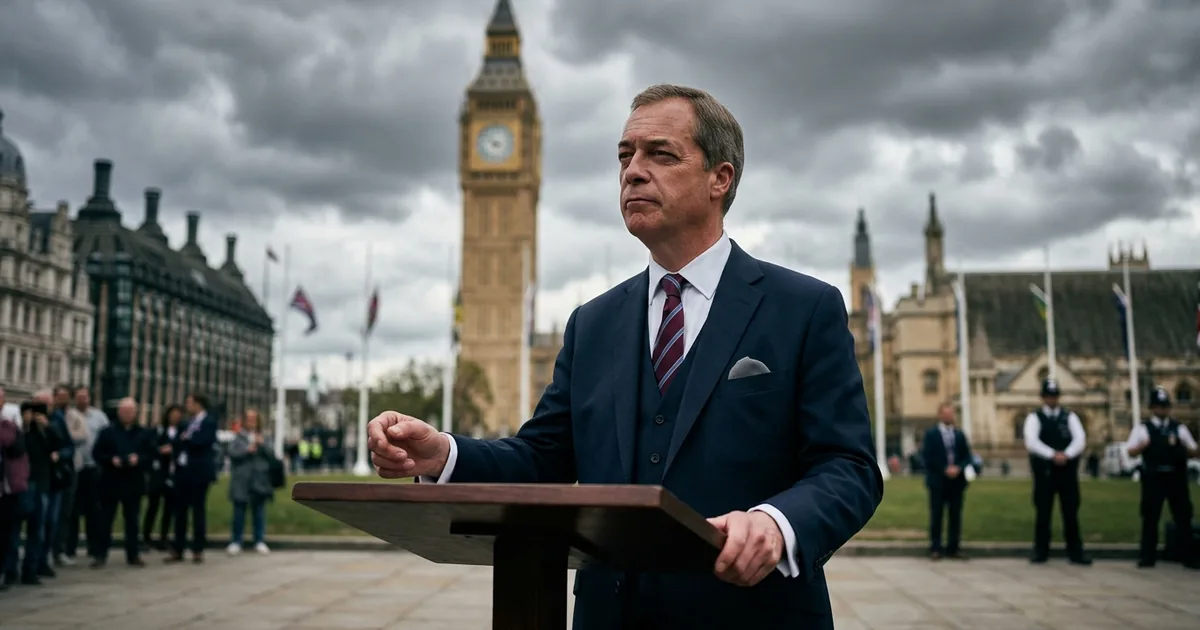
Reform UK leader Nigel Farage quit as the member of parliament for Clacton on Monday, forcing a by-election he says he will “fight to win” while a parliamentary standards investigation into undeclared donations hangs over his political future.
It is a calculated gamble that trades institutional accountability for a populist mandate, and it tells you everything about how Farage has always operated.
The Money Trail That Forced the Move
The resignation follows weeks of intensifying scrutiny over the financial backing that powered Farage’s path to Westminster. Al Jazeera reported that the Parliamentary Commissioner for Standards, Daniel Greenberg, opened a formal probe into undeclared gifts Farage received in the run-up to the 2024 general election, when he won a seat in the House of Commons for the first time in his career.
At the center of the probe sits a 5 million pound contribution (roughly $6.7 million) from Christopher Harborne, a Thailand-based cryptocurrency investor whose financial ties to Farage had not been properly disclosed. Separately, The Sunday Times revealed that Farage received financial support from George Cottrell, a political ally convicted of wire fraud in the United States in 2017. Cottrell pleaded guilty to one count of wire fraud as part of a plea deal after being arrested by the FBI at a Chicago airport.
Farage, in a pre-recorded statement distributed by Reform UK with no opportunity for media questions, insisted he had “not broken the law in any way at all” and had “not misused public money.” He framed the standards investigation as a political weapon: “Parliamentary standards are being used as a political tool against me.”
The Strategic Logic: Resign to Escape, Win to Reset
Here is the structural why that makes this resignation more than a protest gesture. Under parliamentary rules, the Commissioner for Standards can only investigate sitting MPs. The moment Farage vacates his Clacton seat, Greenberg’s probe effectively suspends. If Farage wins the by-election (and given that Reform UK has led most UK opinion polls since April 2025, the odds favor him), he returns to Westminster with a fresh democratic endorsement that makes resuming the investigation politically radioactive.
It is the populist playbook executed with precision. When institutions threaten accountability, go over their heads to “the people.” Let the voters be judge and jury so the actual investigators never get to finish their work. Farage said as much explicitly: “I will let the people of Clacton be the judges of my actions.”
The maneuver carries echoes of how political figures on both sides of the Atlantic have learned to weaponize elections as shields against institutional scrutiny. The question is not whether Farage broke donation rules. The question is whether the system is structured to let a popular enough politician simply outrun the enforcement mechanism, and the answer, today, appears to be yes.
What Reform UK’s Poll Position Means for the Gamble
The timing is not accidental. Reform UK’s sustained polling lead makes Clacton one of the safest by-election bets in recent British political history. Farage is not risking his career. He is stage-managing a public vindication that doubles as a campaign rally.
The broader implication matters beyond one constituency. Reform UK is polling as the likely winner of the next general election. Its leader treating a parliamentary ethics probe as something to be outmaneuvered rather than answered sets a precedent for how the party would govern. If the man who would be prime minister treats accountability mechanisms as “political tools” to be gamed before he even holds executive power, the pattern is unlikely to improve with a Downing Street address.
The Trump Parallel Is Not Coincidental
Farage’s close relationship with Donald Trump is well documented, and the resignation playbook borrows from the same strategic vocabulary. Treat legal and institutional processes as persecution, reframe compliance as weakness, and convert every accountability moment into a campaign rally. Trump faced his own financial scrutiny questions while turning investigations into fundraising fuel. Farage is running the British version with a parliamentary twist.
The pre-recorded statement with no press questions was itself a tell. A politician confident in their financial disclosures takes questions. A politician managing a narrative distributes a produced video and disappears into campaign mode.
What Happens Next
The by-election timeline is now in the hands of the House of Commons Speaker. Clacton voters will decide whether Farage returns to parliament, and every poll suggests they will. The standards investigation will sit in limbo until that outcome is clear.
The real test comes after. If Farage wins, does Greenberg resume the probe into undeclared donations, knowing the political cost? Or does a democratic mandate effectively function as an amnesty for financial disclosure failures? British parliamentary democracy is about to run that experiment in real time, and the answer will shape how every future MP calculates the cost of transparency.