
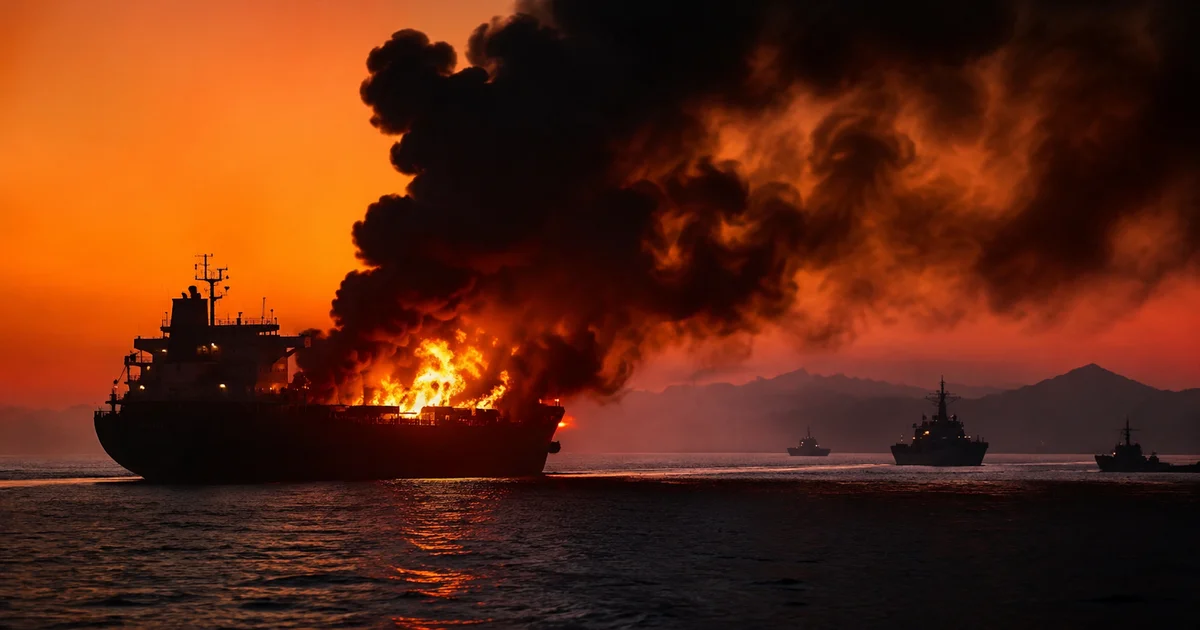
A cargo ship is burning in the Strait of Hormuz, its crew rescued from the water while global fuel markets absorb another shock, and the diplomatic framework that was supposed to prevent exactly this has quietly collapsed.
The US-Iran conflict has escalated into a new and arguably more dangerous phase, and the reason it keeps escalating is the same reason it started: neither Washington nor Tehran is willing to give up control of the 21-mile chokepoint that moves roughly 20 percent of the world’s oil.
How the Ceasefire Fell Apart
The June 25 Iranian drone strike on a cargo vessel was the triggering incident, but calling it the cause would be letting everyone off easy. The ceasefire agreement was already fragile because it was built on a misalignment about what “de-escalation” actually required. Iran read it as a pause. The US read it as surrender of Iranian interdiction capability. Neither reading was wrong, which is what made the deal structurally impossible to hold.
Once the drone hit the cargo ship, the US expanded its strikes beyond the strait itself. Northern Iran is now in the targeting envelope, which is a significant geographic and strategic expansion. Hitting targets far from the waterway signals that the US is no longer constraining its response to protecting maritime traffic; it’s now treating the broader Iranian military infrastructure as a legitimate target set. That changes the logic of the conflict entirely.
Iran, for its part, says the US strikes since hostilities resumed have killed more than 46 people and wounded over 400. Those are the Iranian government’s numbers, and they should be treated with the same skepticism any government’s casualty figures deserve during an active conflict. But the trajectory is clear: the human cost is rising on the Iranian side, and Tehran has responded by claiming the destruction of tankers in the waterway.
As Al Jazeera reported on the ship ablaze in the strait, crew members were pulled from the water alive. The UK Maritime Trade Operations agency confirmed the fire. These incidents are no longer exceptional; they’re becoming the operational rhythm of the conflict.
The Strait Is Not Negotiable (for Either Side)
The reason this keeps escalating, despite ceasefire attempts, is that the Strait of Hormuz is not a negotiating chip. It’s the whole game.
For Iran, the ability to threaten, interdict, or close the strait is its single most powerful lever against the United States and its Gulf partners. Iran’s conventional military cannot win a direct confrontation with the US. But a credible threat to disrupt global oil flows gives Tehran asymmetric power that it simply cannot afford to surrender at the negotiating table. Any ceasefire that leaves Iran with that capability intact is unacceptable to the US. Any ceasefire that strips Iran of it is unacceptable to Tehran.
For the US, allowing Iran to demonstrate that it can hit cargo vessels with impunity would effectively signal the end of freedom of navigation as a norm the American military enforces. That has downstream implications not just for Gulf oil but for how every adversary calculates what the US will and won’t defend. The symbolic stakes are as large as the material ones.
This is the structural trap that makes the diplomatic efforts to salvage the ceasefire so difficult to watch. Both sides have real interests that are genuinely incompatible, and every cycle of attack and retaliation makes each side’s domestic politics harder to manage. The Iranian government cannot be seen ceding the strait. The US administration cannot be seen tolerating attacks on commercial shipping.
What “Expanding to Northern Iran” Actually Means
The geographic expansion of US strikes deserves more attention than it’s getting. Hitting targets in northern Iran is not the same as defending the strait. It’s a different kind of message, one that says the US is no longer operating under a purely defensive frame.
There are two ways to read this. The optimistic read is that the US is trying to degrade the command-and-control infrastructure that directs drone attacks on shipping, which would theoretically reduce the threat to the waterway over time. The pessimistic read is that it’s a deliberate escalation intended to raise the cost for Iran, in hopes of forcing a more durable diplomatic settlement.
The problem with the pessimistic read, as the Times of Israel has noted in its coverage of the expanding conflict, is that raising costs for Iran has historically not produced the behavioral change the US wants. Iran has absorbed significant economic and military pressure over decades. The nuclear deal era aside, sanctions and strikes have generally produced Iranian hardening, not capitulation.
Global Trade Is Already Feeling It
While the strategic arguments play out, the economic effects are not waiting. Fuel prices are rising. Shipping insurers are reassessing their exposure to Gulf routes. Vessels are rerouting around the strait where possible, which adds time and cost. The disruptions that Arab News has documented across regional trade flows illustrate how quickly a military confrontation in 21 miles of water can ripple into grocery store prices and logistics timelines globally.
This is also, it’s worth saying, a feature rather than a bug from Tehran’s perspective. Every percentage point increase in oil prices, every rerouted vessel, every spiking insurance premium is Iran demonstrating that it has leverage. Strangling that leverage is exactly what makes the conflict so intractable.
The Democratic Institutions Question No One Is Asking Loud Enough
There is a domestic dimension here that deserves more scrutiny. The US expansion of strikes to northern Iran represents a significant military operation with major geopolitical consequences. The question of what congressional authorization of US military operations in the region exists for these operations, and whether the current administration’s war powers usage is being adequately reviewed, is not a secondary concern.
History suggests that military escalations that begin as “defensive operations” have a way of becoming something larger without the institutional checkpoints that are supposed to slow them down. The ceasefire’s collapse happened fast. The expansion to northern Iran happened fast. The institutional mechanisms designed to slow these decisions and force deliberation seem to be running at a different speed than the conflict itself.
That gap, between the pace of military operations and the pace of democratic accountability, is where the most consequential decisions tend to get made by the fewest people.
Where This Goes From Here
Efforts to salvage a ceasefire are reportedly continuing. That’s the diplomatic phrase for “nobody is ready to admit this is over, but nobody has a workable proposal either.” The fundamental incompatibility hasn’t changed. What’s changed is that both sides have now demonstrated a willingness to escalate past what the previous round of negotiations contained, which means any new agreement would need to be more durable, not less, while being built on a more damaged foundation.
The ship burning in the strait is not a symbol. It’s a data point. The question worth watching is whether the next data point comes from a diplomatic channel or from a flight path over a new Iranian province.