
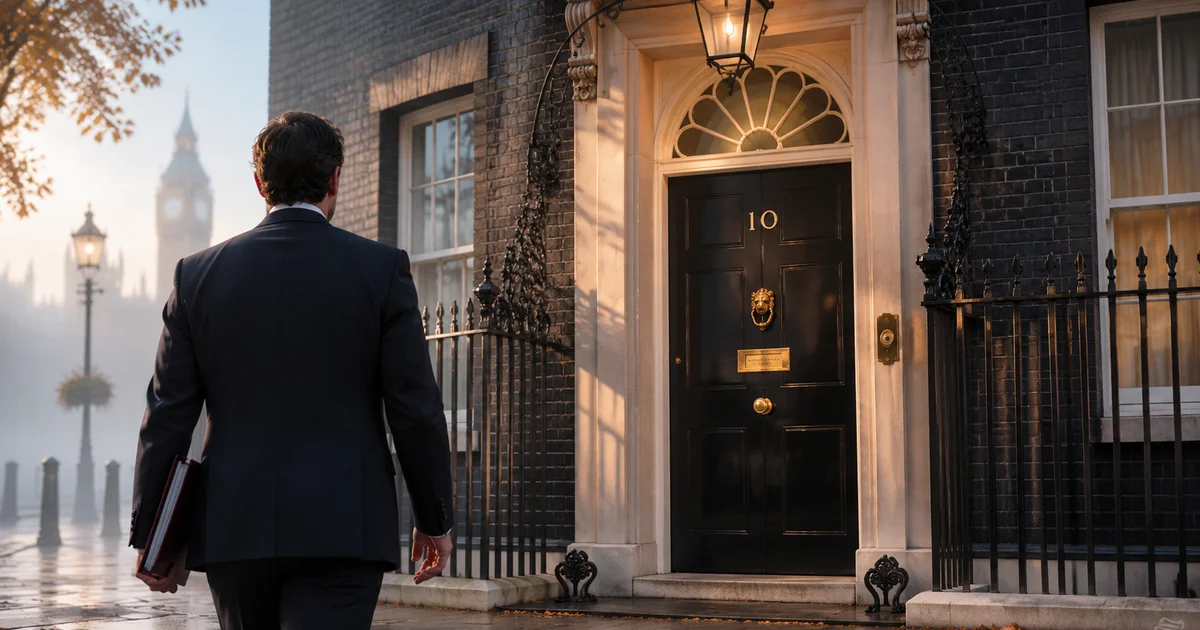
Andy Burnham becomes the UK’s 59th Prime Minister on Monday, July 21, succeeding Keir Starmer and inheriting a country that has burned through seven heads of government in ten years.
The sheer arithmetic of that turnover is the real political crisis, and Burnham’s improbable path from the mayor’s office in Manchester back to Downing Street is its most vivid symptom.
From “King of the North” to Number 10
There is something almost literary about the route Burnham has taken. He left Westminster nearly a decade ago after a bruising 2015 Labour leadership run that ended in defeat to Jeremy Corbyn. He went north, became Greater Manchester’s metro mayor, and rebuilt himself entirely outside the parliamentary bubble. He became locally beloved, won a high-profile standoff with Boris Johnson over pandemic funding in 2020, and cultivated a following that national politicians spent years trying to replicate. Most assumed he’d stay in Manchester forever.
Then Starmer resigned in June, and everything accelerated. Burnham returned to Parliament only weeks ago, ran for Labour leader unopposed, and as NBC News reported, was formally declared leader on July 17. He meets King Charles III on Monday to receive the commission to form a government.
The opposition put up no candidate. That tells you something about the state of British politics right now.
Why Seven Prime Ministers in Ten Years Is a Systems Failure
To understand why Burnham’s elevation matters, you have to stop treating each individual PM’s departure as a personal story and start reading the pattern.
David Cameron resigned after losing the Brexit referendum in 2016. Theresa May ground herself down trying to pass a withdrawal agreement Parliament kept rejecting. Boris Johnson fell to a cascade of ethics scandals. Liz Truss lasted 45 days after her mini-budget caused a gilt market meltdown. Rishi Sunak called an election he had to call and lost it badly. Starmer came in promising stability and left before completing a full term.
Seven leaders. A decade. As NPR has noted in its coverage of British political instability, the UK’s political system is now cycling through prime ministers at a rate that makes structural reform nearly impossible. Each new government inherits the wreckage of the last, finds its agenda constrained by fiscal reality, and then gets consumed by whatever crisis it failed to anticipate.
That is the inheritance Burnham is walking into.
What “Rewiring Britain” Actually Means
His platform is not radical in the ideological sense. He has pledged to place the cost-of-living crisis “front and centre,” which is the kind of framing that polls well and covers a lot of ground. The phrase “rewire Britain” is doing significant work: it suggests structural change without committing to anything specific enough to frighten financial markets or backbench MPs.
One concrete move he has already made: dropping the digital ID scheme that his predecessor had floated. The decision was reported by Al Jazeera as a signal of his intent to distinguish himself from Starmer on civil liberties grounds, appealing to both left-libertarian voters and the traditional Labour base that never warmed to technocratic governance projects.
His Manchester years offer better clues than his current positioning. As metro mayor, he pushed hard on transport funding, homelessness, and regional economic equity. He was willing to fight publicly with central government when he thought they were shortchanging the North. He is not a Blairite triangulator or a Corbynite ideologue. He occupies a space that doesn’t map cleanly onto the internal Labour factions that consumed the party for the better part of a decade.
That is either his greatest asset or his central vulnerability, depending on how Parliament shapes up over the next six months.
The Outsider Who Was Always Inside
There is a ready-made narrative about Burnham as an outsider, and it is partly true and partly myth. He did leave Westminster. He did rebuild his political identity outside London. But he was also a Cabinet minister under Gordon Brown, served as Shadow Home Secretary, and ran for Labour leader twice. He is not someone who was ever genuinely outside the system. He just left one room of it and spent nine years in another.
What the Manchester years gave him is different from outsider status. They gave him a record. Not a record of parliamentary votes or committee appearances, but a record of actually governing something, managing a budget, dealing with public services in real time, and being accountable to people who see you at the supermarket. That is rarer among British prime ministers than it should be.
The risk is that the governing record he has is primarily regional and the challenges awaiting him are national and international. The NHS. The housing crisis. The UK’s post-Brexit trade posture. Relations with the Trump administration in Washington, which CNN has described as increasingly transactional toward European partners. A public that has been promised stability by each of the last six prime ministers and received something considerably less.
The Precedent Nobody Wants to Say Out Loud
Britain’s revolving-door premiership has created a feedback loop. Each prime minister who fails accelerates the next succession, shortens the time horizon for any government that follows, and deepens voter fatigue. Governing becomes harder when your authority is partly contingent on how long the last person managed to stay.
Burnham’s uncontested leadership election is both a sign of Labour unity and a warning about what that unity might conceal. Parties often close ranks when they’re worried, not when they’re confident. The fact that no serious candidate challenged him for the leadership suggests either that the party is genuinely behind him or that potential rivals are waiting to see what the first year looks like before deciding whether to position themselves.
The contrast with the Tories is real but should not be overstated. Labour is more stable. It is not obviously stable.
What Burnham brings that none of his immediate predecessors quite managed is a politics that is legible to people outside London, a personal story that connects to the places where Labour lost seats it used to hold as a matter of course, and a willingness to talk about regional inequality in terms that go beyond infrastructure spending announcements. Whether that translates into governing capacity is the question that Monday’s handshake with the King only begins to answer.
A man who spent years running one of Britain’s great cities now has to run the country. The question is whether the lessons he learned in Manchester, about fighting for funding, about building coalitions outside Westminster, about talking to people who feel ignored by the capital, will travel. Or whether Britain simply adds a new chapter to a pattern that has been repeating for a decade: high hopes, structural constraints, early promise giving way to diminishing returns, and another resignation that leaves the country exactly where it started.