
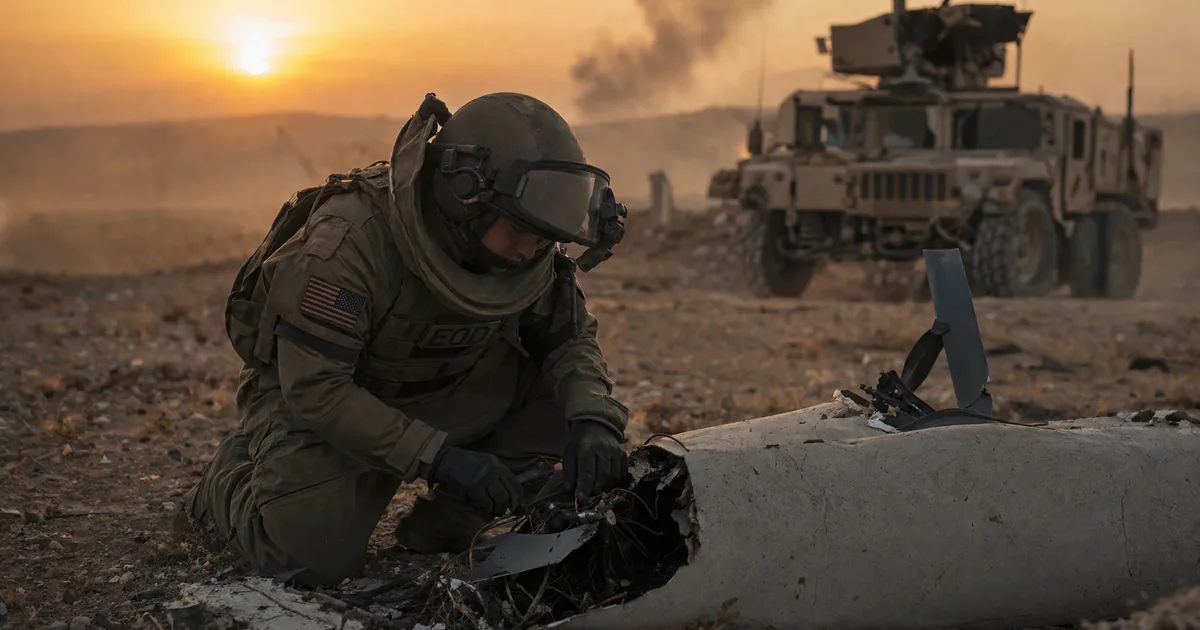
A U.S. service member was killed in northern Iraq on Friday while conducting a controlled detonation of unexploded ordnance from a downed Iranian one-way attack drone, U.S. Central Command confirmed on Sunday.
A second service member was wounded and is receiving treatment for what the military described as a minor injury.
The death came just one day after two American troops were killed and another went missing during ballistic missile and drone attacks on a U.S. base in Jordan, an attack that prompted President Trump to order a fresh round of retaliatory strikes against Iran on Saturday evening. The pace of American casualties is accelerating, and the strategic logic behind keeping troops in exposed forward positions across the Middle East is growing harder to defend.
Seventeen Dead, Over 430 Wounded, and No Off-Ramp in Sight
The Iraq death brings the total number of U.S. service members killed since the war with Iran began to approximately 17, with more than 430 wounded across the conflict, according to CBS News. CENTCOM is withholding the identities of the killed and missing out of respect for their families during the notification process. Unidentified remains found Sunday at the Jordan base are still being evaluated.
What makes this particular death so telling is the circumstance. This was not a combat engagement or a base under fire. A service member was killed by the very weapon the U.S. had already neutralized, a downed drone that detonated during disposal. The threat is not just from active Iranian strikes but from the vast debris field of unexploded ordnance those strikes leave behind across Iraq, Jordan, Kuwait, and the broader theater.
Trump Orders More Strikes, but the Cycle Keeps Spinning
Saturday evening’s U.S. airstrikes, ordered at Trump’s direction, targeted underground weapons storage facilities, surveillance sites, and Islamic Revolutionary Guard Corps assets inside Iran. The Pentagon said the strikes were designed to degrade Tehran’s ability to threaten commercial shipping through the Strait of Hormuz and to punish IRGC forces responsible for the Jordan attack, NPR reported.
But the retaliatory cycle has not produced deterrence. Iranian strikes continue to hit targets across the region: Kurdistan saw at least eight opposition fighters killed in Iranian attacks this week, and a water desalination plant and an oil facility in Kuwait were struck, CNN reported. Each American reprisal brings an Iranian counter-strike, which brings another American reprisal. The war is now entering its second week of sustained air operations, with no diplomatic channel open and no ceasefire framework on the table.
The Strait of Hormuz Is the Pressure Point
The underlying strategic contest remains control of the Strait of Hormuz, the chokepoint through which roughly a fifth of the world’s oil supply passes daily. Iran has used its drone and missile arsenal to threaten commercial shipping, and the U.S. has framed its strikes as necessary to keep the strait open. But keeping the strait open while absorbing a steady drip of troop casualties in Iraq, Jordan, and across the Gulf is a posture that tests both military sustainability and domestic political tolerance.
The geography of the conflict makes the troop-exposure problem structural, not incidental. American personnel are spread across bases in Iraq, Jordan, Kuwait, Bahrain, and Qatar, forward positions designed decades ago for counterterrorism operations and regional deterrence, not for sustained state-on-state warfare with a country that possesses ballistic missiles and mass-produced kamikaze drones. Every one of those bases is within range of Iranian weapons. The drone that killed the service member in northern Iraq was already shot down, and it still killed someone. That is the threat calculus the Pentagon is working with.
The broader fear, now stated openly by multiple defense analysts and regional governments, is that this is no longer a contained exchange of strikes but the opening phase of a wider war. Every additional American death strengthens the domestic pressure on the White House to escalate further, and every escalation gives Iran’s hardliners the justification they need to keep firing.
What Comes Next Is the Question No One Is Answering
Seventeen families have now received the worst possible news. The Pentagon continues to frame each death as an isolated incident within a broader deterrence strategy, but the pattern tells a different story: forward-deployed troops are absorbing the consequences of an air campaign that has not stopped Iranian attacks and may be provoking more of them.
The controlled-detonation death in Iraq is a grim reminder that even “successful” defense, shooting down a drone before it reaches its target, creates secondary risks that persist long after the immediate threat is neutralized. If the war continues on its current trajectory, the question is not whether more Americans will die, but how many casualties the public is willing to accept before demanding a strategy that goes beyond the strike-and-absorb loop.