
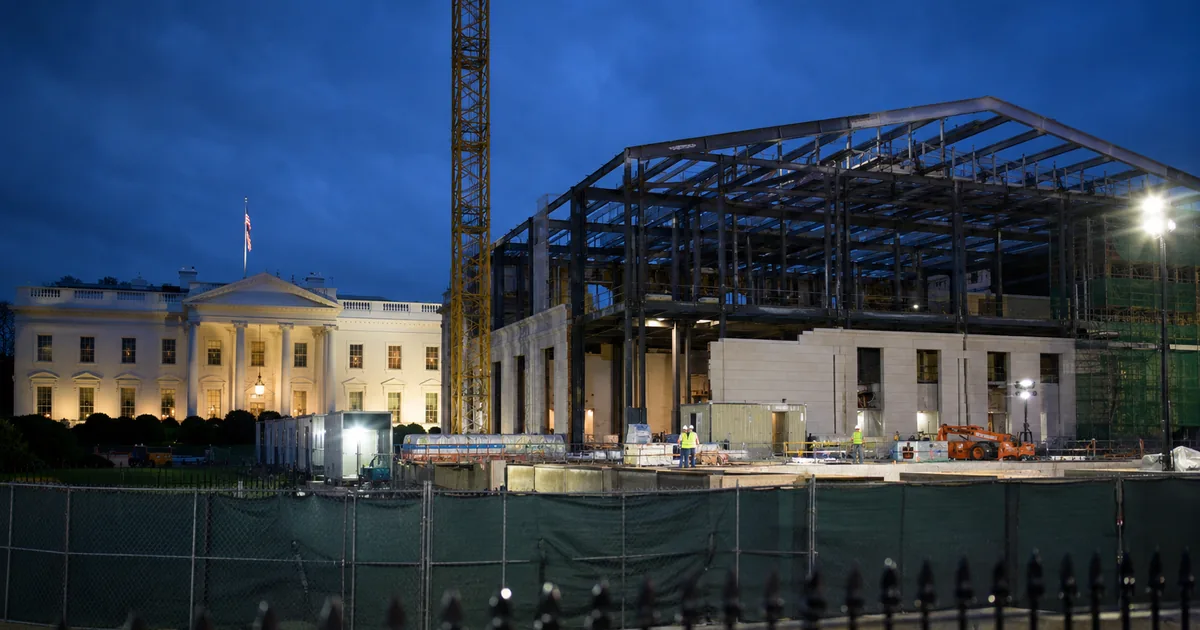
The Supreme Court cleared the way on Monday for President Donald Trump to finish his new White House ballroom, and the order that did it never says the project is legal.
It says something narrower and far more useful to the White House: that the people objecting have no right to be in court at all.
Nearly every account of the ruling has led with the outcome, which is that construction continues. The sentence that matters more is the one the majority wrote about what it was refusing to decide. On the question anyone has actually litigated, whether a president can demolish part of the White House and put up a nearly 90,000 square foot event space without Congress, four federal judges have now weighed in, and all four have said he probably cannot. One of them is the Chief Justice of the United States, who spent Monday in dissent.
The Order Decides Who May Sue, Not What Is Legal
The vote was 5 to 4. In an unsigned, eight-page order, NBC News reported, the conservative majority granted the Trump administration’s emergency application and lifted the injunction that had frozen above-ground work. The reasoning was procedural. The National Trust for Historic Preservation, the nonprofit that brought the case, probably lacks Article III standing, which is the bare minimum a plaintiff needs before a federal court will listen to them.
The majority was unusually blunt about the limits of what it had just done:
Today, we do not pass upon the legality of the government’s East Wing project.
The rest of that passage, published in full by the Washington Times, concludes only that the government is likely to prevail in showing the Trust lacks standing and that the remaining stay factors favor relief. That is the entire holding. No plaintiff with standing has been identified anywhere in this litigation. So the legality of the ballroom stays open in the particular way a question is open when there is no longer anybody permitted to ask it.
The Chief Justice Broke With His Own Side
John Roberts wrote the dissent, and the court’s three liberal justices signed it. “That construction is likely unlawful,” he wrote. The ballroom is going up on federal park land in the District of Columbia, and Congress, by his reading, has passed nothing resembling the express authority the executive would need to build it there.
Roberts also went at the majority’s standing logic directly, arguing that it misconceives the plaintiff’s injury and, in doing so, permits what he described as the executive branch’s likely infringement of Congress’s power of the purse and its authority over federal property in the capital. His shortest line is the one that will outlast the case: “The White House is not just any building.”
A Chief Justice breaking from the conservative bloc to tell the country that a presidential construction project is probably illegal is not a footnote. It is the most significant thing that happened on Monday, and it is running fifth or sixth in most coverage of a decision the White House won.
Every Judge Who Reached the Merits Landed in the Same Place
Senior U.S. District Judge Richard Leon barred above-ground construction in March until Congress approved the project, while letting underground bunker and security work proceed. NPR reported at the time that his order turned on congressional approval the White House had never sought.
A divided D.C. Circuit panel upheld him on August 7. Judges Patricia Millett and Bradley Garcia held that Congress alone has authority to regulate construction at the White House and had not funded this one; Judge Neomi Rao dissented on standing, arguing improvements to the presidential residence fall inside executive power. That is the ruling we covered earlier this month, when the injunction was still in force and the East Wing was already rubble.
Count them. Leon, Millett, Garcia, and now Roberts have all looked at whether this is lawful and said it probably is not. Rao and Monday’s five-justice majority did not disagree with them. They declined to reach the question, on the ground that the wrong party was asking it.
The Facts on the Ground Did the Deciding
Here is where we part company with the majority. When the government filed its emergency application on August 14, it told the Court the ballroom was 65 percent complete, with a 250-person crew working 20 hours a day, seven days a week, on what its lawyers called a vitally required secure complex. Demolition of the East Wing began in October 2025. The Trust has argued throughout, including in its filing to the Supreme Court, that the administration has no unilateral authority to build there absent express approval from Congress, and that the damage is irreversible.
That 65 percent figure deserves more scrutiny than it received. The Washington Post reported last week that by the White House’s own yardstick for measuring progress, set out in a confidential agreement with the contractor Clark Construction, the work was considerably less finished than the number the administration handed the justices. The completion percentage was not a neutral fact in this case. It was the load-bearing element of the government’s equities argument, the reason stopping work would supposedly be intolerable, and it went untested.
Irreversibility is the operative idea, and it is why calling Monday’s order merely procedural understates it. A standing dismissal normally leaves a dispute alive for a better plaintiff. This one does not. Whatever plaintiff eventually satisfies five justices that they were concretely injured will arrive at a finished building, at which point there is no injunction left to grant and no remedy short of demolishing a structure Congress will by then have every incentive to simply accept. The construction schedule, not the Constitution, is doing the deciding here. The majority understood that and ruled anyway, which is a choice rather than a technicality.
It is also becoming a habit. This is the second time in a week the Court has used its emergency docket to let a Trump policy operate while conspicuously declining to say whether it is lawful; the mail-voting order got the same treatment on August 24. A court that keeps resolving the biggest separation-of-powers fights of the moment on threshold questions, in unsigned orders, without argument, is not avoiding politics. It is picking winners while preserving the ability to say it never ruled.
What Is Actually Left
The case, National Park Service v. National Trust for Historic Preservation, goes back down for further proceedings, and the Trust can keep litigating a standing theory that five justices have now called likely deficient. Roberts had already bought the administration time with an administrative stay on August 21, which SCOTUSblog noted gave the full Court room to consider the application. Ten days later he was in dissent from the result that stay enabled.
Congress could still assert the authority Roberts says it holds, by appropriating for the project, by refusing to, or by legislating on construction in President’s Park. It has done none of those things while a wing of the White House was demolished and replaced. The building will open. The question of who was allowed to authorize it will be settled by whoever cuts the ribbon.