
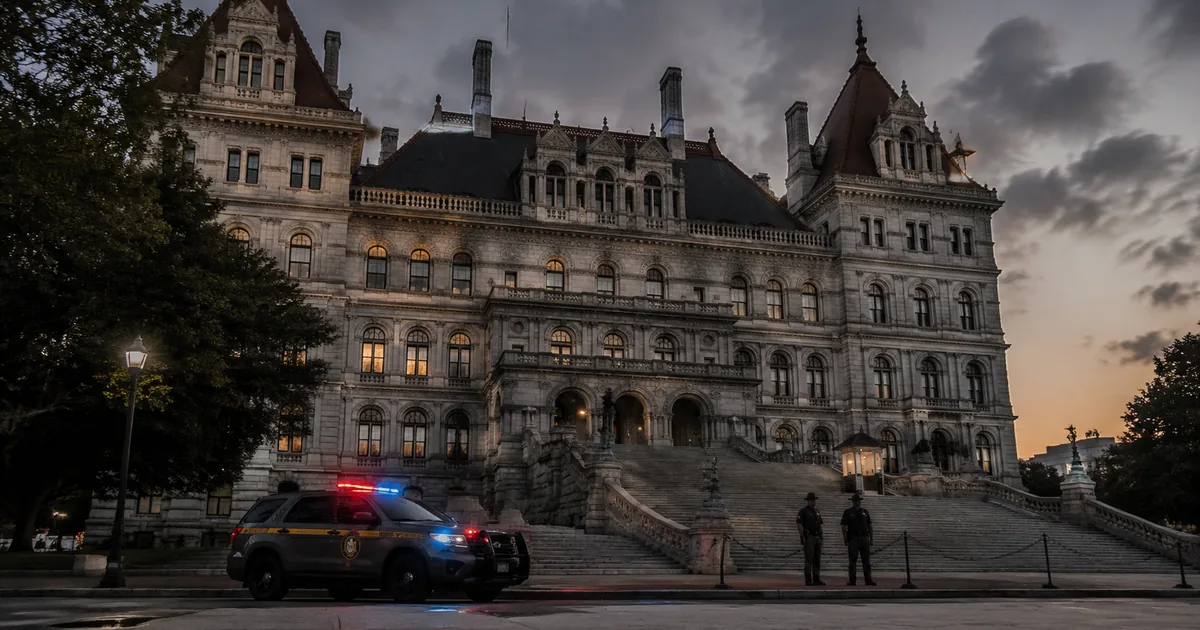
Federal prosecutors charged a 35-year-old Albany woman on Thursday with attempting to provide material support to ISIS, alleging she spent a month planning to bomb the New York State Capitol and kill state senators while the chamber was in session. The plot never had a working explosive in it, because the FBI controlled that end of it from the start, and that is precisely what makes the rest of the complaint uncomfortable reading for anyone responsible for the building.
Jessica Bowie, who the criminal complaint says also went by the name Aisha Saif, was arrested on August 19 after taking possession of what she believed was a live improvised explosive device and a functioning handgun. Both were inert and both came from the government. She appeared in federal court on Thursday afternoon and, as NY State of Politics reported, is being held at the Schenectady County Jail. The Justice Department said in announcing the charge that she faces a single count carrying a maximum of 20 years in prison and a $250,000 fine.
A Month of Reconnaissance That Nobody Interrupted
Strip out the informant and look at what the complaint says Bowie did on her own initiative. Between July 21 and August 9 she allegedly walked the Capitol grounds roughly five times, photographing the building, its entrances and its security posture from several vantage points, including a nearby observation area. She allegedly settled on a delivery-worker disguise, planning to carry the device in a food delivery bag so that a person walking into a government building with an insulated satchel would read as unremarkable. She wanted to strike when senators were meeting.
None of that surveillance was interdicted by the Capitol’s own security. The reason the FBI knew about the photographs is that Bowie allegedly sent them to a confidential source she believed was an ISIS facilitator. Had she never opened that channel, the record suggests she could have completed the same reconnaissance without anyone noticing.
Governor Kathy Hochul said the state has “taken steps to strengthen security at the State Capitol and across state government” in response to rising political violence. That is true and it is also beside the point of this particular case. Strengthened security did not generate the lead here. A federal informant did.
The alleged timeline is tight enough to see the whole arc:
- July 16: Bowie allegedly begins communicating over encrypted messaging with an FBI confidential source posing as an ISIS operative, asking for help learning to build explosives.
- July 21 to August 9: Roughly five surveillance trips to the Capitol, with photographs sent onward to the source.
- August 5: Using $200 supplied by the source, she allegedly buys nails, electrical tape, a 9-volt battery and acetone at a Home Depot.
- August 19: She allegedly hands over $150 for a firearm, a magazine and ammunition, is shown an inert device built from the components she bought, and is arrested after walking away with it.
The Charge Is Smaller Than the Alleged Plot
Bowie is charged with attempting to provide material support to a designated foreign terrorist organization. She is not charged with attempted use of a weapon of mass destruction, or attempted murder of state officials, or any of the offenses that would carry decades more exposure and that would, on the face of the allegations, seem to fit.
This is not prosecutorial squeamishness. Material support is the workhorse count in nearly every ISIS-inspired case in the federal system because it is the count the government can actually prove. The elements turn on what a defendant tried to give to a designated organization, and a recorded oath of allegiance plus a documented attempt to obtain weapons gets you there. Charges built around the bomb itself invite a harder fight, because the bomb was never real and the components were bought with the government’s money. Prosecutors charge what survives cross-examination, not what matches the headline.
The practical consequence is a ceiling. Twenty years is the top of the range for a plot that the complaint describes as an attempt to destroy as much of a state capitol as possible and then flee to ISIS-held territory in Syria. That gap between alleged intent and charged conduct is a structural feature of how the United States prosecutes domestic terrorism, not an accident of this case.
“That someone would harbor such hatred toward our way of life and seek to target the New York State Capitol and New York state senators, that’s an attack on democracy itself, and one we will not tolerate.”
That is John Sarcone, the First Assistant U.S. Attorney, quoted by CBS New York. The rhetoric is calibrated to the alleged intent. The indictment is calibrated to the evidence.
The Informant Question Does Not Go Away
Every case built this way arrives with the same objection attached, and it deserves a straight answer rather than a dismissal. The government supplied the money for the bomb components, supplied the inert device, supplied the firearm, and supplied the human being on the other end of the encrypted conversation. In a meaningful sense the FBI built the only version of this plot that ever physically existed.
The complaint’s answer is predisposition, and on the allegations it is a reasonably strong one. Prosecutors say Bowie recorded and circulated a formal oath of allegiance to ISIS, maintained social media accounts promoting the group, and posted statements including “Praise be to Allah for September 11th.” They say she identified the Capitol as her target and asked the source for bomb-making help rather than the other way around. If those allegations hold up, this is not a case of an aimless person talked into something by the government.
The honest reading is that both things are true at once. Bowie allegedly brought the intent and the target list, which reportedly also included Albany City Hall, and the FBI supplied the capability that made an arrest possible before she could go find capability elsewhere. That is the bargain American counterterrorism has run on since 2001, and it works right up until the moment someone with the same intent never happens to message a federal source. This is the second foiled plot in recent months where the interception came from inside a federal channel rather than from a physical security perimeter, following the drone and sniper plot the FBI disrupted near a White House event in June.
What Albany Should Actually Take From This
The case will move slowly now. Bowie is presumed innocent, the complaint is one side’s account, and a defense attorney has not yet publicly responded. NBC News and the Times Union both note the allegations rest heavily on communications with the confidential source, which is where the defense pressure will land. New York has watched a terrorism prosecution built on far more public conduct grind through its courts before, as it did when Hadi Matar was convicted over the Salman Rushdie stabbing.
The security question does not need to wait for a verdict. Someone allegedly photographed the seat of New York’s government five times across three weeks, studying where people enter and how they are screened, and the state learned about it from the FBI. Hochul thanked the bureau and the State Police, which is the right instinct and an incomplete one. The next person who circles the building may not be talking to anyone at all.