
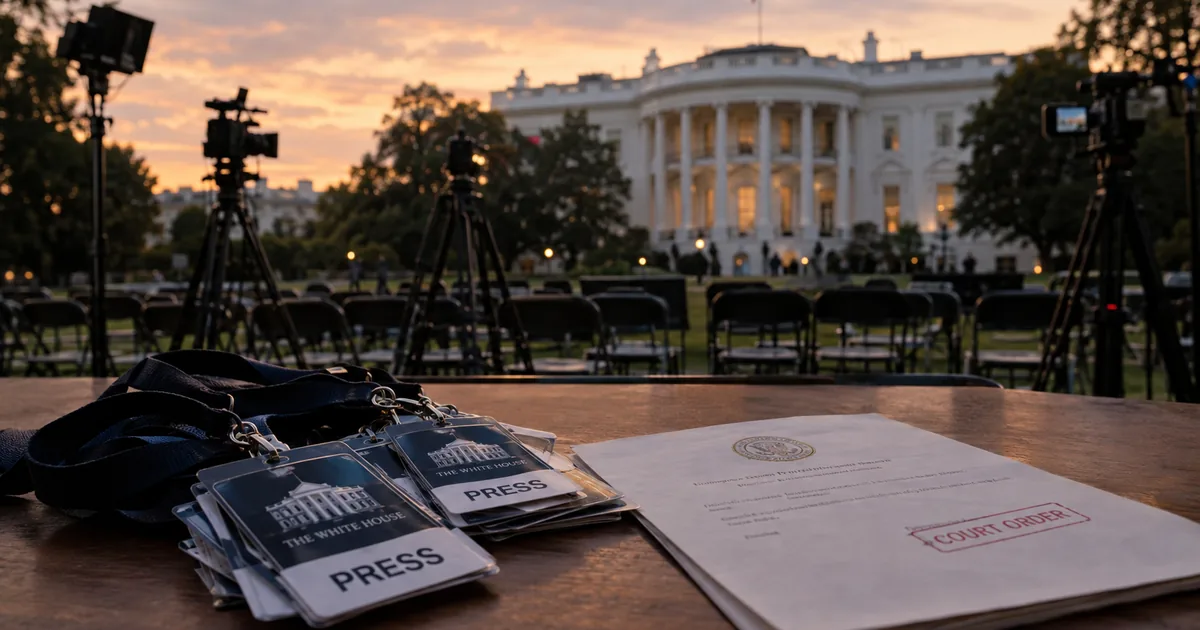
Less than a day after Judge Timothy Kelly ordered the White House to restore press access for CNN, MS NOW and Politico, the White House kept CNN and MS NOW journalists away from Chinese President Xi Jinping’s arrival for Thursday night’s state dinner. About an hour before Xi arrived, the White House told CNN it could cover the event with a photojournalist and an audio technician and nobody else, which left the network’s reporter and producer outside. MS NOW’s journalists were blocked from the event as well, according to television reports Thursday night; the network had already had a reporter and camera operator stripped of their badges at the gate that morning.
That is what compliance looks like now. The badges work again. The White House has decided it still gets to choose which networks, and which of their journalists, get to use them.
A Day of Doors Opening and Closing
Thursday started the same way. Kelly issued his order overnight, and by morning Secret Service officers were still turning away journalists from all three outlets; an MS NOW reporter and camera operator had their badges confiscated at a gate outside the West Wing. The outlets asked for an emergency hearing, and Kelly gave the government until 12:30 p.m. to answer. The White House filed a declaration saying access had been restored as of 9:55 a.m., and ABC News reports that CNN’s Betsy Klein and the other barred journalists were back on the grounds shortly after noon. With the passes working, Kelly declined to hold the emergency hearing.
The evening undid the afternoon. ABC, CBS, NBC and Fox News crews were at the White House for Xi’s arrival but kept up the television pool boycott they began after CNN was pushed out of the pool on Monday, so there was no pool feed of the moment Trump wanted televised. Trump then posted that “CNN and MSDNC” had “refused to cover” the arrival. That is false: both networks covered it on their digital platforms, and their journalists were outside because the White House kept them there.
The first day under the ruling produced exactly what the analysis below warned about. Kelly’s order says the passes come back. It says nothing about which journalists get to cover a state dinner, and the administration found that gap before the first toast.
The Ruling Behind It
“Individuals must receive notice and an opportunity to be heard before the Government deprives them” of a protected interest. Judge Timothy Kelly, September 24, 2026
A federal judge ordered the White House on Thursday to give CNN, MS NOW and Politico their press passes back, and the early coverage has called it a win for the free press. It is a win for paperwork. Judge Timothy Kelly ruled that the three outlets are likely to succeed because their reporters lost their credentials without notice or a hearing, which is a due process problem, and he left the First Amendment question for another day.
That distinction matters more than the celebration suggests. A due process ruling tells the government it skipped a step. It does not tell the government it cannot take the walk.
What the Order Actually Buys
The temporary restraining order runs 14 days. Kelly, the same judge who restored Jim Acosta’s pass in 2018, found that the administration only told reporters how to appeal after the Secret Service had already confiscated their hard passes at the gate last Saturday, the morning MS NOW crews were turned away. Take the credential first, offer the hearing later: courts in the Acosta and Karem cases already said that order of operations does not work, and Kelly said so again.
He also went out of his way to puncture the justification. According to CBS News’ account of the order, Kelly wrote that nothing in the record from before the lawsuit suggests the revocations were motivated by national security, and he described the stories the White House cited as routine and months old. The complaint, stripped of its costume, was that the coverage was negative.
Here is the part that should keep the three newsrooms’ lawyers busy this weekend. On Tuesday, before the hearing, the Justice Department sent the outlets letters alleging they had failed “minimum standards” of professionalism and gave them until 5 p.m. Friday to respond. Read that sequence slowly. The government lost on process on Thursday, and it had already started building the process on Tuesday.
What Kelly found
Passes seized with no prior notice or hearing. No pre-lawsuit evidence of a national security motive. The cited stories were routine and old. The outlets are likely to win on due process.
What the DOJ argued
White House access is “a privilege, not a right.” The outlets fell below minimum professional standards. National security justified the removal. A response window now exists, closing Friday at 5 p.m.
The incentive this creates is not subtle. If the constitutional flaw is the missing hearing, the cheapest fix is a hearing: send a letter, wait a few days, review the responses in-house, find them unpersuasive, and pull the passes again with a tidy file attached. Kelly’s order protects reporters from being ejected by Truth Social post. It does not, on its own terms, protect them from being ejected by memo.
So, can the White House ban them again when the 14 days run out? On the reasoning Kelly actually used, a ban that arrives with notice and a chance to respond is harder to knock down than the one he just blocked. Only a First Amendment ruling, one that says the government cannot punish a newsroom for the content of its coverage, would close that door. Kelly signaled sympathy for that argument when he called the stated reason what it was. He did not rule on it.
The administration has also signaled it will not wait around. Trump has said on Truth Social that the government will appeal, and NBC News reports the Justice Department is expected to move quickly. The last time a press access fight went up the ladder, over the Associated Press and the Gulf of Mexico, the appeals court let the White House keep AP out of the Oval Office and Air Force One while the case continued. Narrow spaces, broad precedent.
What the site thinks is this. The due process win is real and it should be taken, because reporters are back in the building, on the occasions the White House lets them through the door, and that is where accountability actually happens. But if the free press is going to be defended in this case, it has to be defended on the free press, not on the timing of a letter. A government that can revoke access for “negativity” as long as it schedules a comment period first has not been restrained. It has been handed a checklist.
The outlets now have a choice about Friday’s 5 p.m. deadline. Answering the letter on its merits risks legitimizing a review whose outcome looks settled. Refusing to answer risks giving the government the record it wants. Watch which one they pick, and watch whether Kelly, with two weeks and a fuller record, is willing to say out loud what his order only implied: that the reason for the ban was the coverage, and that is the one reason the Constitution does not allow.
There is a bleaker footnote worth keeping in view. CNN’s own future is tangled up in a settlement that hands its parent a board answering to Paramount, which means the White House may soon find it has quieter levers than a Secret Service officer at the gate.