
The Justice Department’s brief admits the thing it is supposed to deny. Filed late Tuesday, it argues that the government may keep reporters out of “restricted presidential areas, such as the Oval Office, even for viewpoint-discriminatory reasons.” The ban Donald Trump announced on Friday does not stop at the Oval Office. It took the hard passes of CNN, MS NOW and Politico reporters, the credentials that open the whole building, briefing room included.
That gap between what the government defended and what the President actually did is the case. U.S. District Judge Timothy Kelly hears the three outlets’ request for a temporary restraining order this afternoon. Kelly is a Trump appointee. In 2018 he ordered Jim Acosta’s pass returned.
What Happened in Five Days
Trump announced the ban on Truth Social on Friday, citing what he called the outlets’ “constant ‘reporting’ FAKE NEWS!” On Saturday the Secret Service turned away CNN’s Betsy Klein and Politico’s Cheyenne Haslett and took their credentials, NBC News reported. MS NOW’s Akayla Gardner was also barred. We covered the first morning at the gate.
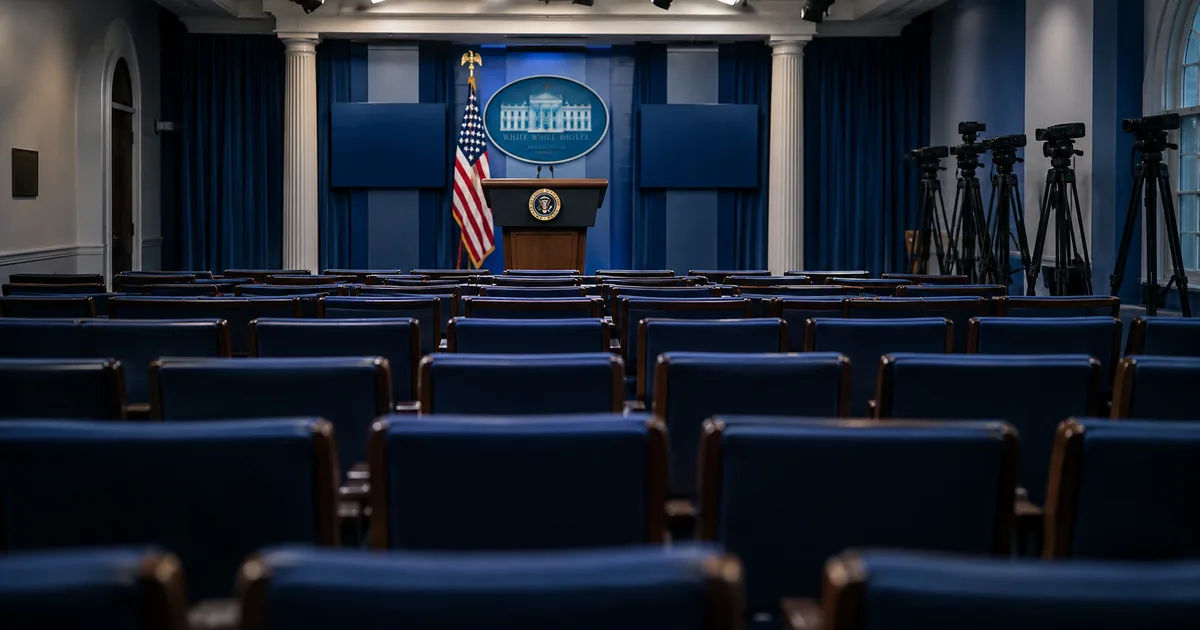
What came next was the part the White House did not plan for. CNN was due to hold the rotating TV pool on Monday. The other pool networks, ABC, CBS, NBC and Fox News, declined to fill the slot. Their joint statement said no administration “should restrict a news organization because it objects to its reporting.” Monday went by with no televised pool at all. By Tuesday NPR and the White House still photographers had suspended live coverage as well.
The same day, the three outlets filed a 27-page complaint. Theodore Boutrous represents them. CBS News lists the defendants: Trump, chief of staff Susie Wiles, spokesman Steven Cheung and Secret Service Director Sean Curran.
The Leverage Each Side Holds
On paper this is a First Amendment case. In practice it is a negotiation, and each side has shown its hand.
The Networks
The pool is how the country sees the President. Every cable network and local station runs the footage. Pull the cameras and Trump’s events go unseen unless the White House films them itself. Fox News joining the walkout is the tell. The White House cannot call this a liberal media sulk.
The White House
Its answer was to become the network. It launched “TRUMP TV: The Essentials Station” on YouTube and then an app promising “just the news that matters most,” Yahoo News reported. It is betting the public will accept the President’s footage in place of independent footage.
Neither side can hold for long. The networks are giving up footage of the most-covered person on earth. And a White House that only films itself is running a campaign channel, which even Republican Rep. Don Bacon said on CNN he would not watch.
Read the Brief, Not the Press Release
The White House line is that access “has always been a privilege.” The Justice Department’s filing says the same, and then it says more. CNN’s account of the filing shows the government naming specific stories as threats to national security. For CNN, it named reporting on a “top secret” bunker planned under the East Wing ballroom, plus coverage of the Iran war. For MS NOW, it named Iran coverage and a leak investigation. For Politico, it named Iran, the ballroom and Russia sanctions talks.
Put those stories next to the remedy. If a story endangered national security, the tools are a classified-information referral or a leak investigation. Taking a reporter’s pass for the briefing room does not stop the next story. It only stops the reporter from asking the press secretary about it.
The brief’s own words also sink the pretext. A government confident the ban was about security would not need to argue that it may discriminate by viewpoint. It argued exactly that.
The Precedent the Government Is Stretching
The phrase “restricted presidential areas, such as the Oval Office” was not invented for this case. It comes from the Associated Press fight last year. The AP was cut out of the pool after it refused to call the Gulf of Mexico the “Gulf of America.” In June 2025, a divided D.C. Circuit panel let the White House keep the AP out of the Oval Office and Air Force One. Its reasoning was that those small spaces were never opened to the press at large. We wrote in August about what that ruling cost the AP.
That ruling went only so far. The panel left the AP’s East Room access alone. It also reaffirmed that once the White House opens a space to the press generally, as it does with the Brady Briefing Room, it cannot pick and choose by viewpoint.
So the government has a precedent for the Oval Office and nothing for the hard pass. It took the hard passes anyway. Its brief defends the narrow thing and hopes the judge will not notice the broad one.
Why Kelly Matters
Kelly’s 2018 Acosta ruling did not rest on the First Amendment. It rested on the Fifth. The White House had pulled a credential with no notice and no chance to respond, and Kelly held that due process required both. That is the easier ground here too. According to the outlets’ lawyers, no written warning came before Saturday’s confiscations. The administration then gave the outlets until 5 p.m. on September 25 to contest a revocation it had already carried out.
Due process gives Kelly a way to restore the passes without deciding the larger question. That would be the cautious ruling. It would also be the correct one.
Our Read
This ban was not a security decision. NewsNation reported, citing a source, that it followed aide Natalie Harp showing Trump coverage that infuriated him, and that it caught many of his own advisers by surprise. We looked at Harp’s undefined role in August. The national security case was assembled afterward, from the same stories that made him angry.
Kelly should restore the three hard passes today on due process grounds. He should also say plainly what the brief conceded: the government asked for permission to punish viewpoints and pointed to rooms the ban never needed.
The networks have done the most useful thing so far, and it was not the lawsuit. The pool is a shared asset, and it only has value if the White House cannot pick who holds it. ABC, CBS, NBC and Fox understood that on Monday. If Kelly rules against the outlets, the pool’s refusal is the only protection left. The next outlet banned may be one of theirs.