
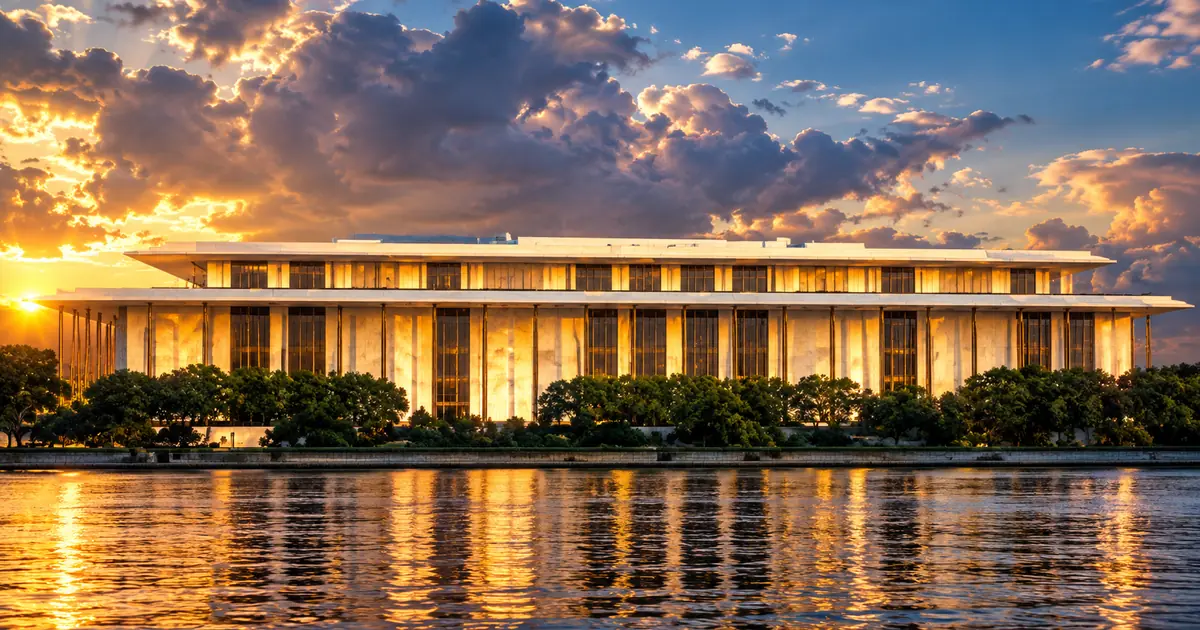
On Thursday a federal judge required the United States government to give a month’s warning before it knocks down a memorial to an assassinated president, which is the kind of order a court only bothers to write once somebody has made the possibility credible.
Here is what is actually on the record:
- On August 25, Justice Department lawyers told the court in writing that without the administration’s renovation plan the Kennedy Center “will deteriorate further into an unsafe, decrepit structure that will be required to be taken down.”
- On September 4, a section of water-damaged plaster came loose from the Grand Foyer ceiling and fell roughly sixty feet to the floor. Nobody was standing under it.
- On September 16, executive director Matt Floca closed the main building for a week, citing imminent life-safety risks.
- That same evening, Trump told a reporter that if his name does not go on the building, “it’s going to close. It’ll end up being ripped down.”
- On September 17, Judge Christopher Cooper ordered thirty days’ notice before any change to the renovation’s scope, “including but not limited to any ‘demolition’ of the Center’s main building.”
Nearly all of this week’s coverage has been about the photograph: Trump aboard Air Force One at Joint Base Andrews, lit in the window, holding a placard that appears to read that the Kennedy Center is to be demolished. It is a striking image and it tells you almost nothing you did not already know.
The document nobody is reading is the August filing. The demolition threat was not improvised on a tarmac three weeks later. It was submitted to a federal court, on letterhead, as a legal argument, and it named a mechanism.
The Threat Was Filed in Court Before It Was Said Out Loud
The filing came in response to Rep. Joyce Beatty’s motion to stop the administration from closing the building outright. Justice Department attorney Brantley T. Mayers argued that the renovation had to proceed on the administration’s terms, and spelled out the alternative.
“Without those efforts, the Center will deteriorate further into an unsafe, decrepit structure that will be required to be taken down.”
Read that again for what it is not. It is not a threat to send in wrecking equipment. It is a forecast, and the thing being forecast is neglect.
NBC News reported that the same filing floated replacing the building with an outdoor amphitheater overlooking the Potomac, and credited Trump with obtaining $258 million from Congress for capital restoration without detailing how any of it has been spent.
Preservation lawyers have a term for the mechanism in that sentence. They call it demolition by neglect, and it exists as a legal concept precisely because owners worked out long ago that you do not need a permit to let a roof fail.
What makes this version unusual is that the owner is the federal government, the building is a congressionally chartered memorial, and the argument was made to a judge rather than concealed from one.
The Building Is Already Doing What the Filing Predicted
Ten days after that filing, the Grand Foyer ceiling gave up a piece of itself.
The plaster that fell on September 4 was water-damaged, which means the failure was the visible end of a process that had been running a long time. It dropped about sixty feet into a public space during a storm.
Twelve days later, Floca shut the main building for seven days, naming soffit panels, electrical infrastructure and structural conditions, and describing the closure as a management decision to address imminent life-safety risks rather than anything ordered by a court.
That distinction matters, and it cuts in an awkward direction for everyone. The closure is not Trump’s two-year rebuild starting early. It is the building independently corroborating the Justice Department’s prediction, about three weeks after the Justice Department made it.
The Kennedy Center’s own spokesperson, Roma Daravi, has said flatly that “nothing is being demolished” and that the institution has never said otherwise. She is describing the wrecking ball. The filing was describing the ceiling.
Congress appropriated the money to fix that ceiling. The question the record does not answer is what has happened to it.
A Notice Requirement Is Not a Block
Several outlets have written up Cooper’s Thursday order as the judge blocking demolition. He did close to the opposite.
Cooper ordered advance notice. Thirty days, before any change to the scope of the renovation, demolition explicitly included. Beatty’s lawyers flagged the Air Force One photograph to the court, and this is what the court could offer in response.
A notice requirement does not prohibit an act. It schedules it.
What it does, and this is genuinely useful, is destroy the option of doing the thing quickly and explaining afterward. Thirty days is enough time to file an emergency motion, convene a hearing, and get members of Congress in front of cameras. It turns a demolition into a process with a public comment period nobody asked for.
That is a real remedy. It is also an admission. When the strongest available judicial response to “we may have to take the building down” is “give us a month’s warning,” you are watching a legal system operate at the outer edge of its authority.
The Only Person Who Can Sue Is There by Accident of Statute
Every part of this fight runs through one Ohio Democrat, and the reason is a piece of 1958 statutory plumbing that nobody thought about for sixty-seven years.
When Congress chartered the building, it placed a handful of sitting members of Congress on the board of trustees automatically, by virtue of the offices they hold. Ex officio trustees. It is the sort of provision that gets drafted in an afternoon and then sits inert for decades, because boards of cultural institutions do not usually need a dissenter with subpoena access.
Joyce Beatty is one of them. She holds the seat because of her job, not because anybody selected her for it, and that turns out to be the entire point.
When the reconstituted board voted to rename the building after Trump, Beatty was muted during the meeting. She sued in December, and Cooper eventually granted her summary judgment on the voting-rights claim, holding that the statute “makes no distinction between the powers of general and ex officio trustees” and reading common-law trust principles into the structure: trustees of a trust stand on equal footing.
That ruling is why Trump’s name came off the facade, why the trademark applications for “Trump Kennedy Center” had to be withdrawn, and why the board has now been told twice that it cannot inscribe his name without Congress signing off.
It is also the whole of the defense. A board packed with allies cannot be outvoted by one person. What one person can do is refuse to leave, and generate a paper trail a judge is able to act on.
The 1958 statute handed the board the usual powers and obligations of a trustee. It did not contemplate a trustee who would prefer the trust property gone.
What We Think Is Happening Here
This stopped being a renovation dispute some time ago, and treating it as one is doing the story a favor it has not earned.
A president installed himself as chairman of a memorial to a murdered predecessor, tried to put his own name on it, lost in court twice, and has now said in public that the building will come down if he does not get the recognition he wants. His lawyers put the same proposition to a federal judge in writing three weeks earlier, with an amphitheater sketched in as the replacement.
That is a ransom note. The hostage is a national memorial, the ransom is signage, and the $258 million Congress appropriated to keep the roof intact is the leverage, because the threat only works if the repairs can be withheld.
The board is supposed to prevent exactly this. Its legal obligation runs to the trust, not to its chairman, and it has spent the year functioning as the mechanism rather than the check.
We do not think the wrecking ball is coming. We think it does not have to. A building already dropping its ceiling does not need anybody’s permission to become unsalvageable, and the Justice Department has told a court, in advance and in writing, how that version ends.
On Friday night, hundreds of people linked hands around the building, organized by a group calling itself Hands Off the Arts, objecting to the closure, the new security fencing, and the talk of demolition, and demanding Trump be removed as chairman.
They were standing outside a fenced structure that is shut because its ceiling is falling, forming a human barrier against a threat that was never going to arrive as a bulldozer. Which is not naive. It is just what is left when the strongest thing the law can promise you is thirty days’ notice.