
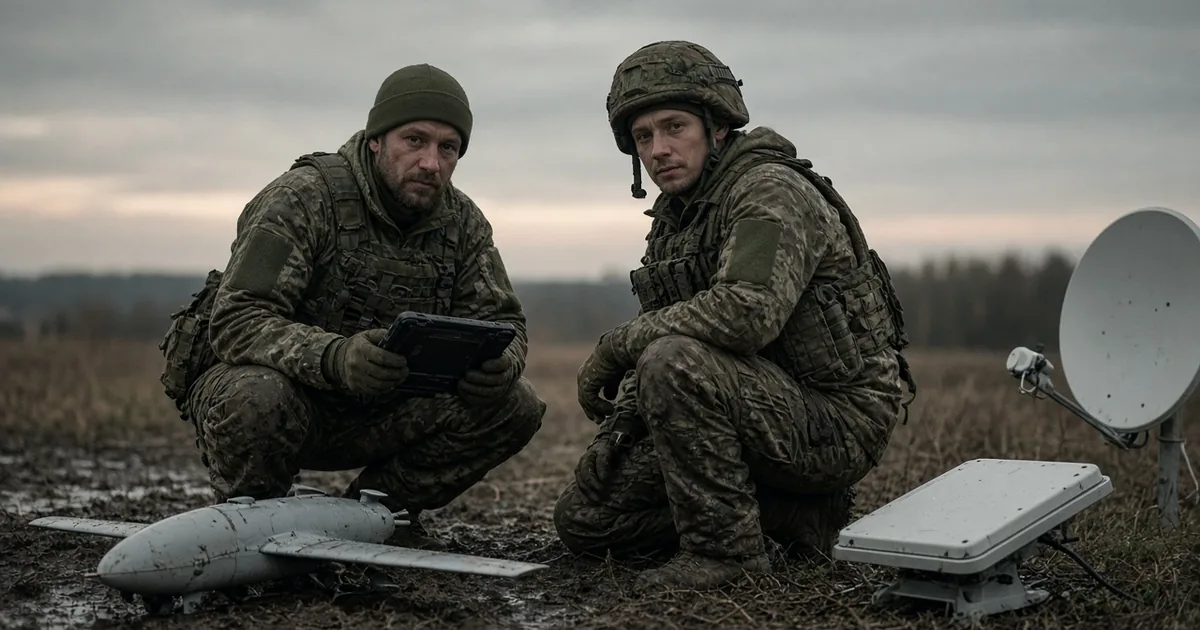
Five days ago we wrote that nobody would own the speed cap on Ukraine’s military Starlink terminals. Someone now does, or is being made to: the Wall Street Journal reported Tuesday, citing U.S. officials and people familiar with the matter, that Elon Musk ordered the slowdown, and that he spoke with Trump and other senior administration officials around the time he did it. The question the report leaves hanging is the one that matters: if Musk gave the order, why did he tell the world on October 14 that the decision belonged to the U.S. military and “ultimately POTUS”?
That sentence, posted on X in reply to Ukraine’s digital minister Mykhailo Fedorov the day the cap began, is the thing to hold against everything that came after.
“Any limits on speed or usage are decided by the US military and ultimately POTUS.”
Six Days, Four Owners
We pulled the public record into one place, because the statements are hard to line up when they arrive a day apart from different officials.
| Date | Who | What was said |
|---|---|---|
| Oct. 10 | Trump, Musk | Trump says he warned Zelensky about refinery strikes. Musk replies that Zelensky “has gone too far.” |
| Oct. 14 | Musk | Says limits are “decided by the US military and ultimately POTUS.” Replies “True” to a post saying the government made the call. |
| Oct. 15 | Reuters | Two U.S. officials and a Western official say the order came from inside the White House, without naming who. |
| Oct. 16 | Trump | “It wasn’t me, and I don’t think it was Elon.” |
| Oct. 19 | Trump, Rubio | Trump: “I don’t know who it was, but I’d like to find out.” Rubio calls reports of White House involvement “categorically false.” |
| Oct. 20 | Hegseth, WSJ | Hegseth: “we haven’t made any directives or anything like that.” The WSJ reports Musk ordered the cap. |
Read the middle column and you get four different owners of one decision in under a week: the military, the president, an unnamed White House official, and now Musk himself. Trump’s Friday answer and his Monday answer are also not the same answer. One is a denial. The other is a man asking who did it.
What the Cap Did
Terminals moving faster than about 160 km/h (100 mph) lost their connection, according to reporting on the military accounts, and some units reported failures below that. Regular Starlink carries a 70 km/h limit while in motion; the military Starshield service had no artificial cap before this. Interceptor designs that carry a terminal aboard could not operate under the restriction. A commander of a medium-range strike unit said its operations were on hold and called the effect “comparable to a nuclear strike against us.” That is one commander’s description, and we are reporting it as his, not as a measurement.
Some Ukrainian systems kept working. Wild Hornets said its interceptors use their own link and its ground terminals were normal, which shows the damage fell unevenly instead of arriving as a blackout.
The Motive Is Sitting in the Timeline
The WSJ says Musk and Trump were both unhappy about Ukraine hitting Russian oil refineries, which Trump blames for high energy prices. The sequence fits. Trump announced a deal to buy Russian diesel on October 9. The next day he said Zelensky “better damn well stop” the strikes, and Musk answered with “Zelensky has gone too far.” Four days later the terminals started failing.
None of that proves intent, and the officials who say Musk acted without a presidential order may be right. But both possible answers are bad, and we think the country should say so plainly. If Musk did it alone, a private contractor who is the Republican Party’s biggest donor this midterm cycle decided on his own authority to degrade an ally’s weapons in the middle of a war. If he did it after talking to Trump, then the administration used a billionaire’s company to do something it would not say out loud, and then denied it for six days. Rubio said Starshield was “not at this moment available to Ukraine,” then conceded Ukraine “has benefited from it.” Those do not fit together either.
SpaceX has not commented. One detail rests on the WSJ’s sources alone, so treat it as unconfirmed: that SpaceX proposed to White House counterparts a joint statement saying the two sides had coordinated beforehand. A company that believes it did nothing wrong does not usually need a co-signer.
What Happens Next
Nine senators, led by Jeanne Shaheen and Thom Tillis, have asked the Pentagon’s inspector general to investigate. Tillis said the outage was either “an unacceptable error or lapse” or a “decision to clear the field for a Russian attack,” and Rep. Mike Turner has called for a congressional investigation. Those are Republicans saying this. Ukraine’s Denys Sienik said Kyiv is still waiting for an official answer from the Pentagon and SpaceX, and Zelensky said Sunday the system was not fully restored.
Our earlier piece treated the cap as a mystery. It is less of one now. What remains is a question with a short list of answers, and an inspector general can demand the document that settles it: whatever Musk sent, to whom, on or before October 13. Until that exists in writing, the one accountable-sounding sentence in the whole affair is still the one Musk posted himself.