
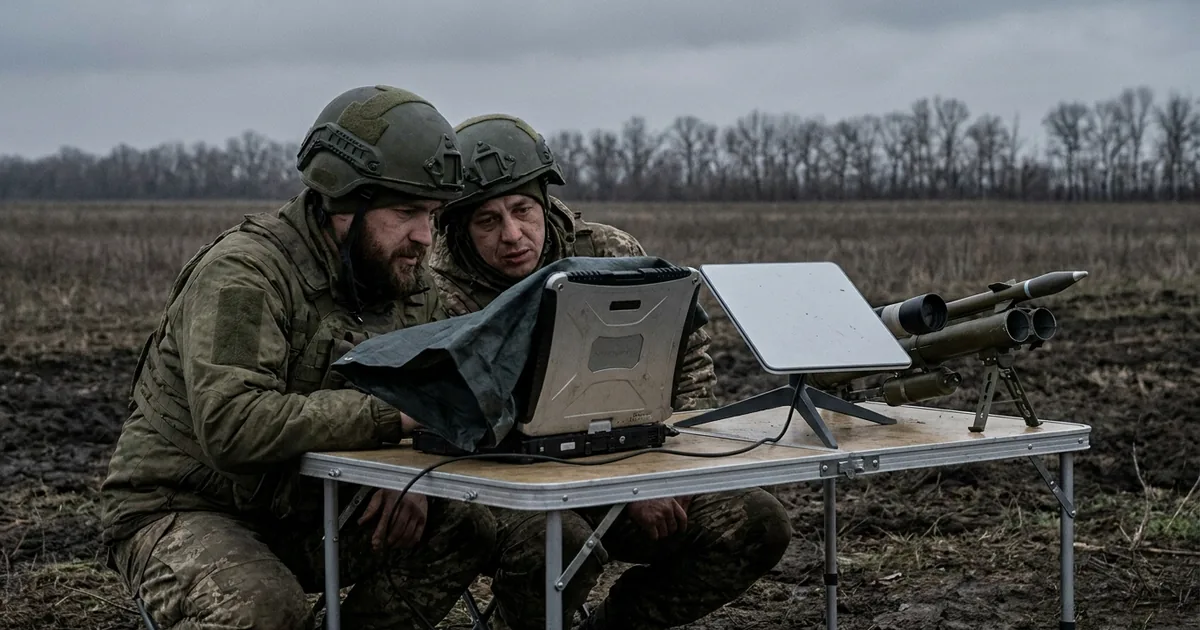
Overnight on Oct. 13 and 14, Ukraine’s military Starlink terminals began dropping their connection whenever they moved faster than somewhere between 72 and 161 kilometers an hour, the link Kyiv uses to steer interceptor drones against Russia’s jet-powered Shahed drones. One Ukrainian source put the speed those interceptors need at 450 km/h or more. Zelenskyy’s adviser says SpaceX imposed the limit. Elon Musk says Starshield belongs to the US government and that any limits are decided by the military “and ultimately POTUS.” A senior administration official told Axios the White House had no role. Speeds have been restored only up to 160 km/h, and the cap is still on.
Every account so far argues over who flipped the switch. None sets what the administration said this week beside what happened this week, and the official line contradicts itself inside four days. We built that ledger below. The license underneath it we read on Saturday: two paragraphs, no price, and no condition on Russia.
What Trump said
Intelligence, Oct. 13: “We are helping them, and we are sharing intel.”
Diesel, Oct. 9: prices for Americans will be “COMING DOWN, IN RECORD NUMBERS, AND FAST.” Four days later: “That’s a diesel deal. Not for us.”
What the record shows
Intelligence: Russian ballistic missiles hit Kyiv with no warning on Oct. 12 and again on Oct. 13, after the State Department and Pentagon warned Kyiv that intelligence sharing could be suspended.
Diesel: the license names no buyer, and Lawfare’s analysis said the license “seems unlikely to lead to an actual increase in U.S. imports.” The 4.8 million tons Trump listed is about nine days of American demand.
The Week in Order
- Fri., Oct. 9. Trump says Putin will supply more than 300,000 tons of diesel, and Treasury issues General License 135 shortly after.
- Sat., Oct. 10. Trump says Ukraine should get a new leader. Musk posts that Zelensky “has gone too far.”
- Sun., Oct. 11. Trump announces an energy ceasefire Kyiv learned of from his post.
- Mon., Oct. 12, and Tue., Oct. 13. Two unwarned ballistic strikes on Kyiv. Twelve senators, six of them Republicans, tell Trump to rescind the diesel deal.
- Overnight, Oct. 13 to 14. The speed limit lands on Starshield. Ukraine says its forces got no notice.
- Wed., Oct. 14, and Thu., Oct. 15. Ukraine’s air force says air defenses stopped 536 drones overnight, with impacts at 31 locations. Zelenskyy puts the total above 850 and says it came while defenses were “artificially restricted.” Ukraine resumes strikes on Russian refineries.
The Diesel Arithmetic
Trump’s post listed 300,000 tons “immediately,” 500,000 in November, 1 million after that and 3 million later, which adds to 4.8 million tons. At roughly 7.5 barrels to the ton that is about 36 million barrels. EIA puts 2025 U.S. distillate consumption at 3.9 million barrels a day, so even if every ton came here it would cover nine days, and the first tranche is under 14 hours. Those tonnages are Trump’s. The Kremlin’s own readout said only that Russia confirmed its readiness to supply oil and oil products.
On Oct. 9 the White House did not answer AP’s questions about who was paying for the diesel or when it would arrive. The reason for the license is at the pump: diesel sat at $6.23 a gallon that day, with the midterms 25 days off. US officials told CNN that Ukraine’s refinery strikes were part of what led Trump to strike the deal, and that negotiators told Kyiv not to take actions that hurt American consumers.
Three Answers to One Question
- Ukraine: Serhii Beskrestnov, Zelenskyy’s defense tech adviser, confirms SpaceX implemented the limit and that the armed forces were given no warning.
- Musk: “Starshield systems are owned and controlled by the US government,” he wrote, with limits set by the military and “ultimately POTUS.” Ukraine’s former defense minister Mykhailo Fedorov thanked him anyway when speeds up to 160 km/h came back.
- The White House: it had no role, a senior official told Axios, and US officials called it a technical malfunction. The administration said it would contact SpaceX to find out what happened.
Republican Sen. Thom Tillis said it was at best an unacceptable error and at worst “a conscious decision to clear the field for a Russian attack,” and said he would ask the Pentagon’s inspector general to investigate.
Whose Switch It Is
We cannot tell you who set the cap, and no one else can yet: three answers, and they cannot all be true. We can tell you where each one lands. Musk’s answer puts the cap on the president. The White House’s answer makes it the failure of a system Musk says Washington controls, and US officials asked about Kyiv’s missing missile warnings had already blamed the weather. Neither is a defense.
We think the pattern is a pressure campaign aimed at the refineries, because the administration said as much itself: the warnings to Kyiv were about those strikes, and a US official named them as part of the reason for the diesel deal. We do not say Trump ordered the cap. No one has sourced that. We do say Kyiv got demands, threats and a speed cap that week while Moscow got a license with no conditions, and that the cheapest remedy sits in the White House: name who set the limit, and lift it.
On Thursday morning the drones were still coming and the cap was still on. With the midterms 19 days away, that is the administration’s to explain.