
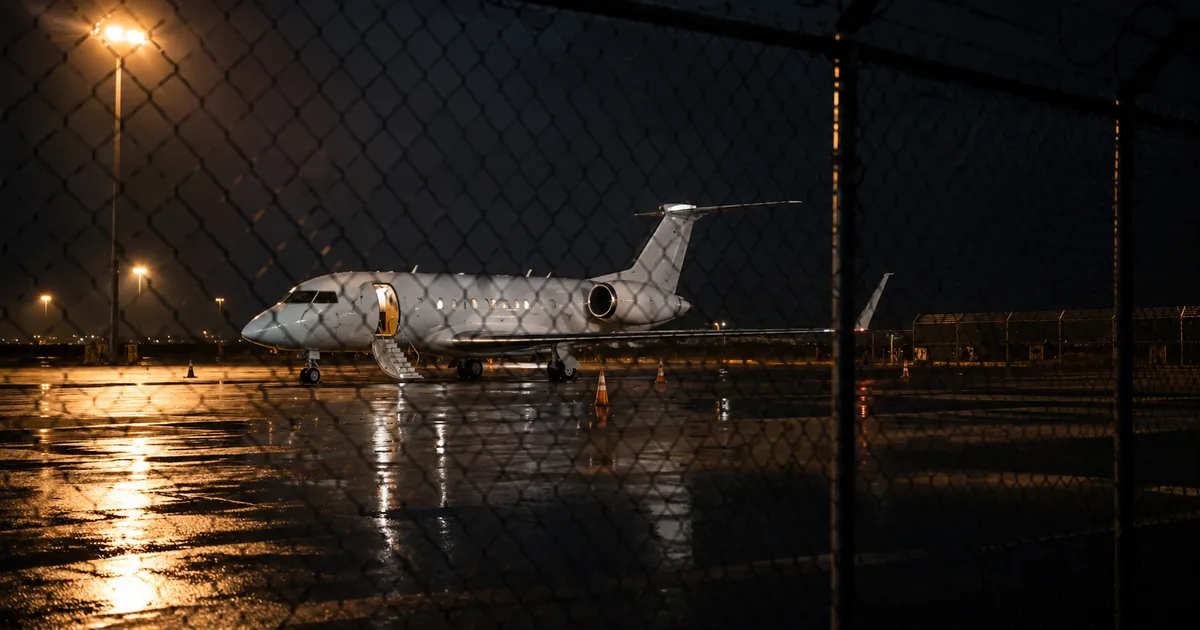
Internal government documents obtained by CBS News show that over ten days, three ICE flights carried more than 100 people to eight African countries none of them came from.
The reporting told us where they landed. It did not tell us what the landing cost, and that number is already sitting on the public record.
The prices are not secret in the way the contracts are. A Senate Foreign Relations Committee minority report published in February documented at least $32.3 million flowing to five foreign governments under third-country deportation arrangements, and made a second finding that has gone almost entirely unreported: Congress has never specifically appropriated funds for third-country deportation payments. Money is going out. No line item authorizes it. That is the story underneath the flight manifests, and it is the one nobody chased this weekend.
Where the Flights Went
The CBS documents put deportees on the ground in Burundi, Cameroon, the Central African Republic, Equatorial Guinea, Eswatini, Liberia, Rwanda and Sierra Leone. The people on those planes were Afghan, Cuban, Nicaraguan, Iranian, Nepali, Turkish and Venezuelan, plus African detainees sent to African countries that were not theirs. Not one deportee was a national of the country that received them.
Five of those eight destinations already have a documented price. The Third Country Deportation Tracker maintained by the US Committee for Refugees and Immigrants lists, among the twenty countries that have entered these arrangements:
- Rwanda, $7.5 million
- Equatorial Guinea, $7.5 million
- Eswatini, $5.1 million
- Sierra Leone, $1.5 million
- Central African Republic, $85 million routed through the International Organization for Migration
Eswatini’s numbers are the ones worth sitting with. The country agreed to accept 160 deportees for $5.1 million, which works out to roughly $32,000 a head. According to the Migration Policy Institute’s account, the finance minister, Neal Rijkenberg, confirmed that figure to his own parliament while noting that his ministry had been cut out of the negotiations entirely. A government signed a deal its treasury did not know the terms of. That is what happens on the receiving end when the paying end refuses to publish anything.
The Court Cleared This Without Explaining Why
None of it would be operating at this volume without a one-paragraph order. In June 2025, the Supreme Court stayed a district court injunction that had required DHS to give people notice and a real chance to argue they would be tortured before shipping them somewhere they had never been. The vote was 6 to 3, it came on the shadow docket, and it arrived with no reasoning at all.
The practical effect, as Amnesty International laid out in its legal explainer, is that a person with a final removal order can be put on a plane to a country they have no tie to, with little or no opportunity to invoke the Convention Against Torture first. The United States ratified that convention in 1994. Its central obligation is that you do not send someone somewhere they are likely to be tortured. The mechanism for finding out whether that is likely is the process the Court suspended.
Third-country removal is not new and it is not inherently unlawful. Doing it in bulk, to countries chosen for their willingness to be paid rather than for any connection to the deportee, with the screening step removed, is new.
What the Money Buys, and Who Notices
There is a reason the receiving countries are the ones on the list. Colombia is instructive by contrast: when Bogotá turned deportation flights away, the response was tariffs. Countries with leverage get pressure. Countries without it get an offer. Burundi, Sierra Leone and Eswatini are not in a position to negotiate hard with the United States over anything, which is precisely why they are on the flight plan and Canada is not.
Our position is straightforward. Paying a small, poor state roughly $32,000 to accept a stranger it has no obligation to and no capacity to integrate is not immigration enforcement, it is disposal, and dressing it in the vocabulary of bilateral cooperation does not change what is being purchased. The Trump administration is responsible for designing it. Senators Warren, Van Hollen, Ramirez and Carter were right to ask both inspectors general to look at it. The Supreme Court is responsible for removing the one safeguard that would have made it survivable for the people involved, and for doing so without writing down a single reason.
What should happen next is narrow and achievable. The agreements should be transmitted to Congress in full text. The Government Accountability Office should be asked a specific question, which is whether the funds spent on these payments were legally available for that purpose, because a committee has now said on the record that Congress never appropriated them. Those are ordinary oversight steps, not radical ones, and the reason they have not been taken is that a policy conducted in the dark is easier to run than one conducted in daylight.
The people on those three planes are, at this point, essentially untraceable. They are in countries whose governments were paid to receive them, with no status, no ties and no return route. Six months from now, if anyone asks what happened to the Afghan man dropped in Rwanda, the honest answer will be that the United States does not know and did not build a way to find out.