
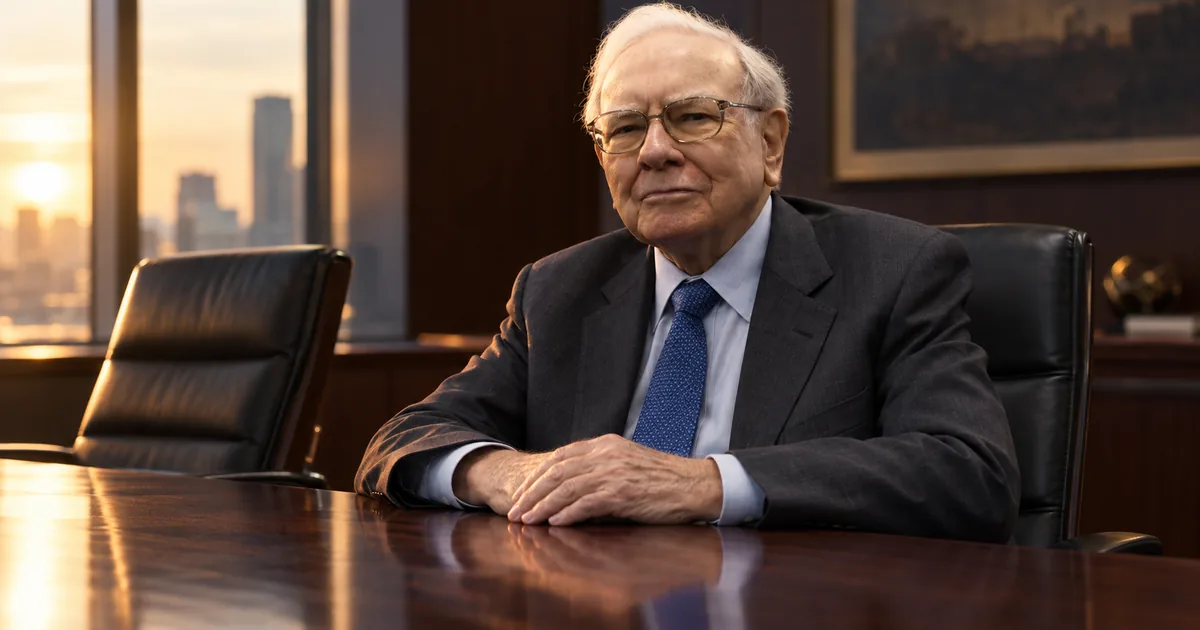
Warren Buffett stepped down as chairman of Berkshire Hathaway on Friday, handing the job to his son Howard and keeping only the title of chairman emeritus and his seat on the board. The line every outlet has pulled from his letter is the one about Father Time, and it is the wrong line.
The right one comes a few sentences later, when Buffett explains what his son is actually for. Think of Howard, he told shareholders, as a policy the shareholders own and hope never to claim against. That is not a warm goodbye. It is insurance language, and it describes a specific piece of corporate machinery with exactly one trigger. Every account of Friday’s announcement has quoted that sentence and then moved straight back to the retirement narrative, the compounding record, the age. Nobody has read it literally. Read literally, it is the most interesting thing Buffett has said about Berkshire’s governance in years, because it concedes that the only power worth building into the chair is the power to fire the chief executive.
What a Non-Executive Chairman Can Actually Do
Strip away the ceremony and the role Howard Buffett has just taken is narrow by design. He does not run a division. He does not allocate capital. He does not approve acquisitions, set strategy, or appear on earnings calls. Greg Abel, who has been chief executive since the first day of this year, does all of that. Buffett drew the line himself in the letter: Greg runs the company; Howard will guard its culture and values, both worth more than anything on our balance sheet.
Guarding culture sounds like the softest assignment in American business, and in ordinary quarters it is. A non-executive chair with no operating remit spends most of his tenure doing nothing visible at all. But the board seat carries one hard capability, and it is the reason the arrangement exists: the chair leads the body that hires and removes the chief executive. Everything else in the job description is atmosphere. The removal power is the product.
Think of Howard as a policy the shareholders own and hope never to claim against.
That is what an insurance policy is. You pay for it, you never want to use it, and its value is entirely in the scenario you hope does not arrive. Buffett spent sixty years selling insurance through Geico and Berkshire’s reinsurance arms. When he reaches for that metaphor to describe his own son’s job, he is not being sentimental. He is telling shareholders the premium has been paid.
The Job He Said He Was Keeping
The reason Friday matters more than a routine succession note is that this was the one seat Buffett explicitly refused to vacate. When he told the 2025 annual meeting he would ask the board to hand the chief executive role to Abel at year end, the immediate question was whether he was leaving altogether. The board answered it within forty-eight hours by voting unanimously to keep him on as chairman from January 1, 2026. CNBC’s Becky Quick reported the vote the morning after it happened.
So the split announced in 2025 was never a clean exit. It was a deliberate two-stage structure: give away the operating company, keep the safety catch. Buffett held the catch for eight and a half months while Abel ran Berkshire, and has now passed it to a family member rather than dissolving it into the board at large. The succession did not finish on January 1. It finished on Friday.
Howard Buffett Is Not a Compromise Candidate
The easy criticism writes itself. Howard Buffett is a farmer and a philanthropist who runs the Howard G. Buffett Foundation. He has never managed a public company, never allocated Berkshire’s capital, and would be an implausible chief executive of a business valued near a trillion dollars. Handing him the chair of that company looks like the oldest story in corporate governance, which is a founder arranging a soft landing for his kid.
It is not, and the reason is the job description above. Berkshire did not give Howard Buffett an operating role because the role is not operational. He has sat on the board since 1993, which is thirty-three years of watching how the company decides things, and the specific thing he is being asked to preserve is not a skill. It is a standard. The question the chair has to answer is not whether a given acquisition pencils out, because that is Abel’s call. It is whether the person making those calls has started behaving like someone Berkshire would not have hired. You do not need a capital allocator to answer that. You need someone who knew the institution before it became a legend and is not financially dependent on the chief executive’s goodwill.
Buffett’s own record makes the distinction cleaner than the hagiography does. His capital decisions were not infallible, and this site covered one of the more expensive reversals when Kraft Heinz unwound the mega-merger he helped assemble. The thing that survived those misses intact was the operating culture: the decentralization, the refusal to chase quarterly numbers, the willingness to sit on cash for years. Abel inherits the capital decisions. Howard inherits the part that kept the misses from compounding.
Right for Berkshire, Wrong as a Template
Here is where we land. This is the correct structure for Berkshire specifically, and it is correct precisely because it is designed to be powerless in normal conditions. A chair with no operating authority cannot meddle, cannot second-guess Abel on a deal, and cannot build a rival power center inside the company. The only thing he can do is act in a scenario that would already be a crisis. Narrow power exercised rarely is the least dangerous kind of power to hand to a family member, and Buffett has clearly thought about this longer than his critics have.
It is also a bad template, and nobody should generalize from it. What makes it tolerable at Berkshire is a set of conditions almost no other public company has: a founder with sixty years of accumulated credibility, a compounded annual return of 19.9% against the S&P 500’s 10.4%, a shareholder base that has self-selected for trusting him, and a successor in Abel who was chosen on merit over the son now supervising him. Remove any one of those and the same structure becomes an entrenchment device. Most founders who install their children as guardians of the culture are installing them as guardians of the family’s position, and the vocabulary is identical either way.
There is a fair objection buried in this, and it deserves saying plainly rather than being smuggled in as someone else’s quote. Shareholders never voted on this arrangement as a separate proposition. They bought into Warren Buffett’s judgment, and are now holding a policy underwritten by his son’s. Those are not the same instrument, and the transfer happened by letter rather than by ballot. Berkshire’s answer is that the board elected Howard and the board is accountable, which is technically true and thin. A company this size making its culture insurance hereditary should have to argue for it out loud.
What to Watch
Buffett is 96, remains a director, and wrote that he still has the best job in the world. He has already given away roughly $66 billion in Berkshire stock since 2006 and has pledged more than 99% of his fortune to philanthropy, so the family’s future influence over this company runs through the board seat rather than the share register, which is the detail most of the coverage skipped.
The test of Friday’s structure will not arrive this year or probably this decade. It arrives the first time a Berkshire chief executive does something the culture forbids and the numbers still look fine. That is the claim nobody wants to file. Whether the policy pays out is the only thing that will tell us what Warren Buffett actually built on his way out the door.