
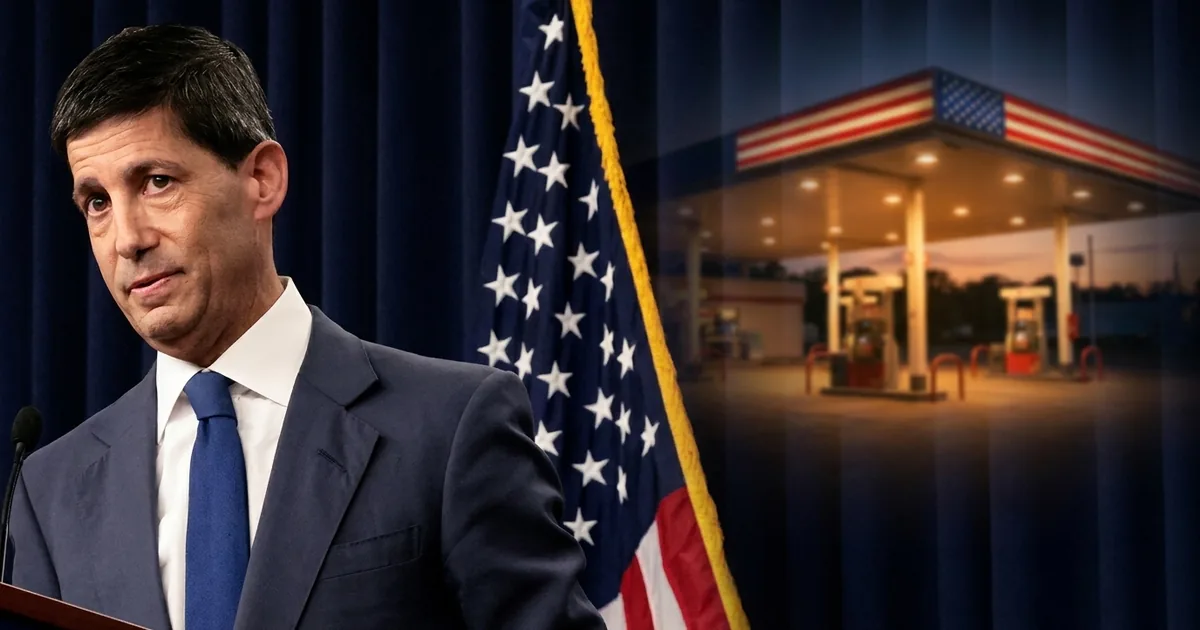
The Federal Reserve raised its benchmark interest rate by a quarter point on Wednesday, to a range of 3.75% to 4%, in a unanimous vote that included Kevin Warsh, the chair President Trump chose because he expected him to cut. It is being told as a story about a central banker defying the man who appointed him, and that framing quietly lets the White House walk away from the inflation that forced the vote.
The story being told: Trump’s own appointee stood up to the president and raised rates for the first time since 2023.
The number underneath it: gasoline is up 27.4% in a year, roughly eight times the 3.4% headline inflation rate, on the back of the Iran war.
The defiance story is not wrong, which is what makes it so useful to the people it leaves out. When Warsh was named in January, LNC called him a convenient convert to lower rates, a longtime inflation hawk who discovered the virtues of cheap money right as the job opened. Trump did not pretend otherwise. NBC News’ Tom Llamas asked him in February whether Warsh would have been picked had he said he wanted to raise rates, and the president answered in seven words.
“He would not have gotten the job.”
President Trump to NBC News, February 2026
So yes, Wednesday is a reversal, and a public one. But a story about two men and a principle is a story in which the interest rate is the thing being fought over. The thing actually driving it sits somewhere else. CBS News reported last week that consumer prices rose 3.4% in the year to August and that gasoline, up 3.9% in that month alone, accounted for more than a third of the monthly increase. That is the war: oil is climbing again after drones shut Saudi Arabia’s Hormuz bypass pipeline. The Associated Press, in its preview of the decision, noted that tariffs may still be lifting some costs, appliances among them.
Now read the Fed’s own statement. It says inflation “remains elevated” and that uncertainty is high “owing, in part, to geopolitical developments.” It never mentions oil, Iran or tariffs. Central banks write like that on purpose, because a Fed that grades a president’s war is a Fed begging for a fight it cannot win. The result, though, is that the only institution publicly acting on this inflation is also the only one that will not say where it comes from, and the naming gets left to the White House.
A Rate Hike Cannot Reopen Hormuz
Our read of the mechanism is simple. Higher rates do not lower the price of a barrel of oil. They work by making mortgages, car loans and credit card balances more expensive until households spend less and employers hire less, and the median Fed official now expects one more hike before the year is out. Against an oil shock, that means the cost of a war gets paid through the borrowing costs and paychecks of people who never had a vote on it.
The White House has already written its part. Before the vote, National Economic Council director Kevin Hassett told Fox News on Sunday, in remarks the AP quoted, that Trump would not be “super happy” but “will defend the independence of Kevin Warsh above all.” That is a gracious loser’s line, and it moves the argument onto Fed independence, where the administration can look principled, and away from gas prices, where it cannot.
Warsh made a defensible call on the evidence, and he should get no medal for it. Declining to do what a president demands is the job.
The people who owe an answer for 3.4% inflation are at the other end of Pennsylvania Avenue. If Trump wants cheaper money, a new Fed chair was never the fast route. Cheaper gas is. So are fewer tariffs.
Both are his to deliver.