
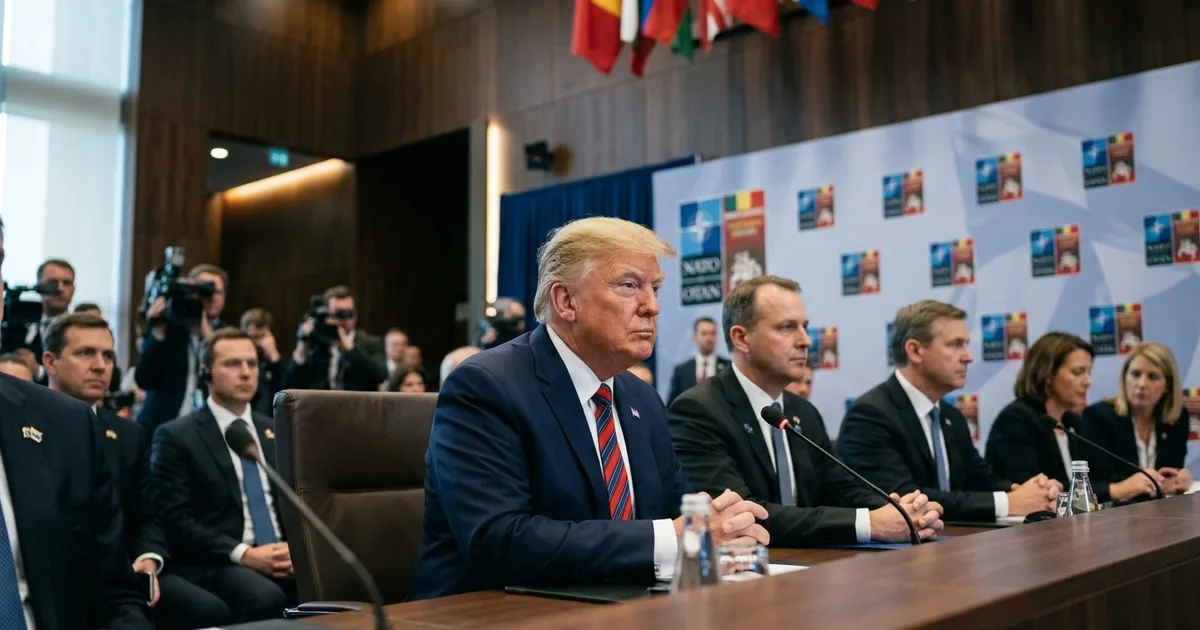
President Donald Trump declared Wednesday that the ceasefire between the United States and Iran is finished, telling reporters at the NATO summit in Ankara that he no longer wants to negotiate with Tehran after days of escalating military strikes across the Persian Gulf.
“I think it’s over,” Trump said, sitting alongside NATO Secretary General Mark Rutte at the alliance’s annual summit. “I don’t want to deal with them anymore. They’re scum.”
What Triggered the Collapse
The declaration came after an overnight exchange of fire that obliterated what remained of the ceasefire’s already crumbling framework. On Tuesday, Iran-linked forces attacked three commercial ships transiting the Strait of Hormuz, the narrow waterway through which roughly 20% of the world’s oil passes daily. The Pentagon responded with strikes on more than 80 Iranian targets, which the U.S. described as proportional retaliation for the shipping attacks.
Iran’s Islamic Revolutionary Guard Corps then escalated further, launching missiles and drones against U.S. military installations in Kuwait and Bahrain, two Gulf Arab states that host significant American force posture. No U.S. casualties were immediately reported, but the tit-for-tat cycle had already moved past the point where the ceasefire could plausibly be called operational.
The European Aviation Safety Agency warned Wednesday that the ceasefire’s implementation was “fragile,” a diplomatic understatement that Trump’s comments effectively rendered moot.
The Ceasefire Was Never a Peace Deal
The structural problem was always that neither Washington nor Tehran had committed to the conditions required to make the truce hold. The ceasefire, brokered under pressure from Gulf Arab states and European intermediaries, was a management tool designed to prevent full-scale war, not a framework for resolving the underlying conflict.
Iran never agreed to dismantle its proxy missile network or halt its nuclear enrichment timeline. The U.S. never offered to draw down its military footprint in the Gulf or lift the sanctions regime that Tehran considers existential. Both sides treated the ceasefire as a pause button, not a settlement, and when Iran’s IRGC resumed attacks on commercial shipping, the pause ended.
Trump’s decision to publicly declare it dead, rather than letting it erode quietly through escalating “incidents” that both sides could disavow, represents a deliberate choice. Walking away from the ceasefire at a NATO podium, with Rutte beside him, signals to both allies and adversaries that the U.S. is prepared for an extended military confrontation rather than another round of back-channel diplomacy.
LNC previously reported on the NATO summit’s opening day in Ankara, where Trump’s demand that allies spend 5% of GDP on defense dominated the agenda. The Iran escalation now threatens to overshadow every other item on the summit’s schedule.
What Comes Next
CNN reported Wednesday that despite the inflammatory rhetoric, Trump did not entirely close the door on future negotiations to permanently end hostilities. That qualifier matters, because Trump’s deal-making instincts have historically pulled him back to the table even after dramatic walkouts, as they did with North Korea in 2019.
But the military dynamics are different now. The Strait of Hormuz attacks crossed a line that even the most flexible ceasefire interpretation could not absorb. Commercial shipping insurers were already repricing Gulf transit risk before Trump spoke, and oil futures spiked in overnight trading as the comments circulated.
The Pentagon’s decision to hit more than 80 targets, as NPR first reported, suggests the U.S. military had pre-positioned strike packages for exactly this scenario. That level of preparation does not happen overnight; it happens when planners have already concluded the ceasefire is functionally dead and are waiting for the political authorization to say so publicly.
The Gulf Allies’ Dilemma
Kuwait and Bahrain now face an acute security problem. Both countries host U.S. bases that Iran has demonstrated it can reach with missiles and drones. Neither government signed up to be a frontline target in a U.S.-Iran war, and the IRGC’s decision to strike those installations, rather than confining its retaliation to maritime targets, raises the stakes for every Gulf state hosting American forces.
Saudi Arabia, which helped broker the original ceasefire, has remained conspicuously silent since the Hormuz attacks began. Riyadh’s calculus is straightforward: it needs U.S. security guarantees, but it also needs stable oil markets and functioning shipping lanes. A full-scale U.S.-Iran conflict delivers neither.
The Question Nobody in Ankara Is Answering
The ceasefire collapse leaves a gap that no one at the NATO summit appears ready to fill. If the diplomatic framework is dead and both sides are actively exchanging fire, the conflict is no longer a managed standoff. It is an undeclared war with no offramp, no mediator, and no consensus among U.S. allies about what the endgame should look like.
Trump’s willingness to say “it’s over” while the rest of NATO’s leaders were still drafting careful statements about “de-escalation” and “restraint” captures the core tension. The U.S. president has decided the ceasefire failed. His allies have not yet decided what replaces it.