
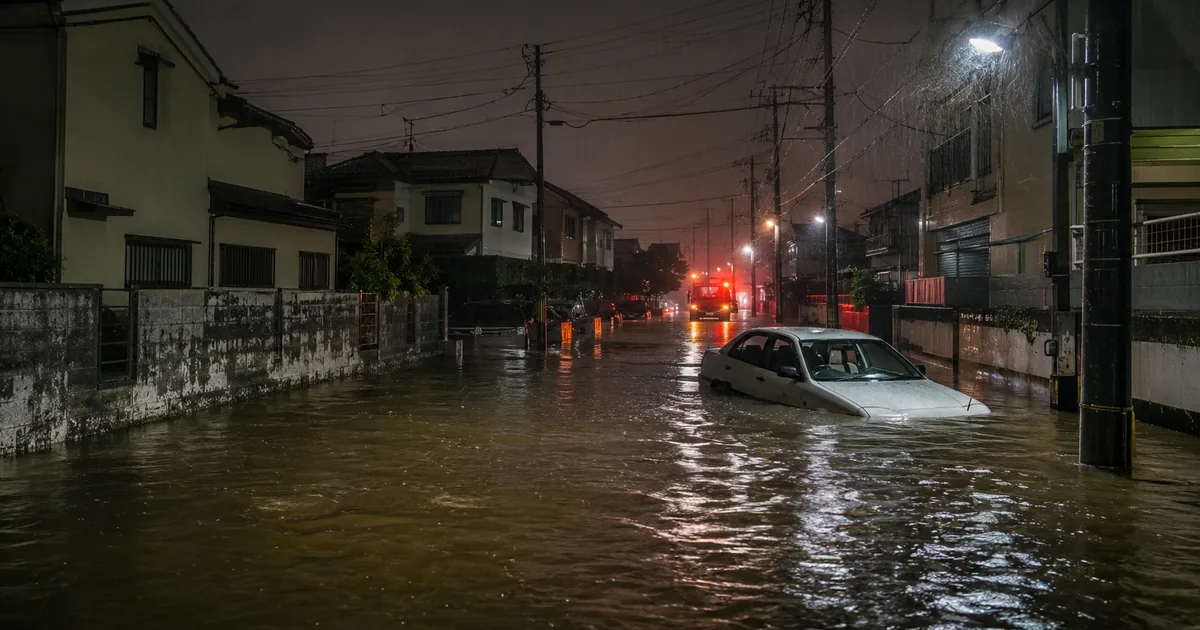
Eight people are dead in the prefecture that borders Tokyo after a night of rain that Japan’s weather agency said had no precedent in the region’s records.
The dying did not happen on a mountainside or in a remote valley, it happened on suburban roads, mostly to people in cars, during the week when the entire country is trying to get home.
The Chiba Prefectural Government confirmed the toll on Friday afternoon across five cities, Chiba, Kashiwa, Ichikawa, Sakura and Yachiyo, with four more people treated for minor injuries. That number climbed all day. Reuters was reporting four dead on Friday morning, NHK had six by midday, and the prefecture’s own count reached eight by early afternoon, which is the shape every flood story takes when the water has to go down before anyone can look underneath it.
What Actually Fell
The rainfall figures are the story here, and they are worth reading slowly rather than skimming as a blur of millimeters.
- Chiba City recorded 348mm in the twelve hours to 1:40 a.m. Friday, the highest since records began there, and roughly three times what the city normally receives across the whole of August.
- An observation station in Chiba City’s Midori Ward logged about 450mm in six hours starting at 6 p.m. Thursday.
- Parts of the prefecture took more than 115mm in a single hour, and more than 360mm across 24 hours.
Three months of August rain in half a day. The Japan Meteorological Agency put out 25 separate emergency bulletins for record-breaking short-term heavy rain over the course of the night, and has since given the event a formal name, “Reiwa 8 August Chiba Heavy Rain.” That naming is the bureaucratic tell that Japan expects to be referring back to this one for years.
The Alert That Had Never Been Used Here
At around 7:30 p.m. Thursday the JMA issued a Level 5 heavy rain emergency warning for Chiba. Level 5 sits at the top of the scale, and the language attached to it is not the language of preparation. It means the disaster is already underway and the window for moving safely has closed.
It was the first time the agency had ever issued that warning for the Chiba region.
“Rain at a level never experienced before,” the agency said, warning that the highest level of caution was needed even in places normally considered safe from disaster.
That second clause is the one that matters, and it is why this is not really a weather story. Japan is arguably the best-prepared country on earth for water, with the hazard maps, the drill culture, the tiered alerts and the engineered rivers to show for it. Chiba’s governor, Toshihito Kumagai, called it an extremely unusual situation and said he had never experienced a case like it. The system worked in the sense that the warning went out. It did not work in the sense that the warning was calibrated for a place that had never needed one.
Why the Deaths Happened on the Road
Here is the part the wire copy leaves as a list of victims.
A man in his 60s or 70s was found floating on a flooded road. A 66-year-old woman was trapped in her submerged car. A man was found collapsed in the street. In Kashiwa, an elderly woman was pulled from a vehicle on a flooded road in cardiopulmonary arrest. These are not people who ignored an evacuation order on a hillside. These are people who were driving, or walking, through an ordinary suburb at night.
The timing did that. This was Bon week, the Buddhist holiday when Japan empties its cities and refills its hometowns, one of the two or three busiest travel periods of the year. The roads were carrying holiday traffic when 115mm fell in an hour, and a road that takes that much water in that little time stops being a road. A car is the most dangerous place to be in a flash flood and the single most likely place for a person to be at 9 p.m. on a travel night. A Level 5 warning issued at 7:30 p.m. to a prefecture that had never received one reached a population already in motion, which is a very different thing from reaching a population at home.
Roughly 230,000 residents were advised to take shelter and about 102,600 were placed under evacuation orders, in a prefecture where the safest instruction available was to stop moving.
Seven Thousand People on an Airport Floor
Narita, one of the two international gateways to Tokyo, spent the night as a shelter. Train and bus links to the airport were cut, and about 7,000 passengers were still stranded there at 4 a.m., queueing for blankets, water and snacks from airport staff before bedding down across the terminal floor. Japan’s Ground Self-Defence Force pulled 4,000 people out of Soga station, where they had been stuck for hours. Hundreds sheltered inside the Chiba prefectural government building. More than 22,000 households lost power, with some counts running nearer 26,000, and dozens of homes flooded across Ichikawa, Kashiwa and Sakura.
By Friday morning the JMA had downgraded the Level 5 warning for 22 municipalities and the emergency landslide warnings for six cities as the heaviest rain eased. Trains resumed in pieces, with delays. More rain sat in the forecast, and on ground this saturated that is a different threat than the first night was.
The Uncomfortable Read
Chiba is not a floodplain village. It is the commuter belt of the largest metropolitan area on the planet, and it just absorbed a rainfall event its own instruments had no record of.
The lesson most places will reach for is about drainage capacity or alert timing, and both of those are real. The harder one is sitting inside the JMA’s own warning: caution is needed even in places normally considered safe from disaster. Risk maps are built out of history. When the rain stops respecting the history, the map stops being a map and becomes a record of what used to be true. Japan will name this storm, study it, and rebuild for it, because that is what Japan does. The open question is how many other commuter suburbs are sitting inside a Level 5 that has not been issued yet.