
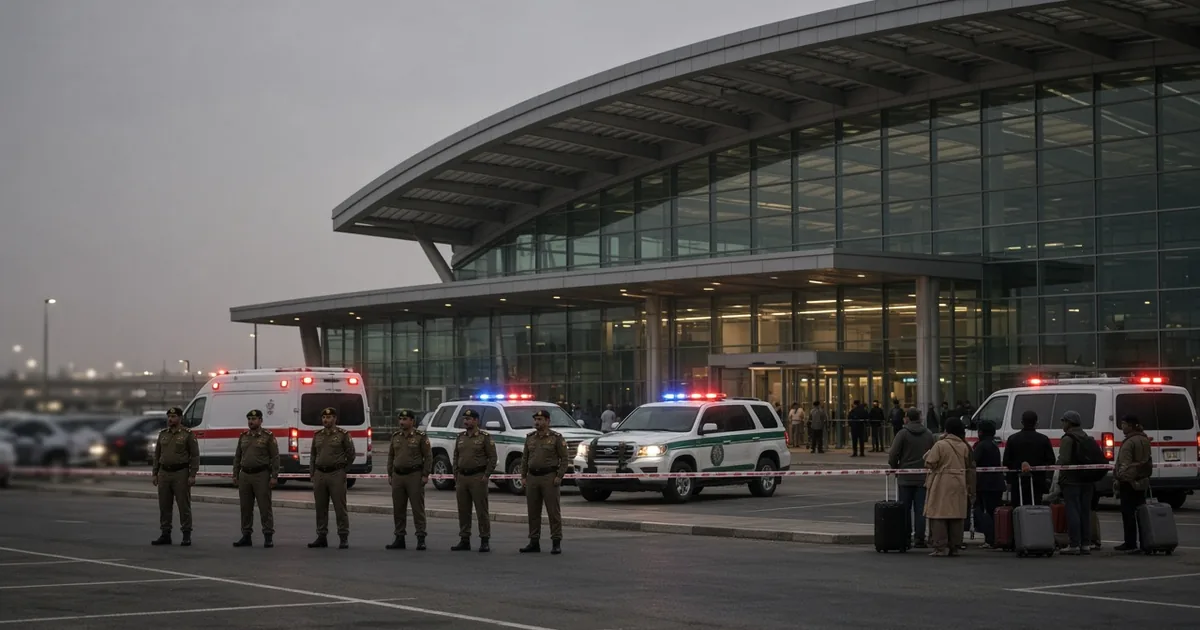
“[T]he number of people killed in an attack on King Fahd International Airport in the eastern city of Dammam has risen to two.”
An attack on King Fahd International Airport in Dammam killed two people and wounded eight on Wednesday evening, Saudi Arabia’s civil aviation authority said, in a statement whose toll had already been revised upward once. The dead are a Saudi citizen and an Indian resident, and the wounded come from five countries. Every report we found treats this as a single incident, when it is at least the sixth day of airport strikes since October 6, the fifth airport on the list, and the point where a timeline that starts at the Yemeni border reaches the Gulf coast.
The authority did not say what kind of attack it was, Saudi officials have not said who carried it out, and the Houthis offered no immediate comment. The Houthis did warn airlines this month against using Saudi airspace while they stepped up attacks on the kingdom, so nobody is guessing wildly about where to look. The Saudi-led coalition said four more drones were intercepted on Wednesday night.
The Month, Counted
The National’s day-by-day timeline runs through October 11. We added its death figures ourselves and put Wednesday on the end:
- October 6: Jazan and Najran airports. Three injured, no deaths.
- October 7: Riyadh’s King Khalid and Abha. Three foreign nationals killed, 36 injured. The Houthis claimed it.
- October 8: Riyadh again. Three killed, including an airline pilot, and a Saudia aircraft damaged.
- October 10: Riyadh a third time, at the domestic terminals. Twelve killed at first, a thirteenth later, 309 injured.
- October 11: Riyadh and Dammam. One Pakistani killed, 11 injured.
- Wednesday, October 21: Dammam. Two killed, eight injured.
Zero plus three plus three plus thirteen plus one plus two is 22. Saudi authorities’ own count, as reported alongside the Dammam attack, is at least 21. We cannot close that one-death gap from published figures, so treat the toll as 21 to 22, and note that the number most likely to be quoted back to you is the smaller one.
What the Map Says
Jazan and Najran sit against the Yemeni border. Abha is in the southwest. Riyadh is the capital, in the middle of the country. Dammam is the eastern oil hub of what Reuters calls the world’s biggest oil exporter. We read that sequence as a widening arc of civilian terminals, and Dammam is where it reaches the part of the country that pays for the rest.
It is also the second time Dammam has been hit. The Houthis claimed the October 11 strike there. Wednesday’s has no claim yet. Silence from a group that has claimed other strikes is not an alibi, and it is not evidence either. We will say what we can source: Saudi Arabia has not named an attacker, and the group that has warned airlines off is the same one that declared “Saudi airspace is a military zone.”
Who Is Standing in Terminals
The October 10 dead alone came from at least eight countries, among them Bangladesh, Egypt, Jordan, Syria, Sudan, Palestine and the United States. Wednesday’s wounded are Saudi, Indian, Yemeni, Nepali and Bangladeshi. These are the airport’s workers and passengers, which is exactly who an airport is made of. We think attacks on passenger terminals are indefensible whatever grievance is attached to them, and that calling this a “pressure campaign” on the Saudi state flatters it.
The Cost of “We May”
When a reporter asked on October 10 whether the United States would join Saudi strikes on the Houthis, Trump answered “We may. We’re going to look at it,” after having ordered such strikes prepared in September and then canceled them. That was eleven days ago, and at least three more people have died at Saudi airports since. Our earlier reporting also found Riyadh short of interceptors and asking France, Britain, Pakistan and Egypt for air defense help, which makes “we may” a long way from a shield. It describes a posture, not a policy.
Watch two things. Whether the Houthis claim Wednesday’s attack, and whether carriers keep flying into a kingdom whose airspace has been formally declared a target.