
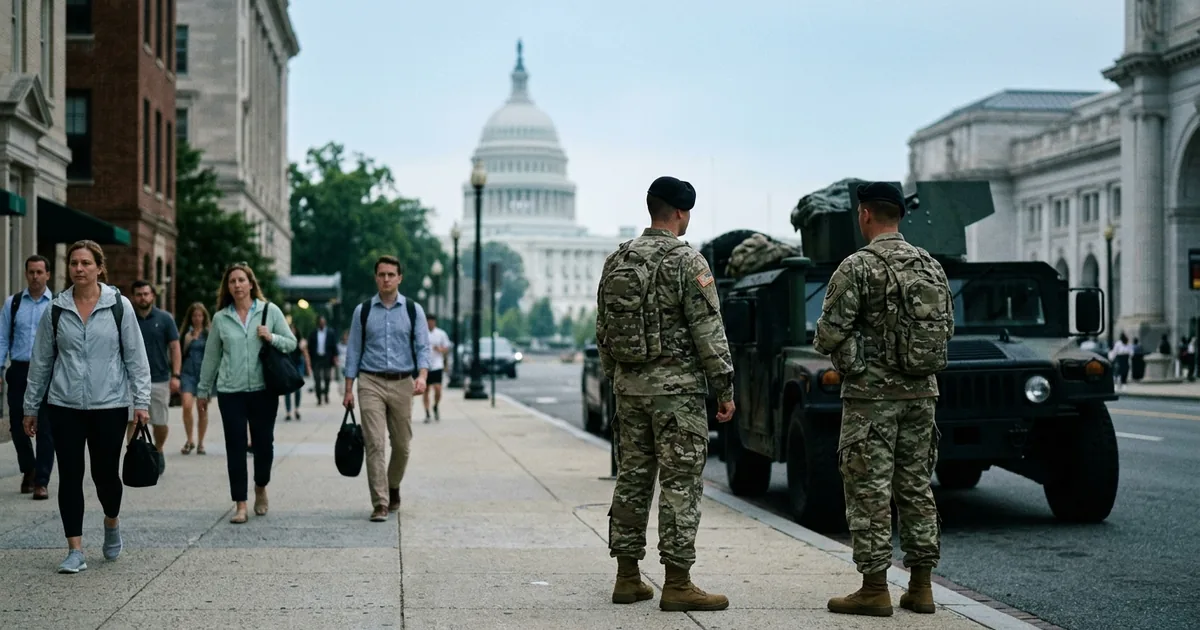
A year ago Tuesday, the emergency in Washington was supposed to last 30 days.
It is now scheduled to end on Inauguration Day 2029, at a projected cost of $1.4 billion, and nobody in the federal government has ever published the number that would make it stop.
That gap, between a legal clock measured in weeks and a deployment measured in presidential terms, is the actual story of the last twelve months. On August 11, 2025, President Donald Trump signed Executive Order 14333 and invoked Section 740 of the District of Columbia Home Rule Act, the emergency-control provision that lets a president commandeer the Metropolitan Police Department. It had never been used before. As Time explained at the time, the statute caps that federal control at 30 days unless both chambers of Congress pass a joint resolution extending it. Congress never passed one.
So the police takeover expired, as written. The troops did not.
The Authority That Had No Off Switch
The reason the two halves came apart is a quirk of the District’s status that most Americans have never had cause to think about. Every state’s National Guard answers to a governor, which is why the Trump administration’s out-of-state deployments have generated a running series of court fights, including the Los Angeles case where a federal judge ruled the deployment illegal. The D.C. National Guard has no governor. It reports to the president, full stop, through the secretary of the Army. There is no intermediate official with standing to object, no state attorney general with an obvious cause of action, and, as Brookings laid out in its analysis of the legal basis, no statutory clock of the kind Section 740 imposed on the police piece.
Section 740 had a 30-day limit because Congress wrote one. The Guard deployment has no limit because Congress never imagined it would need to write one.
That is the structural why here, and it matters more than any individual month’s crime statistic. The emergency did not get extended through some contested act of executive overreach that courts could review. It simply flowed into the one channel where the ordinary checks do not exist, and stayed there. In July, the Pentagon confirmed to NPR that the mission will run through Inauguration Day 2029 unless the president decides otherwise. Read that end date again. It is not tied to a homicide rate, a clearance rate, or a benchmark of any kind. It is tied to the day this administration leaves office.
What $3 Million a Day Bought
The numbers are now large enough to be their own argument. The Defense Department estimates the extension will cost roughly $1.4 billion, a figure PBS NewsHour reported in full, and the Congressional Budget Office has put the current burn rate above $3 million a day. Roughly 4,600 troops from the District and two dozen states were still deployed as of early August, at something over $600 per person per day once salaries, food, clothing and transportation are counted.
What did that buy? The honest answer is: a real effect on one category of crime and almost nothing on the category the emergency was declared over.
Low-level property crime fell by about a quarter over the deployment. Violent and other serious crime barely moved. That is a defensible result for a visible-presence policing strategy, and it is also, precisely, not the result the emergency was sold on. Trump declared a crime emergency in a city where violent crime had already fallen to a 30-year low. The administration has spent the year pointing at the subsequent decline as vindication, which requires ignoring both the pre-existing trend line and the fact that the sharpest movement came in the offenses nobody was calling an emergency.
The Center for American Progress went further in a report this month, putting the cost of Guard deployments across multiple cities at $1.7 billion and concluding they failed to reduce urban crime. Trump dismissed the findings as “another Radical Left SCAM,” which is a response, though not to the arithmetic.
A City That Adapted, Which Is Its Own Kind of Loss
The most quietly alarming reporting from the anniversary was not about the money. NPR’s dispatch found that after twelve months, the troops have simply become part of D.C. life. Residents route around them. Tourists photograph them. The uniformed presence at Union Station and on the Mall has stopped registering as an event.
A military deployment that no longer feels remarkable to the people living under it has accomplished something no court order can undo. It has moved the baseline.
Al Jazeera’s reporting from the District found residents genuinely split on whether the streets feel safer, which is the honest picture and the one most partisans on both sides have avoided. Some people like seeing troops on the corner. That is a real preference held by real residents, and dismissing it is how you lose the argument. But a preference is not a legal authority, and comfort is not a metric. The ACLU of the District marked the anniversary by pressing exactly that point: the question is not whether some residents have made peace with the arrangement, it is whether the arrangement is lawful and accountable to anyone in the city it governs.
Meanwhile the model is spreading. The Pentagon has already moved toward standing up quick-reaction forces in every state’s Guard, which is the infrastructure you build if you expect domestic deployment to be routine rather than exceptional.
The Rally on 16th Street
On Tuesday, the advocacy group Free DC capped eleven straight days of demonstrations with a rally near the White House, on the same block where the emergency was announced a year earlier. Organizer Sam Davis made the symmetry explicit, telling WTOP the group stood in that exact spot twelve months ago when the deployment was announced.
Free DC’s own assessment of the year is more interesting than the standard protest line. Their organizers have said the clearest benefit of the federal surge has been how thoroughly it organized District residents against it. That is the sound of a political movement finding its footing, and it is also an admission that a year of pressure has not moved the deployment by a single day.
What Would Actually End It
Here is the part that should worry people who care about how emergency powers work, regardless of what they think about troops in Washington.
There is no defined condition under which this ends. Not a crime threshold, not a review date, not a certification requirement, not a sunset. Congress declined to extend the police takeover and the deployment continued anyway, which established that congressional inaction is not a constraint. Courts have limited leverage because the D.C. Guard’s chain of command runs straight to the president. The District has no voting representation to withhold. The only listed end point is a date on the electoral calendar.
An emergency power with no exit criterion is not an emergency power. It is a governing arrangement that borrowed the word. The precedent being set in Washington is not really about Washington: it is that a president can convert a 30-day statutory authority into a four-year military presence by finding the one jurisdiction where nobody has standing to say no, and then simply not stopping.
The next president inherits that, whoever it is. So does the one after.