
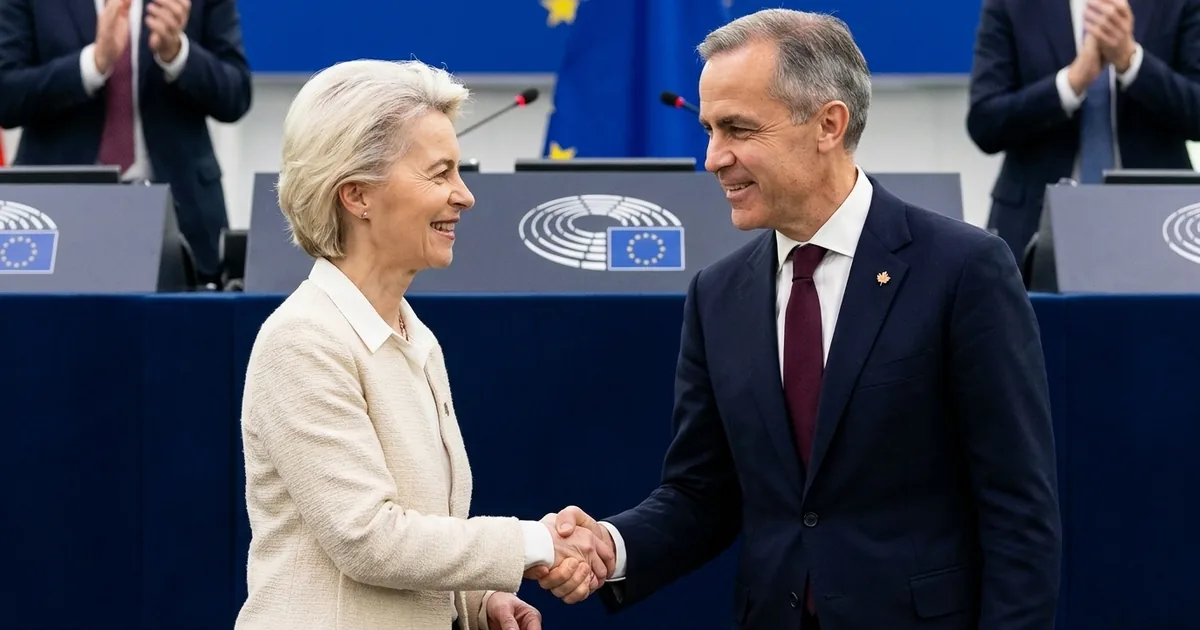
Ursula von der Leyen used her State of the Union address in Strasbourg on Wednesday to invite Canada to become the European Union’s first associate member, with Prime Minister Mark Carney watching from the front row. The status does not exist yet, and the last deal Brussels signed with Ottawa is still unfinished: 10 of the EU’s 27 member states have not ratified the Canada trade agreement, almost ten years after it was signed.
“I would like to work with you on opening the door for Canada to be the first associate member of the EU.”
Ursula von der Leyen, State of the Union address, Strasbourg, September 16, 2026
Nobody in the chamber applauded the ratification gap. It is still the part that decides whether the offer means anything.
The room stood. Carney rose, walked to the podium and embraced her, then went back to his seat. His office followed with a statement that never used the words “associate member.” It welcomed an “alliance for the future” and called the idea “a unique, positive approach that we will define together.”
Jonathan Wilkinson, Canada’s incoming ambassador to the EU, was blunter. The two sides are “a ways away” from agreeing what to call the relationship, he told reporters. Carney had already said on Sunday that Canada is not looking to join the bloc.
What von der Leyen actually put on the table is narrower than the headline. The Globe and Mail listed it: intelligent manufacturing, a technology alliance, integrated defence production, the Arctic as “a flagship joint project,” plus energy, critical minerals, batteries, artificial intelligence and quantum science. “This is not a partnership against anyone else,” she said. Nobody in Strasbourg needed the name Donald Trump to hear who she meant.
Canada has its reasons. Ottawa walked away from trade talks with Washington in August as a 50% tariff kicked in. Last week Carney pledged to build millions of military drones, a third of them for Ukraine, which is exactly the defence output von der Leyen wants wired into Europe’s. And both sides have been answering Trump’s tariffs in tandem since March 2025.
The Real Counterparty Sits in Ten National Capitals
Associate membership has no legal definition. Article 49 of the Treaty on European Union opens membership only to European states, which rules Canada out of the real thing. Anything short of that is a negotiated agreement, and the Globe noted it would need approval from all 27 members.
That is where CETA, the Comprehensive Economic and Trade Agreement, stops being history. It has applied provisionally since September 2017 and covers roughly 90% of the text. The investment protection chapter and its dispute tribunal still are not in force, a Library of Parliament review found, because they wait on every national parliament. Seventeen states have finished. Belgium, Bulgaria, Cyprus, France, Greece, Hungary, Ireland, Italy, Poland and Slovenia have not. Cyprus’s parliament voted the deal down in 2020. France’s Senate refused it in March 2024.
France and Italy are two of Canada’s three largest EU trading partners. Neither has ratified.
The resistance showed up in the chamber within the hour. Nicola Procaccini of Brothers of Italy, Prime Minister Giorgia Meloni’s party, asked why the United Kingdom did not get priority and accused von der Leyen of “bowing to Prime Minister Carney.” Jordan Bardella of France’s National Rally declared the “current system is reaching its end.” His party’s candidate leads most polls for France’s presidential election next April.
The idea is not new either. German Chancellor Friedrich Merz floated associate membership for Ukraine earlier this year, and the EU was reluctant to entertain flexible membership categories then. The model Merz described, Euronews reported, was a seat in decision-making bodies without a vote.
Our view: von der Leyen is right about the direction and ahead of her own members on the mechanics. A bloc that has not finished ratifying a trade deal it has run for nine years is not ready to invent a new tier of membership. A title with nothing behind it hands Pierre Poilievre, who is already warning about Canadian control over “our tax money, and our immigration policies,” a ready-made attack line without giving Canadians a single concrete thing. Carney’s caution is the correct call.
Can Canada actually join the European Union?
Not as a full member. EU treaty rules limit membership to European states, and Carney has said Canada is not seeking it. “Associate member” is not a legal category in EU law today, so it would have to be created through a new agreement.
What would associate membership give Canada?
Nobody has said. Neither leader has spelled out whether it means access to the single market, which EU rules Canada would follow, or rights to live and work across the Atlantic. Norway, Iceland and Liechtenstein already get the single market without membership, and without a vote.
Does this change the existing EU-Canada trade deal?
Not yet. CETA stays in provisional force, and von der Leyen framed the new alliance as the next step beyond it. The investment chapter still needs the 10 outstanding national ratifications.
What Montreal Has to Show
The next test has a date. Canada hosts an EU summit in Montreal on October 29 and 30. CETA was signed in Brussels on October 30, 2016. The summit closes on the deal’s tenth anniversary, with ten ratifications still missing.
The EU wants Canada’s critical minerals, its energy and its Arctic. That is leverage, and Carney should spend it on paper rather than applause: a ratification timetable from the ten holdouts before anyone drafts an associate-membership text. Belgium, whose regions nearly stopped the signing ceremony in 2016, is still on the list.
Strasbourg gave Canada a standing ovation. Montreal will show whether the ten capitals that never finished the last deal are ready to sign the next one.