
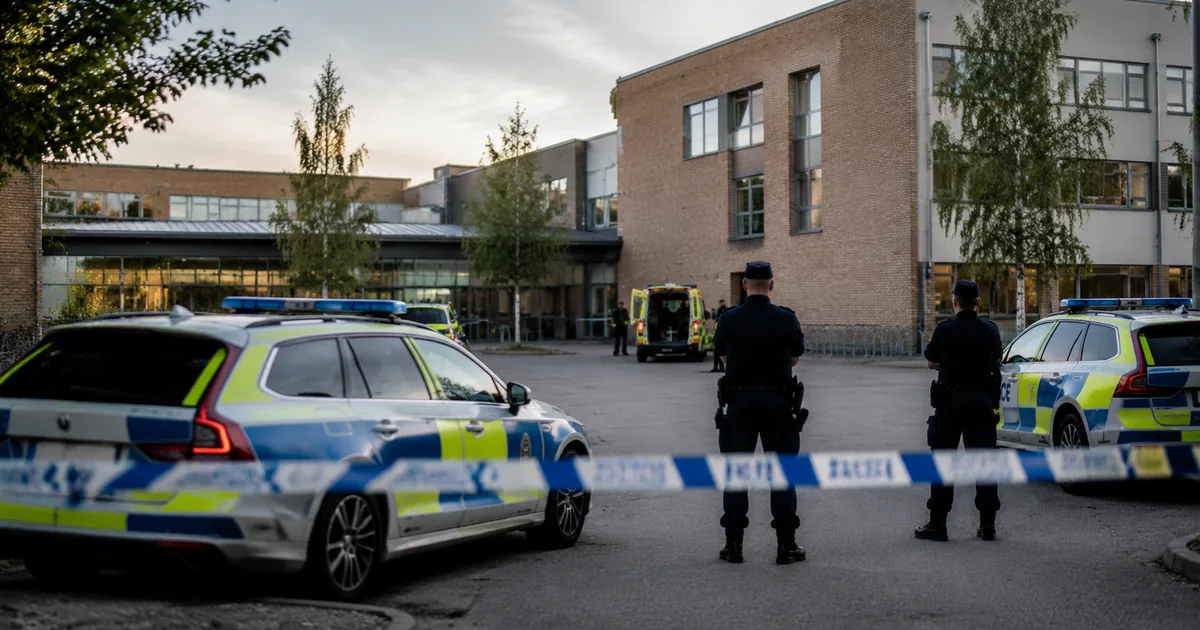
A man carrying a sword walked into Brinellskolan, an upper secondary school in the central Swedish town of Fagersta, on Friday afternoon and wounded several people before police took him into custody. Sweden spent the eighteen months since the Örebro massacre rebuilding its firearms law, and the weapon that reached those students on Friday was not touched by a single line of it.
What Fagersta Knows, and What It Still Does Not
The confirmed picture is thin, which is normal two hours into something like this. Fagersta municipality said in a statement that an assailant armed with a sword had entered Brinellskolan and wounded several people, and Al Jazeera reported that the school holds roughly 450 students between the ages of 16 and 20. The emergency call came in at 14:06 local time, according to Swedish outlet Sweden Herald.
Police have not released a count of the injured, have not described their conditions, and have not confirmed any deaths. One man was arrested at the scene. The tabloid Aftonbladet reported that officers shot the suspect in the leg, a detail police had not confirmed when this was published. Police spokesperson Pelle Vamstad declined to give specifics on either the weapon or the number of casualties, saying only that officers would examine camera footage that could be used in the preliminary investigation.
Treat every number attached to this story as provisional. “Several” is what the municipality said, and “several” is what it means until a hospital or a prosecutor says otherwise. The count in an attack like this usually moves, and it usually moves in one direction.
The Part of the System That Actually Performed
Strip out the parts nobody can confirm yet and something is still visible in Friday’s timeline: the response ran the way a drilled response runs.
Vamstad told reporters the force “responded and sent all available resources to the scene.” A police helicopter went up. Ambulances came in from surrounding regions, with three reserve vehicles staffed and dispatched from Västerås, and Region Västmanland moved into formal staff mode. Eight facilities across a town of about 12,000 people went into lockdown at once, including Brinellskolan itself, Risbroskolan, Fagerstahallen and the Olympen complex. The school was evacuated and students were sent home. Within the afternoon, police had a man in custody and were telling the public they saw no ongoing danger.
“A serious incident has occurred today in Fagersta at a school, right after the summer break.”
That was Prime Minister Ulf Kristersson, and the last clause is the one worth sitting with. This was the opening week of the Swedish school year. Justice Minister Gunnar Strömmer said the government was in close contact with the police, who were, in his phrasing, working very intensively on the incident.
None of that operational performance came from a weapons statute. It came from dispatch protocols, regional health coordination, and lockdown procedures that a lot of Swedish institutions have rehearsed since 2015. That distinction matters more than it sounds, because it is precisely the half of Sweden’s post-Örebro answer that never got written into law.
The Firearms Act Landed in June. It Was Never Going to Cover This.
On 4 February 2025 a 35-year-old gunman killed ten people at Campus Risbergska, an adult education centre in Örebro, in the deadliest mass shooting in Swedish history. The political response was fast and it was specific: Sweden went after the rifle.
The Riksdag decided on a new Firearms Act on 29 April 2026, and it entered into force on 1 June. The Act bans new licences for certain semi-automatic rifles used for hunting, a category Swedish ministers discussed publicly in terms of the AR-15, and it replaces five-year licensing for automatic and one-handed multishot weapons with a supervision regime. Existing owners were handed a transition window to relicense or sell, with a buyback at the end of it.
This is a real law, passed quickly by the standards of European firearms policy, and it is a rational answer to Örebro. It is also, as of Friday, a law that had been in force for eleven weeks and had nothing whatsoever to say about a man walking into a school with a blade.
Sweden’s School Attacks Have Mostly Not Involved Guns
Here is the uncomfortable pattern underneath the policy. Örebro is the outlier in Sweden’s record of school attacks, not the template.
In October 2015 a 21-year-old named Anton Lundin Pettersson entered Kronan school in Trollhättan wearing a mask and carrying a sword, killing three people in a racially motivated attack before police shot him. In March 2022 an 18-year-old student at Malmö Latin School killed two women teachers with an axe and a knife. Now Fagersta, and a sword again.
Of the three fatal school attacks Sweden has recorded in the past decade, two were carried out with edged weapons and one with a rifle. The one involving the rifle is the one that produced a national legislative overhaul. That is not hypocrisy so much as gravity: the deadliest single event pulls the policy toward its own particulars, and the particular in Örebro was a semi-automatic rifle. The same dynamic is visible well beyond Sweden. When we covered the Nonthaburi school shooting in Thailand earlier this month, the reform conversation that followed was again organised entirely around firearm access, and when a teenager was arrested after the attack at the Welfen-Gymnasium in Schongau, Bavaria in July, the German debate ran along the same groove.
Legislatures respond to the weapon in the last photograph. Attackers are not required to cooperate.
The Half of the Answer That Never Became a Statute
Days after Örebro, Sweden’s Minister for Schools, Lotta Edholm, floated the other half of the response: a legal requirement that schools keep their doors locked, paired with mandatory emergency training. It got a fraction of the attention the gun bill got, and there is no public record of it reaching the statute book with anything like the speed of the Firearms Act, which went from proposal to force in roughly sixteen months.
Locked doors and rehearsed drills have an unglamorous property that weapons law does not. They are indifferent to what the attacker is carrying. A door that does not open does not care whether the person on the other side of it has a rifle, an axe or a sword, and a staff that has practised a lockdown executes the same sequence either way. That is the entire argument for weapon-agnostic hardening, and it is also why it loses the news cycle every time. Banning a named rifle produces a headline and a vote. Funding a door-access retrofit across every municipal school in the country produces a line item and a procurement process.
What Fagersta appears to show, pending the facts that have not landed yet, is a country whose emergency response has genuinely absorbed the lessons of the last decade, attached to a legal framework that keeps solving for the previous attack.
The count of the injured will come out over the weekend, and the suspect’s identity and motive with it. The harder question arrives after that, and Swedish legislators have had eighteen months of warning that it was coming: what does a school security policy look like when it stops being organised around the weapon and starts being organised around the door?