
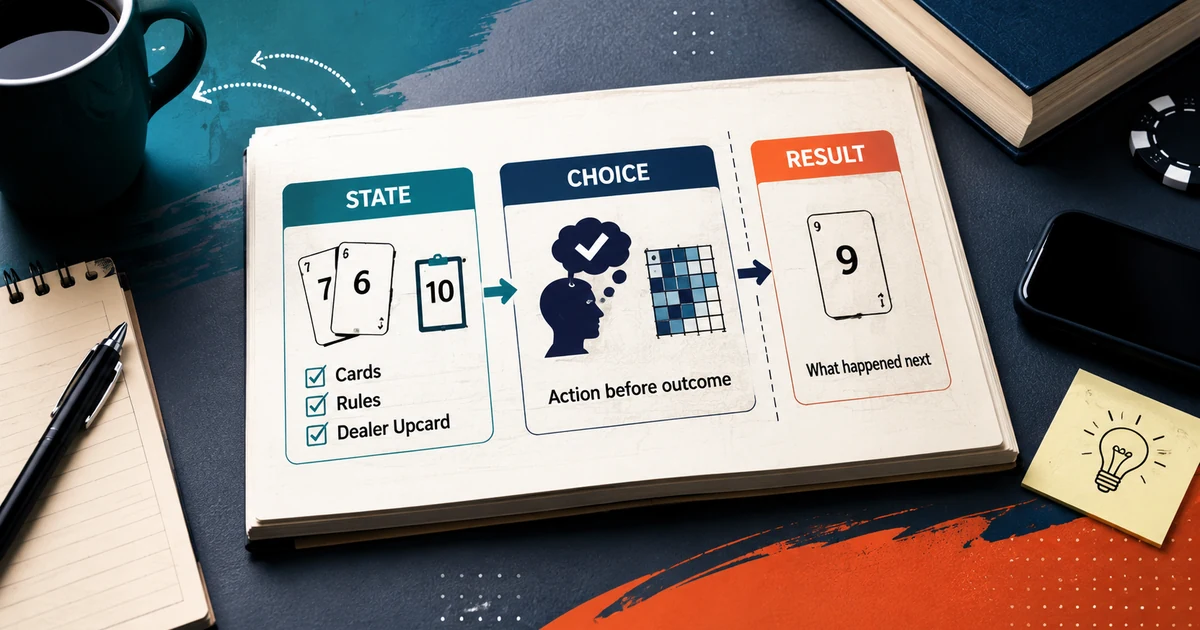
A blackjack hand can produce an unexpected outcome even when the decision was correct. That feels contradictory because the result is immediate and vivid, while the reasoning rests on probabilities spread across many possible hands. Once the dealer reveals the next card, it becomes tempting to judge the earlier choice with information that did not exist when it was made. The useful distinction is simple: a result tells you what happened once, while decision quality asks whether the available information was used correctly.
A PLOS ONE study comparing described and experienced risky choices found that people did not respond to stated probabilities in the same way as they responded to learning through repeated outcomes. This can help us understand why some players feel tempted to ignore the move that a chart tells them is optimal, despite knowing it has been calculated mathematically, and instead prefer to make a move that would have worked out in a similar situation that they remember occurring recently.
Judge the Choice Before the Result
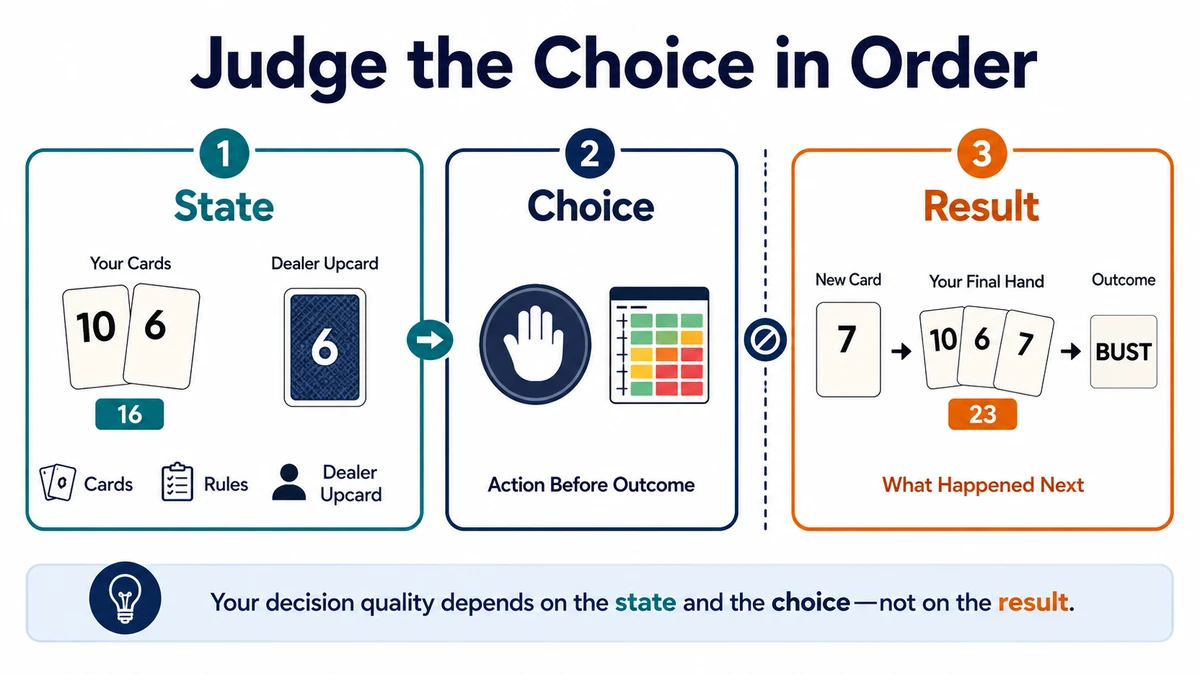
A fair review begins by freezing the hand before the next card appears. Record the state first: your cards, the dealer’s upcard, and the rules governing the version of the game you are playing. Then identify the choice recommended for that exact state, using guidance matched to the correct blackjack variant. This order matters when you play blackjack online, because each result follows so quickly that it can overwrite the reasoning that came before it.
An example shows why the order matters. Suppose the relevant chart calls for a hit, the player follows it, and the next card causes a bust. The review should not begin with the bust. It begins with whether the hand and dealer upcard were read correctly, whether the chart matched the rules, and whether the prescribed action was followed. A chart organizes decisions; it does not predict the next card.
A video covering insurance, paired cards, hard 16, and soft 18 is useful as an illustration of how many different choices can resist intuition. Getting better at blackjack is possible, but you need to know how to separate the rules from your feelings and be dedicated to avoiding the common mistakes and pitfalls.
Separate The Stages Of The Game
It can help to divide the game into three separate aspects: state, choice, and result. The state records everything that is knowable at the time. This doesn’t just cover your own cards, but the dealer’s upcard as well, and other details, such as any special rules and options that may be available to the player. Anything that can affect the outcome of your game is included in state, meaning you should be able to communicate it perfectly to someone else so that they can understand your exact situation and the choices you made from that position.
That brings us to the next aspect, choice. During the majority of a blackjack game, you will only have two real choices, hit and stand, although in some versions you may have additional options near the start, such as insurance, side bets, and the option to split your cards. Record the choice you actually made at each stage of the game, so you can properly review it later and confirm whether that was really the best option available to you at that time.
Finally, we have the result. This is the actual outcome of the game. Did you win, lose, or tie? In games where a natural blackjack pays extra, getting that should also be recorded. If you keep the results for each of your games, you should be able to review them and see whether you are playing well.
Don’t expect every good decision to lead to a good outcome, and don’t assume that a mistake was actually an insightful bout of intuition just because it led to a good result. Blackjack is a game built around randomness, so a certain degree of variation in the results is to be expected. Still, overall, you should see that the results of your games are more frequently positive when you play by the charts than when you try to wing it on feelings. If that isn’t the case, check that the chart you are using is correct for the version of blackjack you are playing.
Four Ways Intuition Can Mislead
The emotional pull changes with the decision. Insurance sounds protective, so refusing it can make you feel exposed, even though it is a separate wager that must be assessed on its own terms. A pair creates a visual urge either to preserve the matching cards or divide them. A hard total such as 16 feels trapped because every available action can produce an unpleasant result. A soft total such as 18 appears settled, although the ace’s flexible value changes the hand’s possibilities. These examples should never be reduced to one universal slogan. Strategy varies with the player’s cards, the dealer’s upcard, and the table rules.
A Frontiers in Psychology study of intuitive and analytic choices found that intuitive choices were associated with stronger emotions, especially satisfaction after positive outcomes, across scenario and retrospective studies. The research did not examine blackjack, and the authors noted that imagined and recalled situations cannot fully reproduce real-time decisions, but it still offers a plausible reason why a successful hunch can become more persuasive than a larger body of abstract guidance.