
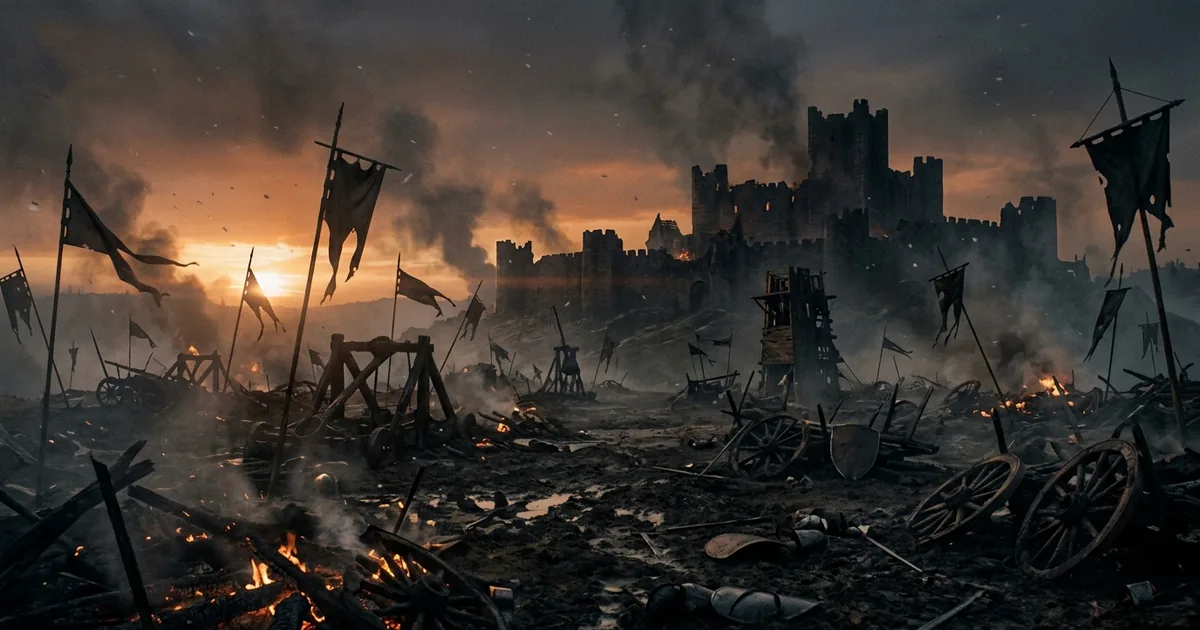
The eighth and final episode of House of the Dragon’s third season burned down half of Tumbleton, put a sword through a High Septon, and threw Helaena Targaryen off the Red Keep, and it did all of it well enough that the critics who spent June complaining about the season spent Monday admitting it stuck the landing.
Then HBO reminded everyone that the fourth and final season is not expected until 2028.
That gap is the actual story here, and it is bigger than any of the deaths. Spoilers follow.
The Season Recovered, Which Makes the Numbers Stranger
The finale earned its violence. Ormund Hightower and Roderick Dustin killed each other in the mud at Tumbleton and were then incinerated by Ulf’s dragon for good measure, a sequence Time walked through in its rundown of who died. Rhaenyra, refused an anointing by the High Septon, had him run through in his own sept. And Helaena, told plainly by Mysaria that she would be a prisoner for the rest of her life, stitched her fate into a tapestry and jumped, taking her unborn child with her.
NPR’s recap of the finale called it the rumble at Tumbleton and did not pretend the patriarchy in Westeros was subtle about why a woman with the better claim still could not get a crown put on her head. Forbes’ Erik Kain, who has been hard on this show, wrote that the finale reminded him why the story works. WBUR framed the whole season as a rocky run that found itself at the end. That is a rare consensus for a show this contested.
It is also a consensus that arrived after the audience had already voted. Deadline reported in June that the season three premiere came in 8 percent below season two’s, which is the kind of number that shapes a network’s thinking long before the finale changes anyone’s mind. Prestige television has a structural cruelty to it: the episodes that win back the skeptics air to the smallest audience of the season, because the skeptics left in week two.
A Two-Year Gap Is a Business Decision Wearing a Production Excuse
Showrunner Ryan Condal, who talked through the finale with Deadline, has confirmed the show ends with season four, with filming intended to start in spring 2027 and release slated for 2028. Dragons are expensive, the effects pipeline is long, and the cast has other jobs. All of that is true.
It is also true that Game of Thrones ran eight seasons in nine years, including its most effects-heavy stretch, and that the industry did not suddenly forget how. What changed is the math around a streaming service. A finished story is an asset that stops generating new subscriptions the moment it finishes. An unfinished story is a reason to keep paying, and the longer the gap, the more the marketing campaign for the return can be treated as a fresh acquisition event rather than a retention one.
The tell is that nobody at HBO seems worried about the risk that gap creates. Two years is long enough for a show to lose the thread of the culture entirely. Ask anyone who tried to explain the plot of the last season of Westworld to a friend. Ask HBO itself, which watched the ending of Game of Thrones become a punchline in part because the show sprinted through material it had spent years setting up. House of the Dragon is adapting the Dance of the Dragons, a civil war whose entire appeal is momentum, and the plan is to pause it for two years directly after the first season in a while that critics agreed was building properly.
Compare the opposite instinct. Apple looked at a show that had ended cleanly and brought Ted Lasso back for a fourth season because the audience relationship was worth more than the tidy conclusion. HBO is running the same logic in reverse: stretch the story that has not ended yet, because an ending is the one thing a subscription business cannot monetize twice.
What the Show Still Has to Prove
Season three’s real achievement was making Rhaenyra hard to root for without making her a villain. A queen who murders a religious leader for refusing to legitimize her is not a hero, and the show declined to soften it. That is a genuinely difficult note to hit, and the finale hit it in the same hour it staged its biggest battle.
Season four has to land the part of this story everyone already knows is coming and nobody has been able to film well: the collapse. The Dance of the Dragons does not end with a satisfying victory. It ends with both sides ruined, the dragons mostly dead, and a settlement that satisfies no one, which is precisely the kind of ending that made the last two seasons of Game of Thrones so hard to sit through when the show rushed it.
Condal has the material and, unlike his predecessors, he has a book that tells him where this goes. What he does not have is the audience’s patience, and he just spent two more years of it before writing a scene.
If season three proved the show can still find its footing after a wobble, season four has to prove something harder: that a story about the exhaustion of a dynasty can hold a room that has been asked to wait since the summer of 2026.