
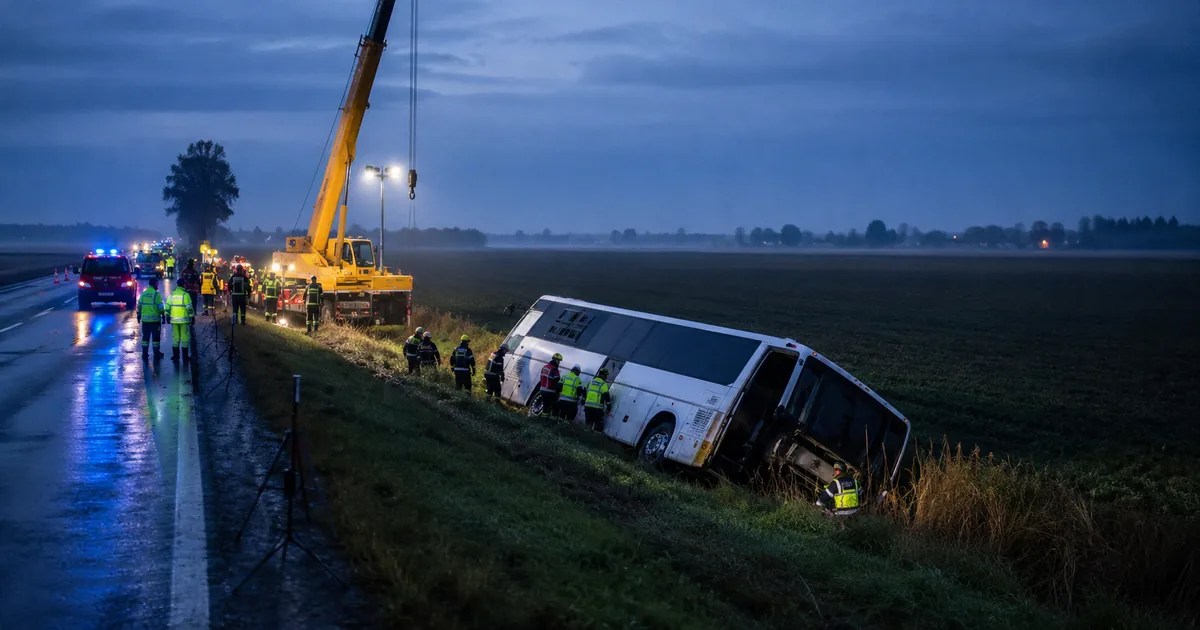
A coach carrying Polish pilgrims home from Bosnia-Herzegovina left the M3 motorway in northeastern Hungary at around one in the morning on Sunday, rolled into a ditch and came to rest on its side, killing twelve people. Hungarian police say the driver most likely fell asleep, which is the detail worth sitting with, because there was a second driver on board.
Eleven died at the scene and one more died in hospital. Al Jazeera reported that ten people were seriously hurt and the ambulance service counted thirty-seven with minor injuries. Passenger figures moved between outlets through the morning, which is normal in the first hours after a crash of this size and worth stating plainly rather than smoothing into false precision.
What Happened on the M3
The coach came off the M3 between Mezőkeresztes and Mezőnagymihály, roughly 140 kilometres east of Budapest, on the stretch Euronews placed it in the early hours of Sunday. It left the road, ended up in a ditch and stopped on its side, according to the account RTÉ carried. Firefighters dragged trapped passengers out through the windows. Two cranes were brought in to lift the vehicle.
One line in the Reuters account does more work than any other. The bus was heading northeast toward Nyíregyháza, and it drifted, Reuters reported, off a straight stretch of road. There was no curve to misjudge, no weather event described, no second vehicle. A coach simply stopped tracking the lane it was in.
Hungary’s National Directorate for Disaster Management put fifty-seven passengers and two drivers on board. Everyone aboard was a Polish citizen, foreign ministry spokesperson Maciej Wewiór told the Polish press agency PAP. They came from Podkarpackie, Poland’s southeastern corner, and they were returning from a pilgrimage in Bosnia-Herzegovina, the Associated Press reported.
Interior Minister Gábor Pósfai said the driver had been taken into custody. Prime Minister Péter Magyar, who defeated Viktor Orbán in this year’s election, said twelve people lost their lives and at least ten were seriously injured when the coach overturned overnight. Polish President Karol Nawrocki said he received the news with deep sorrow. Foreign Minister Radosław Sikorski said the consular service was operating and Warsaw was in contact with Hungarian authorities.
On the Hungarian side of the ledger, it is the country’s worst road accident since 2003, when a train struck a bus at Siófok and killed thirty-three people.
The Second Driver Is the Detail That Matters
Two drivers were on that coach. That is not incidental, and it is the reason this is not simply a story about one exhausted man.
European operators put a second driver on long international runs for precisely one reason: so nobody has to drive tired. Under Regulation 561/2006, the rulebook governing driving time across the bloc, a driver cannot go beyond four and a half hours without a forty-five-minute break, cannot exceed nine hours behind the wheel in a day except twice a week, and must take eleven hours of daily rest. A second driver is how an operator legally covers a route longer than one person can drive. The safeguard was not missing here. It was sitting on the bus.
Police say the driver likely fell asleep. There was another driver aboard whose entire function was to make that impossible.
The question is therefore not whether the rule existed but what the rule is up against. A pilgrimage coach running from Bosnia-Herzegovina to southeastern Poland is a multi-day haul across four borders, and the cheapest way to run it is through the night, because darkness is free and a hotel night is not. One in the morning is not a scheduling accident. It is the schedule, and it is chosen for the same reason the fare is affordable.
The Same Journey Killed Twelve Polish Pilgrims in 2022
Four years and ten days earlier, on 6 August 2022, a coach carrying Polish pilgrims of the Brotherhood of St Joseph toward the shrine at Medjugorje ran off the A4 in Croatia and into a ditch. Twelve people died and thirty-two were injured. Croatian media reported that the driver had fallen asleep or fainted. It was Croatia’s deadliest road accident since 2008.
Same nationality. Same pilgrimage route. Same ditch. Same suspected cause. Same number of dead.
Vatican News covered that crash as a tragedy of faith, and it was one. It was also a transport story that nobody followed up. Twelve deaths on the Medjugorje run in 2022 produced no European review of overnight pilgrimage coaching, no change in how these charters are procured, and no visible tightening of who is permitted to drive Polish pilgrims across a continent at night. That crash was absorbed as weather, as a thing that happens. Sunday suggests it is a thing that recurs.
The distinction between a tragedy and a pattern is not rhetorical. A tragedy calls for condolences, which every official involved has now correctly offered. A pattern calls for somebody to ask why the same trip keeps ending in the same ditch.
Brussels Spent 2023 Loosening These Rules, Not Tightening Them
Here is what will not appear in the condolence statements. In May 2023 the European Commission proposed making driving and rest rules more flexible for exactly this category of operator, the “occasional” bus and coach services that run tours and charters rather than scheduled routes. The proposal would let drivers:
- split the mandatory forty-five-minute break into two pieces of thirty and fifteen minutes, or three pieces of fifteen
- postpone daily rest by an hour on days under seven hours of driving, or two hours on days under five, once per trip of eight days or more
- use the twelve-day weekly rest postponement on domestic occasional runs, not only international ones
The Commission’s reasoning was that coach tourism is seasonal and unpredictable, that drivers sleep in hotels alongside their passengers, and that flexibility would reduce stress and fatigue rather than compound it. Maximum driving times and minimum rest durations were left untouched, so on paper the safety floor held.
Read that against a coach drifting off a straight road at one in the morning with a suspected sleeping driver and a spare driver aboard, and the reasoning gets harder to sustain. The pressure on this sector was never that a forty-five-minute break was awkward to split. It is that a charter market competing on price will use every hour the law leaves open, then schedule against the cheapest constraint remaining, which is a passenger’s willingness to travel while asleep.
What the Investigation Will and Will Not Answer
Hungarian investigators will do what these investigations do. They will pull the tachograph, establish who was driving and for how long, work out whether the crew was inside its legal hours, and determine whether the man now in custody bears criminal responsibility. That process matters enormously to the families, and it will probably settle the narrow question.
It will not touch the wider one, because no national road-accident inquiry is scoped to ask why one particular kind of journey, run by one particular kind of operator for one particular kind of passenger, keeps producing the same outcome in different countries. Poland, Hungary and Croatia share a rulebook and a market. The crashes are beginning to look shared too.
Twelve people from Podkarpackie set out for a shrine and did not come home. In 2022, twelve Polish pilgrims set out for the same shrine and did not come home. Somebody should be counting.