
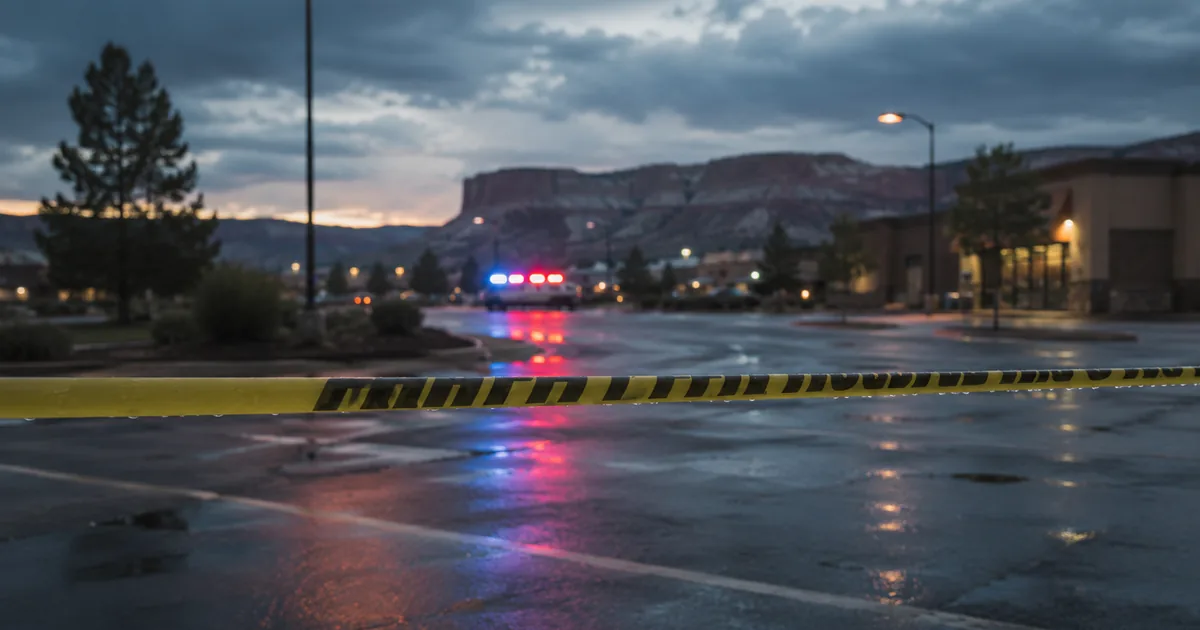
Twin Falls Police Chief Matthew Hicks stood in front of reporters on Saturday evening and declined to say how many people had been killed inside and around an In-N-Out Burger a few hours earlier. By then the number was already circulating nationally, sourced not to the podium but to law enforcement officials speaking privately, which made the first official act of this mass shooting an information gap rather than an answer.
The first 911 call came in at 2:29 p.m. local time, according to Twin Falls Police Lt. Steven Gassert. The restaurant sits at 1965 Blue Lakes Boulevard North, at Canyon Rim, just off the Perrine Bridge on the busiest commercial strip in southern Idaho. By 3:30 p.m. the bridge and the roads around it were closed. By early evening police said the suspected gunman was dead near the scene and that the threat to the public had passed.
The Count Nobody Would Say Out Loud
NBC News reported at least three people dead and two wounded, with the suspected shooter dead separately. Boise State Public Radio put it the same way: three killed, not counting the gunman. The Associated Press account described the dead as including the shooter, which is a materially different arithmetic. Twin Falls County Commissioner Brent Reinke told reporters early on that five people had been hurt.
Hicks himself would not pick a number. He said he did not yet know exactly how many had been killed or wounded, and police told the reporters assembled for the briefing that they would not publicly confirm a death count or release identities.
There is a defensible reason for that, and it is not obstruction. Next-of-kin notification in a county of roughly 90,000 people is not an abstraction; the families of the dead in Twin Falls are likely to hear a number on television before an officer reaches their door if the department gets ahead of itself. Police departments that guess early and revise downward also spend the following week fighting their own first draft.
But the practical result on Saturday night was a vacuum, and vacuums do not stay empty. Four hours after the shooting, the authoritative national figure for how many Americans died in Twin Falls came from anonymous law enforcement sources rather than from the agency running the investigation. Every number in this story should be read as provisional, including the ones in this paragraph.
Eight Days Old and Still Drawing a Crowd
Here is the detail that explains the scale of the scene, and it has been largely buried under the casualty arithmetic. This In-N-Out opened on Friday, July 24. It was eight days old.
Local coverage of the opening recorded the sort of numbers that sound like color writing until a gunman walks into them. Around 30 people camped overnight in the parking lot. The first customer in line, Sam Sapolsky, arrived at 4 p.m. on Thursday and waited something like 16 hours to order a burger. Roughly 100 staff posed for a photo before the doors opened. It was the chain’s 441st location, its fourth in Idaho, and the first anywhere outside the Treasure Valley, which is why people drove in from across the Magic Valley to stand in that line.
The company knew what that would do to the area. In-N-Out’s chief operating officer, Denny Warnick, acknowledged the high-traffic setting around the opening, said the chain was committed to being a great neighbor to the surrounding businesses and the community going forward, and expressed hope that the congestion concerns would be alleviated quickly once the restaurant settled into normal operations.
The novelty had not worn off. A little over a week in, on a Saturday afternoon, the newest restaurant in a chain people will queue overnight for was still running an opening-rush crowd on a commercial strip with a drive-thru backed into it.
Hicks described what that meant for his investigators. He called it a very chaotic scene and said there were, in his words, literally hundreds of people who were in some way in the area of the restaurant at the time and who were being interviewed. That is not a figure of speech about a busy lunch hour. The density was manufactured, over eight days, by a marketing event that worked exactly as designed. Nobody did anything wrong by opening a hamburger restaurant. But the reason this particular parking lot held that many people at 2:29 on a Saturday is a fact about commerce, not about crime, and it is the difference between a shooting with a handful of witnesses and one with hundreds of them.
The Man With the Pistol
The most consequential unresolved question is who stopped the gunman.
A witness named Lane Koehn, 34, told the Associated Press that he watched a man with a pistol fire at the shooter, who had come out of the drive-thru area carrying an AR-style rifle. Koehn said the armed man stayed on scene until paramedics arrived and helped an injured employee. Another witness, Kevin Bell Jr., recorded video of part of the incident. Footage circulating on social media showed a man in a black shirt and jeans with a rifle, at one point firing several rounds into the windshield of a Tesla before walking away.
Police have not confirmed who killed the gunman. That single unanswered question is going to carry an enormous amount of political weight over the next several days, and it is worth being precise about what is actually established: a witness says an armed civilian engaged the shooter, and the department has not said whether that civilian, responding officers, or the gunman himself ended it.
Both of the obvious narratives are currently unsupported. Nobody should be writing the armed-bystander story yet, and nobody should be dismissing it either. The department will eventually say, and the answer will be either verifiable or it will not.
What Is Actually Established
The gunman’s identity has not been released. Neither has a motive. Hicks said investigators were working to determine who he was and what drove him, which is the standard position roughly six hours into a case like this. The FBI and the Bureau of Alcohol, Tobacco, Firearms and Explosives are assisting Twin Falls police and Idaho state authorities. A spokesperson for St. Luke’s Magic Valley Medical Center, Taylor Marschner, said the hospital was working closely with law enforcement.
The shelter-in-place order was lifted Saturday evening, and roads began reopening while the investigation continued.
Five days earlier, a shooting at a crowded summer festival in Seattle produced a similar pattern of chaotic early reporting at a venue that had drawn a large public crowd on purpose. The overlap is not that these events are the same. It is that places built to concentrate people, festivals, openings, waterfront plazas, are the places where the first few hours of information are least reliable, because there are too many witnesses producing too many partial accounts too fast.
The number of dead in Twin Falls will be confirmed, probably within a day. What will take longer is an accounting of how a restaurant that opened eight days ago, to overnight lines and a company promising to be a good neighbor, became the site of a mass shooting, and whether the answer has anything to do with the crowd at all or whether the crowd was simply where the shooter knew the people would be.