
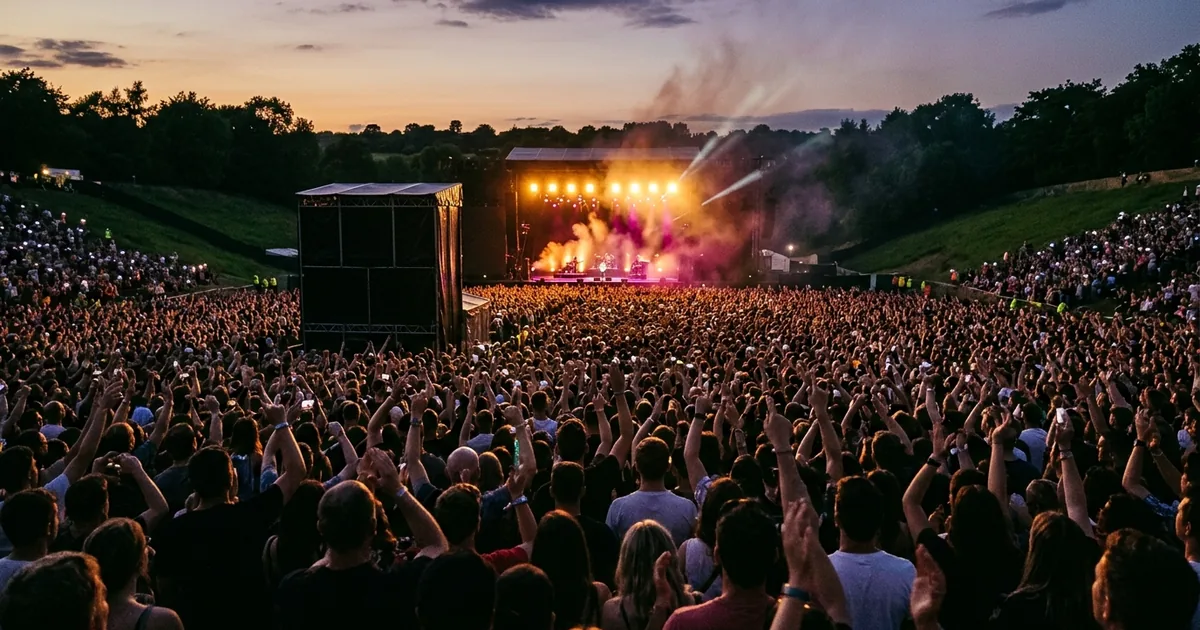
More than 35,000 people filled the National Bowl in Milton Keynes on Friday night for the first UK edition of Diaspora Calling!, the festival Lauryn Hill has been curating since 2016.
Dave Chappelle hosted, with Wyclef Jean, Erykah Badu, Giggs, Fireboy DML, YG Marley, Zion Marley and Seun Kuti on the bill, and nearly every write-up has framed the night as a reunion. It is closer to a founding.
The Night Itself
The setlist did the work you would expect it to do. Hill and Wyclef Jean reached back into The Score for “Ready or Not” and “Fu-Gee-La,” Wyclef took “911” on his own, and Hill ran through “Ex-Factor” and “To Zion” before bringing Badu out for “Doo Wop (That Thing).” Complex counted the full lineup in its account of the inaugural UK edition, including Badu’s own set of “Apple Tree,” “Window Seat,” “On & On” and “Back in the Day,” and a surprise Kano appearance during Giggs’s set for “P’s & Q’s” and “Rudeboy.”
Chappelle hosting is not incidental either. Putting a comedian of that stature in the connective-tissue role between sets is a decision about pacing and about who the room belongs to, and it is the sort of thing a promoter does not think of and a curator does.
Thirty Years of The Score, Performed by Its Owner
The Score turned 30 this year, and there is a version of that anniversary where Hill and Wyclef spend the summer on a package tour someone else assembled, playing the album front to back between two other nineties acts on a shed circuit. That version is extremely lucrative and it is what usually happens.
Instead the anniversary got performed inside an event Hill built. Speaking to the Associated Press before the show, she described the album as something that keeps generating new energy rather than settling into nostalgia: “Every time we perform it, even though (it’s) singing older lyrics, there’s a new energy, a new spirit.” She characterized the Fugees as having embodied “a particular kind of resistance to certain ideas that we knew better than,” which is a more interesting read of that record than most of the retrospectives have managed.
She also spoke about D’Angelo, saying “we lost another timeless soul who made timeless music,” and about wanting his family protected as his legacy is handled. “He was good,” she said. “Without question.”
A Festival Is Not a Comeback
Here is the part the coverage keeps missing, and it matters because of what has been written about this artist for twenty-five years.
Hill’s public narrative has been dominated, almost to the exclusion of everything else, by lateness. Delayed sets, cancelled dates, the running joke that hardened into a consensus. Whatever you think of that record, it produced a frame in which any Lauryn Hill event gets covered as a question of whether she will show up.
Diaspora Calling! does not fit inside that frame, because the thing she showed up to is a thing she made. She told the AP it started in Brooklyn in 2016, after performing in Ghana convinced her that “our conversation was not just about the immediate subject matter,” and that the point was to bring together the communities she and Wyclef had built over decades “in the name of growth, healing and pushing forward.” Ten years later it is a 35,000-capacity international event with a curated visual-art component from Lauren Halsey, fashion activations with Denim Tears and Kids of Immigrants, and a film program including work by Arthur Jafa and Kahlil Joseph.
That is not a set list. That is a program, and programming is a different job from performing. The relevant comparison is not another legacy act’s reunion run. It is the difference between being booked into someone else’s container and building your own, and almost nobody from her cohort has done the second thing.
The other thing worth noticing is the lineup’s logic. Badu and Wyclef are the American nineties spine. Giggs and Kano are UK rap. Fireboy DML is Nigerian Afrobeats. Seun Kuti carries Fela’s band. The Marley grandsons are the reggae line. Nobody assembles that bill by looking at streaming numbers. You assemble it by having an argument about what the diaspora is and then booking the argument.
Why It Landed in England
The UK debut is a choice, not an accident of routing.
Britain has the audience for exactly this proposition: a Black British music culture with its own forty-year lineage, a large West African and Caribbean diaspora, and a festival economy that has historically been more willing than the American one to put a curated one-day event in a field and trust people to come. The National Bowl holds 65,000 and has hosted that scale of ambition since the eighties. A US festival market currently absorbed in cancellations, consolidation and lineup homogeneity is a harder room for something this specific.
What Comes Next
The obvious question is whether year eleven is bigger, and whether Diaspora Calling! becomes an annual fixture on the British summer calendar rather than a one-off with a very good headline.
The less obvious question is whether the model travels. Hill has now demonstrated something that a lot of artists in her generation have talked about and few have executed: that you can convert catalogue equity into an institution instead of a touring annuity. If it holds, the thirtieth anniversary of The Score will end up mattering less for the songs than for what she chose to do with the leverage they gave her.