
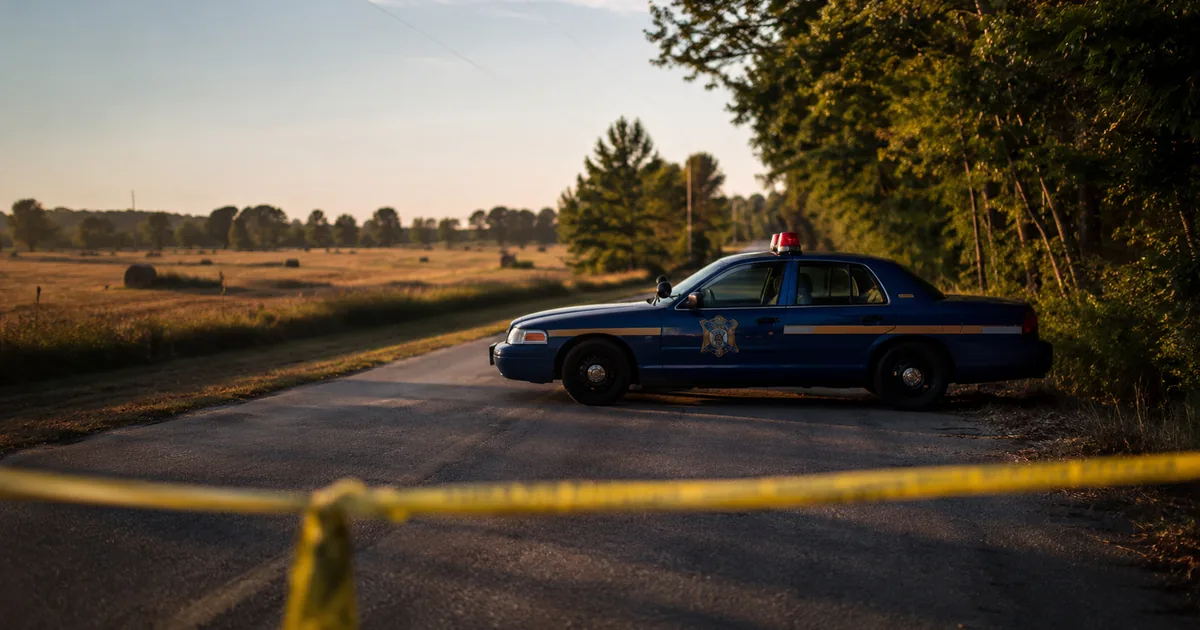
A 911 call from a house on LaChance Road just before noon on Friday brought Michigan State Police troopers to a rural stretch of Richland Township, where they found three people dead and a fourth critically wounded. By Friday evening the toll had reached five victims spread across three separate scenes, plus the man police believe killed them, in a county where roughly 15,000 people live across 574 square miles.
The sequence, as Michigan State Police have laid it out, took hours and covered ground. Troopers were called to the residence near LaChance and Kelly roads at about 11:40 a.m. after someone reported being shot. Inside they found three people dead and one person in critical condition. As investigators pushed outward from that house, they found a fourth victim inside a separate residence and a fifth near a wooded area by Whitlock Lake.
Then a homicide investigation became a county-wide emergency. Shortly after 3 p.m., state police named 39-year-old Chad Hickman of the Lake City and Jennings area as a person of interest, called him armed and dangerous, and warned residents he might be driving a white pickup truck with a discolored tailgate. UpNorthLive reported that detectives said soon afterward Hickman had been located, and that he was found dead near his vehicle in a wooded area. Police have not said how he died. Six people were dead in all. One person was still in critical condition.
Four Hours in 574 Square Miles
The geography here is not a detail, it is most of the story of the response. Missaukee County is farmland, timber and lake tourism in northern lower Michigan, with a population density around 26 people per square mile and a county seat, Lake City, of about 700 residents. Three active crime scenes in a place that size is not a manageable workload spread across shifts and precincts. It is effectively every resource the region has, at once.
For roughly four hours between the first troopers arriving and the announcement that Hickman had been found, an armed man was believed to be loose somewhere in that landscape and the public’s instruction amounted to stay away. 9&10 News reported that South LaChance Road was closed between West Rosted and West Jennings roads while the search ran. Lt. Ashley Miller of the Michigan State Police said afterward that there was no further threat to the public, the sentence every one of those households had been waiting on since lunchtime.
Not only is this difficult for our investigators and our troopers, but it’s very hard for this community.
Miller’s line, given to Fox News, is the part that does not show up in a casualty count. In a county of 15,000, five dead is not an abstraction that arrives through a news alert. It is a number of people that a meaningful share of the county knew personally.
What Police Have Not Said
The gaps in the official account are wide and they matter. State police have not released the names of the five victims. They have not said whether the victims knew Hickman or one another. They have not offered a motive, and they have not explained what connected a house on LaChance Road, a second residence, and a spot in the woods near Whitlock Lake.
That silence is partly procedural, because families get notified before the public does, and partly permanent. When a suspect dies before he can be questioned, the record closes on the one account that would have explained the rest. Investigators can reconstruct a timeline from physical evidence, phone records and whatever the surviving victim can eventually tell them. What made a man drive between three locations on a Friday morning is a different kind of question, and it is frequently the one that never gets answered.
The Most Common Mass Shooting in America Is the One the Data Skips
Here is what makes this case worth more than a wire brief. Whether Missaukee County is recorded as a mass shooting at all depends almost entirely on a fact police have not yet disclosed: whether the victims were Hickman’s family.
Research published in Injury Epidemiology found that 59.1% of fatal mass shootings in the United States between 2014 and 2019 were domestic-violence related, and that in 68.2% of cases the shooter either killed a partner or family member or had a documented history of domestic violence. Those incidents are also deadlier once they start, with a case fatality rate of 83.7% against 63.1% for shootings with no domestic connection. The Rockefeller Institute of Government has made the same argument from the other direction, noting that about half of mass shooting fatalities happen in homes rather than in the public places that dominate coverage.
Yet several of the databases that anchor the national conversation, including those maintained by Mother Jones and The Violence Project, deliberately exclude shootings arising from domestic or gang violence on the grounds that they are contextually distinct from indiscriminate attacks on strangers. There is a defensible methodological reason for that choice. The consequence is still that the most common form of American mass killing is routinely filtered out of the statistics that shape how the country argues about guns, which means the argument is conducted almost entirely about the rarer version.
The difference in public attention follows the same pattern. When a shooting happens at a school, the policy response is immediate and specific, as we saw in coverage of the Nonthaburi school shooting and the gun reform push that followed it. When five people die in scattered houses in a rural county, the story is filed under local tragedy, the cameras leave within days, and no legislature schedules a hearing. Three weeks ago in Michigan, a man fatally shot his wife and their six children before setting the family home on fire and killing himself. Eight people died. It did not become a national policy moment either.
Michigan Already Wrote the Law
The uncomfortable part is that Michigan is not a state that ignored this. After a gunman killed three students and wounded five at Michigan State University in February 2023, a newly Democratic legislature moved fast. Gov. Gretchen Whitmer signed extreme risk protection order legislation in May 2023, making Michigan the 21st state with a red flag law, and the package took effect alongside safe storage rules and expanded background checks in February 2024.
Michigan’s red flag law lets family members, dating partners, police and medical professionals petition a judge to temporarily remove someone’s firearms. It is a genuinely useful tool and it has one structural requirement: somebody has to see it coming and be willing to go to court about a person they love. That is a heavy lift under any circumstances. It is heavier in a rural county where the courthouse is a drive away, where everyone knows everyone, and where a petition against a neighbor is not a private act.
Whether any of that applies to Missaukee County is unknown right now, and it would be irresponsible to pretend otherwise. Nobody has said whether Hickman had a history, whether anyone was worried about him, or whether a court order was ever a possibility. That is precisely the point. The tool Michigan built after a campus shooting only works upstream of a day like Friday, and the country almost never finds out whether it could have been used until after it wasn’t.
Five families in Missaukee County will get a knock on the door this weekend, if they have not already. The rest of the answers will come slowly, and some of them died in the woods near Whitlock Lake on Friday afternoon.