
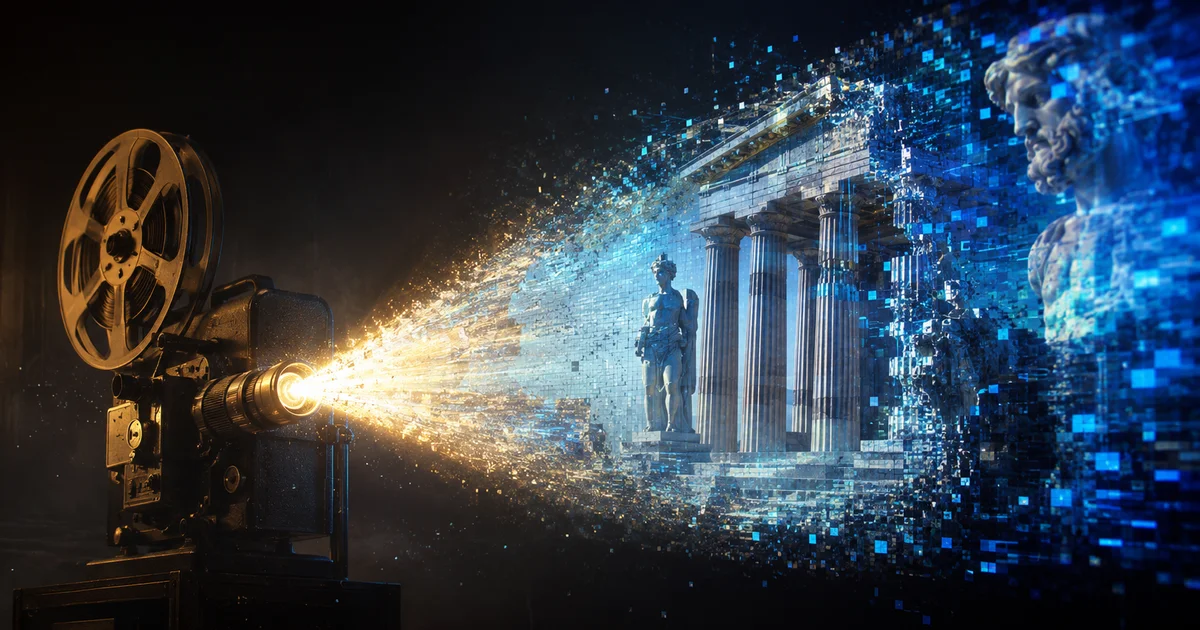
Christopher Nolan’s The Odyssey just pulled in $263.7 million globally in its opening weekend, the biggest worldwide debut of Nolan’s career. It earned an “A” CinemaScore from audiences and holds a 98% on Rotten Tomatoes. Critics love it. Audiences love it. It is, by every available metric, one of the defining films of 2026. So naturally, Elon Musk has decided what the world really needs is an AI-generated version instead.
The Promise
“Before this year ends, Grok Imagine will make a full-length movie of The Odyssey that is historically accurate and true to the art of Homer,” Musk posted on X earlier this week, sharing a three-minute AI-generated dialogue sequence depicting Odysseus speaking to the nymph Calypso. The clip was created using Grok Imagine Video 1.5, xAI’s generative video tool, and looked exactly like what you’d expect from an AI trying to render ancient Greece: impressive in a tech-demo sense, uncanny in every way that matters for actual storytelling.
This isn’t Musk’s first swing at Nolan’s film. Back in June, he shared an xAI-produced trailer styled after a 1970s classical Hollywood epic and predicted “full movies by the end of the year.” The latest post escalated the ambition from “eventually” to “before December,” which is either a bold timeline or a familiar pattern of Musk promising deliverables on schedules that quietly evaporate.
The “Historically Accurate” Problem
The internet wasted no time pointing out the central absurdity of promising a “historically accurate” version of The Odyssey. Homer’s epic features a one-eyed Cyclops, a six-headed sea monster, a witch who turns men into pigs, bag-of-winds magic, and literal divine intervention from the Greek pantheon. As one widely shared response put it, calling any adaptation of The Odyssey “historically accurate” suggests either a fundamental misunderstanding of the source material or a very interesting take on Greek zoology.
The “accuracy” framing is doing specific cultural work here. Musk has spent months criticizing Nolan’s casting choices, particularly Lupita Nyong’o in the dual role of Helen of Troy and Clytemnestra. His complaints about historical accuracy are really complaints about diversity in casting, dressed up in the language of scholarly fidelity to a poem that includes a man being swallowed by a whirlpool and surviving because a goddess told him to grab a fig tree.
What Grok Imagine Can Actually Do
Here is the gap between the promise and the product: no existing AI video generation system can maintain character consistency, narrative continuity, emotional performance, or coherent dialogue across a feature-length film. The technology is genuinely impressive for short clips, trailers, and isolated scenes. It is nowhere close to producing something an audience would sit through for two hours without the experience feeling like a very expensive screensaver.
Musk has not provided footage beyond the demo clips, no technical specifications for how the system would handle the core challenges of long-form storytelling, and no production workflow that addresses why every other AI lab has backed away from promising feature films on anything resembling this timeline.
The Box Office Math That Makes This Funnier
Nolan’s Odyssey earned $124.5 million domestically in its first weekend from 3,919 theaters, making it the director’s biggest opening since The Dark Knight Rises and the fourth-best R-rated debut in history. It accomplished this with practical effects, IMAX cameras, a cast of actual human beings performing actual emotions, and the kind of painstaking craftsmanship that takes years of pre-production.
Meanwhile, the platform where Musk posted his AI alternative recently experienced a global outage and struggles to maintain basic content moderation at scale. The contrast between what careful human artistry produces and what “move fast and generate things” culture promises is the entire story in miniature.
The Bigger Picture
There is a real conversation to be had about AI-generated filmmaking and where the technology is headed. Studios are already using AI tools for storyboarding, visual effects previsualization, and background generation. The technology will get better, and the questions about what it means for working artists, for the craft of filmmaking, and for audiences who value the human labor behind the art are worth taking seriously.
But that conversation requires honesty about what the technology can and cannot do right now, not promises timed to land as counterprogramming against a film that just became the biggest R-rated opening of 2026. Musk isn’t advancing a thoughtful case for AI cinema. He’s picking a fight with the most commercially and critically successful filmmaker working today because he didn’t like the casting.
Seth Meyers probably captured the collective mood best when he told his audience: “I can’t wait for that to suck.” Whether the Grok Odyssey ever materializes or quietly joins the Tesla Roadster, the robotaxi fleet, and Hyperloop in the graveyard of Musk timelines remains, fittingly, an odyssey of its own.