
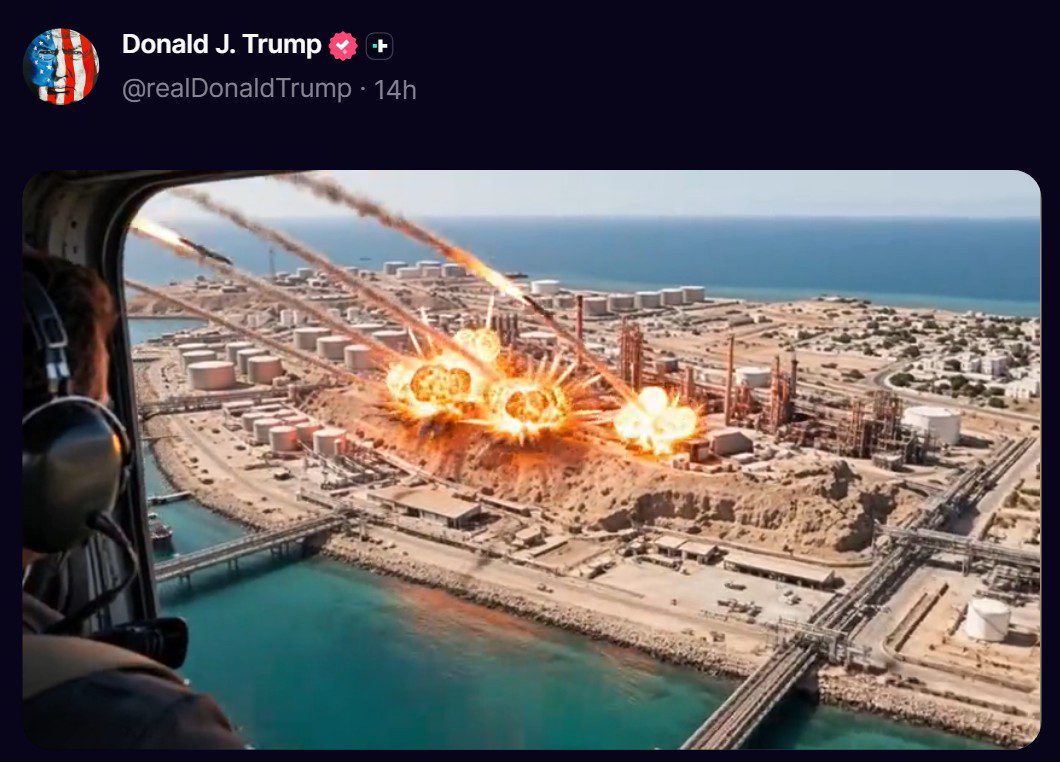
Donald Trump posted a video on Sunday night showing Iran’s Kharg Island oil terminal erupting in fire, captioned “Kharg Island being blown to smithereens!!!” By Monday morning the Defense Department was in the position of publicly correcting its own commander in chief, because no such strike happened and the footage was generated by a computer.
Every outlet covering this has established the same two facts: the video is synthetic, and the island was not hit. What almost none of them have said is that the clip depicts the destruction of the exact infrastructure that real American strikes on Kharg have deliberately spared twice this year, and that it is the third AI-generated video the President has posted in four days, spanning two entirely separate conflicts. The debunk is easy. The pattern is the story, and nobody in the administration has been asked to explain it.
What the Military Actually Hit
American forces did strike Iran on Sunday, for the first time in roughly a month. The targets were two Iranian rocket launchers on Larak Island, in the Strait of Hormuz, under a standing order issued five days earlier. Kharg was not on the list. A US official confirmed as much to Reuters, and the Defense Department was then obliged to deny that the United States had struck Iran’s main petroleum export facility, a denial it would not have needed to issue if the President had not announced the attack in the first place.
Iran’s response was to laugh. Hamid Bovard, chief executive of the state-run National Iranian Oil Company, told Reuters that the post was worth nothing.
Trump’s tweets are laughable and conditions in Kharg are calm and appropriate.
That is a foreign state oil executive publicly rating the credibility of the President of the United States, and having the better of the exchange. It is difficult to think of a cheaper way to lose a round of information warfare than to be corrected, on the facts, by the country you are bombing.
The Video Shows the One Thing the Real Strikes Avoided
Here is the detail that reframes the whole episode. Kharg has been struck before, and the restraint was the point.
In March, the United States conducted a large bombing raid on the island. As PBS NewsHour reported at the time, the strike left the oil infrastructure intact, and Trump warned that he would reconsider his decision not to wipe it out if anyone interfered with shipping through the Strait of Hormuz. The destruction of the terminal was not an oversight. It was held back on purpose, as a threat with a stated trigger. American forces hit the island again in July, and Iran responded by threatening Gulf oil infrastructure in return. Kharg handles roughly 90% of Iranian crude exports. Destroying the terminal is not a bigger version of hitting a rocket launcher. It is an economic decapitation that moves global oil prices and invites retaliation against every export facility in the Gulf, which is precisely why two real operations stopped short of it.
The synthetic video does not stop short. It shows a storage tank and a tanker going up, the oil field burning, the harbor in flames. The President did not post an exaggerated version of a strike that happened. He posted the escalation his own military has twice declined to carry out, the one he explicitly reserved as leverage, and presented it as a completed fact. Whatever that threat was worth as leverage on Saturday, it is worth less now that Tehran has watched him claim it and be corrected by his own Defense Department.
Four Days, Three Synthetic Videos
Sunday’s post did not come out of nowhere. It closed a run.
On Wednesday, Trump signed an executive order directing federal agencies to refer to Lake Ontario as “Lake America,” in the middle of a tariff fight in which he has imposed 50% duties on about $20 billion of Canadian goods and Canada has promised dollar-for-dollar retaliation from September 8. On Saturday he posted an AI video of himself kicking over a “Welcome to Lake Ontario” sign, replacing it with an American one, and dancing. Earlier the same day he posted another showing an armed formation of geese wearing his hairstyle, carrying assault rifles, patrolling the Toronto shoreline to the theme from Hawaii Five-O.
Then, roughly 24 hours later, the shooting war. Same account, same format, same absence of any label.
We covered the Lake America order last week, and the more consequential half of that story was what it cost the Associated Press to refuse to repeat the new name. The armed-geese video looked at the time like a joke about a trade dispute. Read next to Sunday’s post, it looks like the same instrument being used at two very different pressure levels: a fabricated image of force, aimed at a neighbour on Saturday and at a country the United States is actively bombing on Sunday.
Nobody Has Answered the Only Question That Matters
Reuters ran the clip through detection software and confirmed it was synthetic. Fine. The harder question has gone unasked in almost every account: did the President know?
There are three possibilities and they are not equally comfortable.
He knew, and posted it as deliberate psychological pressure on Tehran. That is at least coherent as strategy, though it burns the credibility of every future American claim about a strike, which matters enormously when the next announcement is real and Iran has just been handed a reason to assume it is not.
He did not know, and believed he was posting footage of something that occurred. This is not far-fetched. He has announced real Kharg strikes twice this year. Sunday’s actual operation hit Larak, another island in the same waters, and reporting has floated that he may simply have conflated the two. If that is what happened, the Commander in Chief announced a military operation to the world on the basis of a video he could not distinguish from reality, and the Pentagon found out the same way everyone else did.
Or he does not consider the distinction to be his problem. Given four days in which synthetic geese, a synthetic sign-kicking and a synthetic oil terminal all went out under the same account without a single label, this is the reading the evidence best supports, and it is worse than either of the others.
Our View
The White House should be asked, on the record and repeatedly, whether the President knew the Kharg video was generated, and it should be made to answer. That is not a gotcha. When a head of state announces a strike on the oil infrastructure of a country he is at war with, allied governments, insurers, shipping firms and commodity markets act on it. The Defense Department having to walk it back within hours is not an amusing footnote. It is a demonstration that the fastest-moving official channel of American war communication now carries unlabelled fiction, and that the institution responsible for the actual bombing is reduced to fact-checking it in public.
There is a straightforward fix available and no sign of anyone reaching for it: label the synthetic ones. No rule requires it. That is the gap, and it is not a technology problem. Every other outlet that publishes an AI-generated image of a war zone marks it as one, because the alternative is indefensible. The President is currently held to a lower standard than the news organisations he spends his mornings attacking.
Iran’s oil company got to call the President of the United States laughable this week and be correct. The next time Washington says it has hit something in the Persian Gulf, everyone who needs to believe it now has a documented reason not to. That cost has already been paid. What remains to be seen is whether anyone in the building considers it a cost at all.