
“If the Big Bend Sector is an area of high illegal entry, so is every other sector, and the waiver authority would apply to the entire U.S.-Mexico border.”
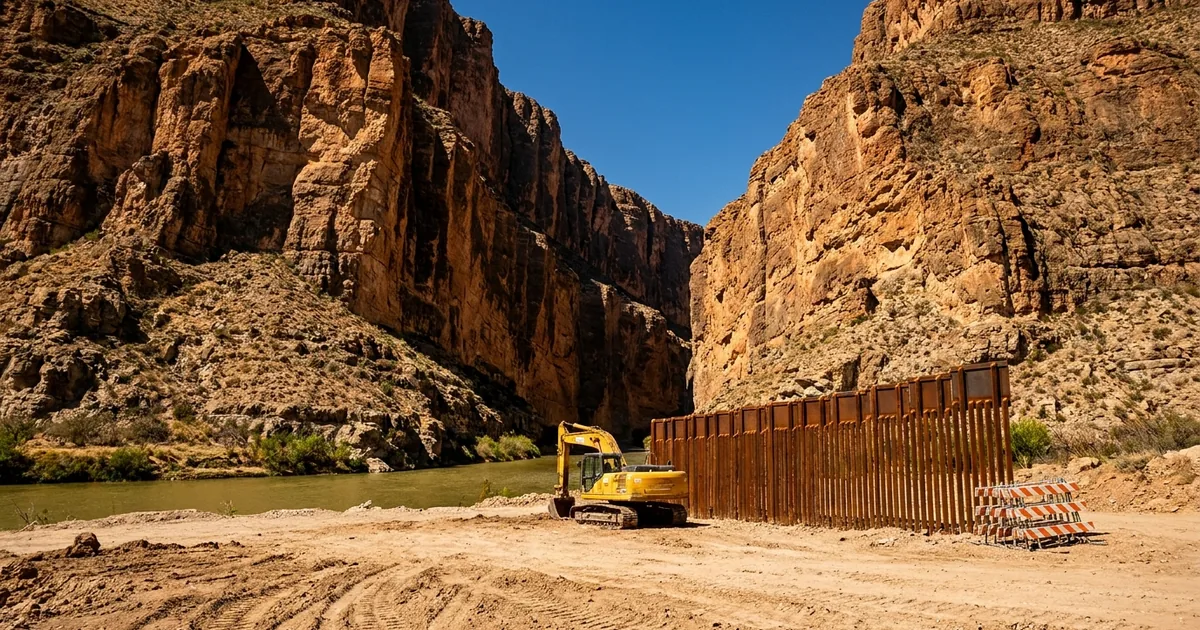
On Aug. 14, an excavator was plowing through land near Santa Elena Canyon, inside Big Bend National Park, for a section of Donald Trump’s border wall. On Monday the Supreme Court said the digging can start again.
Judge Kathleen Cardone wrote the sentence above in the Oct. 14 opinion explaining the injunction she issued from El Paso on Oct. 2. The justices lifted that injunction in a five-page unsigned order that, as NBC describes it, says she had no authority to rule at all, with Justice Ketanji Brown Jackson the lone dissenter. The early accounts report the vote and the mileage. We read the filings the order rests on, and they show a Court that settled who may ask a question and never had to answer it: is Big Bend “an area of high illegal entry”? On the government’s own numbers, that is a hard claim to defend.
The Question the Order Skips
The law lets the Homeland Security secretary waive “all legal requirements” to build border barriers fast, and it says the barriers are meant “to deter illegal crossings in areas of high illegal entry.” The waivers for Big Bend set aside the Clean Water Act, the Clean Air Act, the Safe Drinking Water Act and the Endangered Species Act, among dozens of laws, according to the challengers’ response to the Court.
After an Oct. 2 hearing at which, the challengers say, the government called no witness, Cardone found that the sector is “by far” the one “with the lowest rate of migrant apprehensions along the entire U.S.-Mexico border.” The government’s stay application does not say she miscounted. It concedes the arrests in Big Bend are “comparatively lower” than elsewhere and argues that she was not allowed to weigh them, because Congress barred district courts from hearing any waiver challenge that is not constitutional.
What the Government’s Own Number Says
The application leans on one figure: Customs and Border Protection apprehended “over 89,000” people in the sector from fiscal 2021 through 2025. Spread across five years, that is about 17,800 a year, or 49 a day, in a sector the government says covers nearly a quarter of the border.
The challengers’ filing, citing figures in its appendix, gives two points of comparison from fiscal 1996, the year Congress passed the law. The San Diego Sector recorded 483,815 apprehensions, about 670 per border mile per month. Big Bend recorded 13,214, about two. Our arithmetic: 483,815 divided by 89,000 is 5.4, so one year in San Diego then was more than five times Big Bend’s entire five years now. The decades differ, and the comparison is ours, but 1996 is when Congress wrote the phrase the government says Big Bend satisfies. The challengers add that the government’s new declarations, filed after the injunction, name 18 people apprehended over a period of years.
Nobody Agrees How Long It Is
The application says the waivers cover “over 300 miles” of wall and road. NBC cites the government for 341. The first waiver, issued Feb. 17, covers a project area of about 164 miles, according to the application, while the challengers put the combined span of the waivers at roughly 607 miles. Four counts, four lengths. A project of that scale, through a national park and a river corridor, has had one public test of its premise, the October hearing in El Paso, and that ruling is now off the books.
The Dissenter Wrote the Sentence
The government’s jurisdiction argument cites a Jackson opinion. The application quotes her 2019 ruling in Center for Biological Diversity v. McAleenan for the line that Congress “expressly deprived the federal courts of jurisdiction over non-constitutional claims that challenge DHS’s section 102(c) waiver decisions,” and lists the case among those that turned waiver challenges away. NBC does not report her reasons for dissenting, and as we write the order is not on the Court’s docket, so we will not guess at them. The fact stands on the page: the government quoted her own words to the Court, and she dissented anyway.
What We Think
This is a bad ruling, reached the wrong way. Congress gave one official the power to set aside dozens of federal laws to build barriers in areas of high illegal entry. A judge tested that phrase against the government’s own data and it failed. The Court’s answer, on an emergency application filed Oct. 21 and decided 19 days later with no oral argument on its docket, is that no district judge gets to run the test.
Consider what that does over time. A condition that nobody may check is a condition the next secretary can rewrite in a Federal Register notice, for any sector, and Cardone’s point about “every other sector” stops being a hypothetical. The urgency was thin, too. The challengers’ filing says the government itself paused ground-disturbing work in the sector for weeks after construction began in the park in August, and the injunction it called baseless and unprecedented stood for 38 days.
Crews can go back to Santa Elena Canyon. What happens to the case in El Paso, where summary judgment motions are pending, is now an open question, because the judge was just told she could not decide it. The government’s reading of the statute sends every fight over these waivers to one place, a petition to the Supreme Court. The first time the justices face the arrest numbers directly will be the real ruling on Big Bend.