
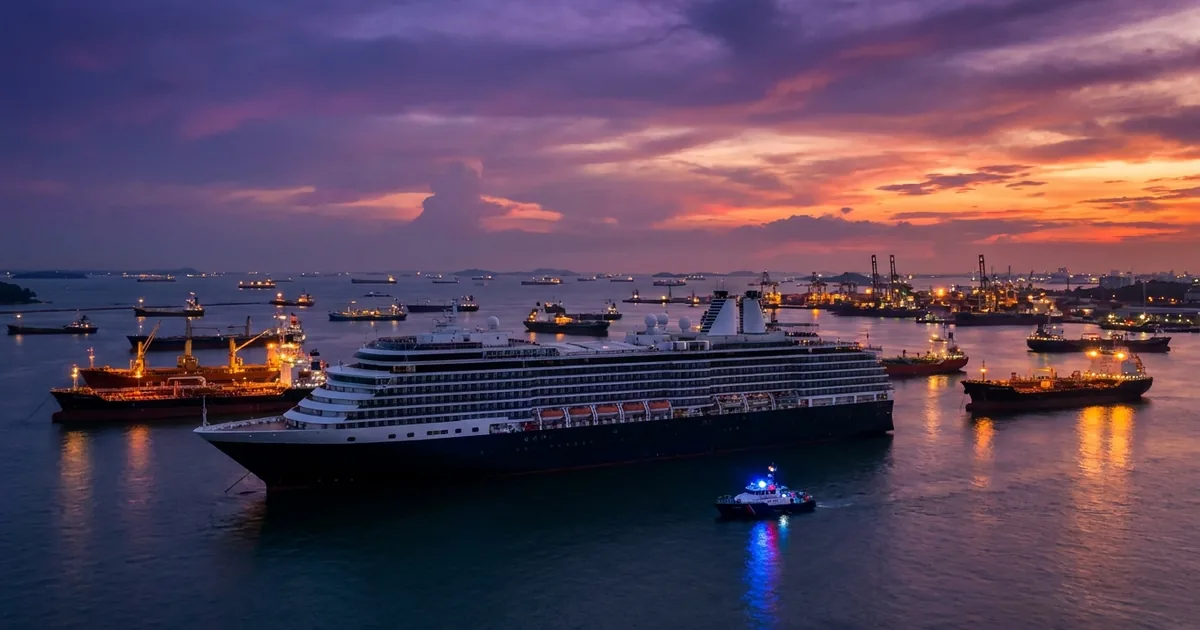
What the headlines say. The “forever cruise” ship was “arrested” in Singapore, and it may be auctioned.
What that leaves out. An arrest is a court-authorised hold on the ship, applied for by a creditor. No report names a resident as one of the parties.
If you bought a cabin on the Villa Vie Odyssey, you learned this weekend that the ship you lived on is sitting at anchor east of Singapore’s Changi Air Base with a court’s warrant attached to it. Government records show the arrest was logged at 10:34 a.m. local time on Sunday, Nov. 8, on an application from a Singapore law firm, Helmsman LLC. CBS News reported that the firm’s client is not identified and that a source familiar with the matter said it is likely a fuel supplier. What none of it says is what an arrest does to the people who paid for a home on that ship, so we went to the court’s own rules to find out.
Who Is Who on One Ship
The reporting so far names a handful of parties and one large group of people. Laid out together, the picture is less tidy than “the ship was arrested.”
| Party | Role | What is on the record |
|---|---|---|
| Villa Vie Residences | The ship’s owner | Fell behind on payments and owes one regional supplier about $500,000, CBS reports |
| The lender (unnamed) | Operating the ship | Took control, according to a message to residents |
| Residential Cruise Holdings | Parent company | Founder Mike Petterson told CBS the residents’ fuel loans were routed through it |
| Helmsman LLC | Singapore law firm | Listed as the arresting solicitor, client not identified |
| Residents | Cabin buyers and fuel lenders | At least two efforts to reclaim the ship, one failed and one still active |
Two of those rows have no name attached. The lender is unnamed in public reporting, and so is whoever stands behind the warrant. Until both are known, nobody outside the case can say how the ship’s debts line up.
What an Arrest Does to a Ship
Singapore’s courts describe an arrest as a court-authorised detention of a vessel in a claim against the ship itself, and the sheriff’s office page says it applies to a vessel inside Singapore’s port limits. The party that applied has to hire guards from the court’s approved list and send the sheriff’s office the ship’s location every day until it is released. Once the ship is arrested, the Maritime and Port Authority, the Immigration and Checkpoints Authority and the Police Coast Guard must be notified.
The owner has two ways out. It can provide security for the claim, which releases the ship, or it can ask the court to set the arrest aside. If it does neither, the plaintiff may apply for an order that the sheriff sell the vessel in a judicial sale. Nothing in the reporting says that application has been made.
Where Residents Stand in the Line
The court’s published order of payment from a judicial sale is short. Proceeds cover the sheriff’s expenses and other dues first, then go to the plaintiff and other relevant parties, and anyone holding a judgment can ask the court, by summons with an affidavit, to set the order of priority. That is the whole list, and residents are not on it by name.
Take Craig and Cindy Voight, who boarded in Belfast in October 2024. They told CBS they spent more than $300,000 on their cabin and monthly dues and another $100,000 in the fuel loan program the company opened in April, when residents reportedly raised more than $2 million to keep the ship running. CBS obtained the agreement, which describes the loan as “Unsecured,” with no collateral or guarantees. Craig Voight said, “They’ve never paid one penny.” Petterson says the financing was routed through the parent company because existing restrictions kept Villa Vie Residences from borrowing directly, that he is seeking investors, and that he may consider a Chapter 11 filing to sell the company.
Put that beside the court’s list. By Petterson’s account the loans ran through the parent, not the ship’s owner, and the agreement as CBS describes it lists no collateral. As we read the court’s page, that does not obviously make them one of the “other relevant parties” in a sale. A maritime lawyer would have to say for certain, and we have not seen one say it in public.
We think the residents are the least protected people in this story and the ones with the most to lose in the next few weeks. The company that sold the cabins and ran the loan program should publish who is owed what, and by which entity, before the ship’s fate is decided around them. We asked for a written account of where residents’ money went on Oct. 29, when 203 residents were given seven hours to leave, and the arrest makes that account more urgent.
Questions Residents Are Asking
Can the owner just pay and sail?
It can obtain release by providing security for the claim, or by persuading the court to set the arrest aside. CBS reports the owner is behind on payments and the ship is run by its lender, so the money would have to come from somewhere.
Will the ship be auctioned?
Two different sales are in play. A judicial sale would need the plaintiff to ask the court. Separately, CBS says the lender could auction the ship, and a resident-led group still plans to bid. No report says which would come first.
Who is the plaintiff?
Unknown. Helmsman LLC filed, its client is not identified, and a source told CBS a fuel supplier is likely. CBS also reports the ship was temporarily detained in Hong Kong.
Watch for the plaintiff’s name. It is the first fact that would show whether this stays a fuel bill or turns into a sale.