
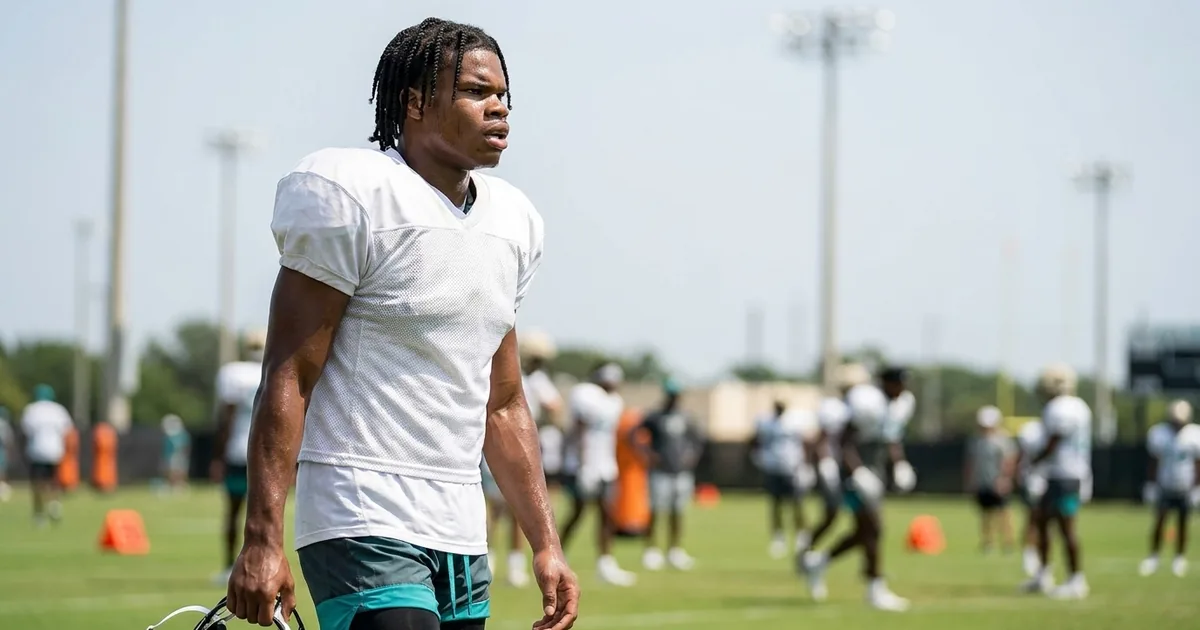
Asked at Jacksonville’s training camp how many snaps a week he wants, Travis Hunter answered “all of them,” and added that he cannot stay on the sideline. It is the best quote to come out of any NFL camp this summer, and the Jaguars have already, quietly, declined it.
The Day That Started It
Hunter had the kind of practice that makes a coaching staff’s job harder. On day four of camp he intercepted a pass on defense and then, three plays later, pulled in an explosive 35-yard twisting catch on offense, which is roughly the platonic ideal of a two-way highlight reel and exactly the sort of thing that ends up on a loop.
The quote came shortly after. NFL Network’s Judy Battista asked the direct version of the question everyone has been circling since Jacksonville drafted him, and Hunter said he wants all of the snaps. No hedging, no “whatever the team needs.”
Now Count the Reps
Here is where the romance meets the whiteboard.
On the same Sunday Hunter said he wanted every snap, ESPN’s Michael DiRocco charted his actual workload in team drills: 17 snaps total, 10 on defense and seven on offense. Across camp to that point the split was 34 defensive to 22 offensive. Pro Football Rumors has tracked the ramp-up and the pattern is consistent: he is a defensive back who plays a meaningful package of offensive snaps, not a genuine iron man.
That ratio is not an accident and it is not a slight. It is a decision, made in advance, written into a practice script, and executed every day while the player says something different into a microphone twelve feet away.
Why the Number Will Never Be All of Them
The two-way debate keeps getting framed as a question about Hunter’s conditioning or his will, and it is neither. He has answered both. It is a question about how a modern NFL roster manages an asset.
Start with the arithmetic. A team that runs 65 offensive and 65 defensive snaps in a game is asking a player who takes every one to log 130, plus special teams if anyone is feeling reckless. Nobody in the modern league does that. The reason is not toughness. It is that soft-tissue injuries scale with volume, and the recovery window between Sunday and the following Sunday is fixed at seven days no matter how much a second-year pro believes otherwise.
Then add the practice rules. The collective bargaining agreement caps padded practices and limits the on-field hours, which means Jacksonville’s coaches are rationing a scarce resource. Every rep Hunter takes at receiver is a rep he does not take at corner, and vice versa. A one-position player gets to spend his entire allotment becoming excellent at one thing. Hunter is being asked to split a budget that was never designed to cover two jobs.
And then there is the part nobody says out loud. Jacksonville has an enormous investment in this player. Organizations protect investments. A front office that watched its two-way experiment break down in week six because somebody honored a training-camp quote would not survive the press conference.
What the Split Actually Tells You
The 60/40 defensive lean is the most informative thing in the whole story, and it has gone almost unremarked.
It says the Jaguars have made up their minds about what Hunter primarily is. He is a cornerback. The offensive package is real, it will produce highlights, and it is a package. Teams do not accidentally settle into a ratio and hold it for a week of practice. Somebody drew that up in March.
If you want the honest version of what Sunday afternoons look like, imagine a full defensive workload with fifteen to twenty designed offensive snaps layered on top, weighted toward situations where a defense has to declare its coverage before it knows he is out there. That is not “every snap.” It is also, if it works, the most disruptive personnel wrinkle in football, because no defensive coordinator’s week is currently built to account for a corner who might line up wide on third and six.
The Quote Is Still Worth Something
None of this makes Hunter wrong to say it.
Players who accept their usage limits in year two do not become the exceptions. The gap between what he wants and what he is getting is the engine of the whole thing, and a coaching staff would much rather talk a player down from 130 snaps than talk one up from 40. Jacksonville has the good version of this problem.
The number to watch is not what he says in August. It is what the game charts say in November, when the season has taken its toll and the temptation to shrink the offensive package to nothing gets real. If the split is still holding at 60/40 in week ten, the experiment worked. If the receiver snaps have quietly gone to zero, everyone will pretend it was always the plan.